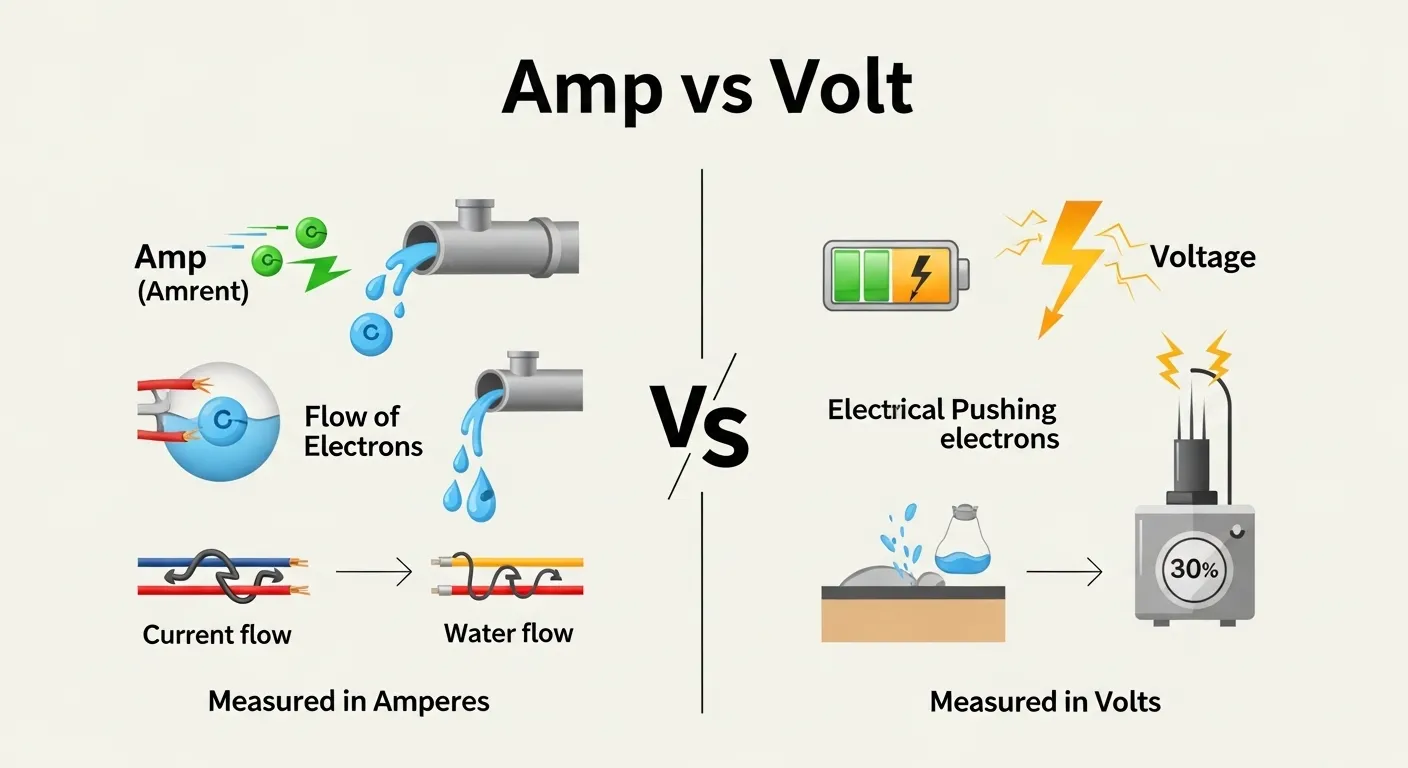
Amp and volt are both electrical units, but an amp measures the flow of electric current, while a volt measures the electrical pressure that pushes the current.
Understanding the difference between amp and volt is essential for anyone learning about electricity or working with electrical devices. Imagine electricity like water flowing through a pipe—the pressure pushing the water forward is like voltage, while the amount of water flowing is like current.
The difference between amp and volt lies in what each unit measures. Voltage represents the force or pressure that drives electric current, while current (amps) measures how much electricity is flowing. Learning the difference between amp and volt helps students, electricians, and everyday users understand how devices work safely and efficiently. By knowing the difference between amp and volt, you can better handle electrical systems and avoid common mistakes.
Pronunciation
Amp (Ampere)
US: /æmp/
Volt
US: /voʊlt/
Key Difference Between the Both
The main difference between amp and volt is that amps measure the amount of electric current flowing, while volts measure the force that pushes that current through a circuit.
Why Is Their Difference Necessary to Know for Learners and Experts?
Knowing the difference between amp and volt is important for students, engineers, and technicians. For beginners, it builds a basic understanding of electricity. For experts, understanding the difference between amp and volt helps in designing and maintaining electrical systems.
In daily life, this knowledge ensures safe use of appliances, prevents overloads, and improves energy efficiency. Understanding the difference between amp and volt is key to electrical safety and performance.
Difference Between Amp and Volt
1. Definition
Amp measures electric current. Volt measures electric potential difference.
Examples
Amp:
- Current in a wire.
- Flow of electrons.
Volt:
- Voltage of a battery.
- Electrical pressure.
2. What It Represents
Amp represents quantity of flow. Volt represents force or pressure.
Examples
Amp:
- High current in heavy appliances.
- Low current in small devices.
Volt:
- 12V battery.
- 220V household supply.
3. Role in Circuit
Amp shows how much current flows. Volt shows what drives the current.
Examples
Amp:
- Determines load.
- Affects heating.
Volt:
- Pushes electrons.
- Enables flow.
4. Measurement Unit
Ampere (A) is the unit of current. Volt (V) is the unit of voltage.
Examples
Amp:
- 5A current.
- 10A load.
Volt:
- 120V supply.
- 240V system.
5. Analogy
Amp is like water flow rate. Volt is like water pressure.
Examples
Amp:
- More flow = more current.
- Less flow = less current.
Volt:
- High pressure = high voltage.
- Low pressure = low voltage.
6. Effect on Devices
Amps affect how much power is used. Volts affect how strongly power is delivered.
Examples
Amp:
- High current heats wires.
- Low current uses less energy.
Volt:
- High voltage powers large devices.
- Low voltage for small electronics.
7. Safety
High amps can cause overheating. High volts can cause electric shock.
Examples
Amp:
- Overload risks.
- Wire damage.
Volt:
- Shock hazards.
- Insulation needed.
8. Measurement Tools
Amps are measured using an ammeter. Volts are measured using a voltmeter.
Examples
Amp:
- Clamp meter.
- Current tester.
Volt:
- Multimeter.
- Voltage tester.
9. Relationship
Amp and volt are related in electrical formulas.
genui{“math_block_widget_always_prefetch_v2”:{“content”:”V = IR”}}
Examples
Amp:
- Current depends on voltage and resistance.
- Higher voltage increases current.
Volt:
- Voltage depends on current and resistance.
- Controls flow strength.
10. Practical Usage
Amps are used to rate current capacity. Volts are used to define power supply levels.
Examples
Amp:
- Circuit breaker ratings.
- Appliance current use.
Volt:
- Battery ratings.
- Power outlets.
Nature and Behaviour of Both
Amps represent the flow of electricity, showing how much current is moving. Volts represent the force behind that movement, determining how strongly electricity flows.
Why People Are Confused About Their Use?
People often confuse amps and volts because both are related to electricity and often appear together on devices. However, the key difference is that volts push electricity, while amps measure how much flows.
Table Showing Difference and Similarity
| Feature | Amp | Volt | Similarity |
| Meaning | Current flow | Electrical pressure | Electrical units |
| Unit | Ampere (A) | Volt (V) | Used in circuits |
| Role | Measures flow | Drives flow | Work together |
| Safety | Overheating risk | Shock risk | Important in safety |
| Usage | Load measurement | Power supply | Device operation |
Which Is Better in What Situation?
Amp
Amps are important when determining how much current a device uses or how much a circuit can safely handle.
Volt
Volts are important when selecting the correct power source for devices to ensure proper operation.
How the Keywords Are Used in Metaphors and Similes
Examples:
- “His energy flowed like high amps.”
- “Her motivation hit like a strong volt.”
Connotative Meaning
Amp
Connotation: Energy, intensity, flow.
Example:
“The crowd was full of amps of excitement.”
Volt
Connotation: Power, force, impact.
Example:
“The idea struck like a volt of inspiration.”
Idioms or Proverbs Related to the Words
Full of energy
Example:
“He was full of energy, like a high-current circuit.”
Works in Literature
Amp and volt are scientific terms commonly found in physics textbooks and electrical engineering materials.
Movie Names Made on the Keywords
There are no major movies directly based on amps or volts, as they are technical terms.
Five Frequently Asked Questions
1. What is the main difference between amp and volt?
Amp measures current, while volt measures electrical pressure.
2. Which is more dangerous?
Both can be dangerous depending on levels.
3. Can you have volts without amps?
Yes, voltage can exist without current flow.
4. How are they related?
Through Ohm’s Law.
5. Which is more important?
Both are equally important in electricity.
How Both Are Useful for Surroundings
Amps and volts help power homes, devices, and industries, making modern life possible.
Final Words for the Both
Amps and volts are fundamental electrical concepts that work together to power everything around us.
Conclusion
The difference between amp and volt lies in their role in electricity. Amps measure the flow of current, while volts measure the force that drives that flow. Understanding the difference between amp and volt helps ensure safe and efficient use of electrical systems. By learning the difference between amp and volt, you can better understand how electricity powers the modern world.

I am a professional SEO content writer specialising in comparison-based and grammar-focused articles. Through my website GrammarCompare.com, I help readers clearly understand the difference between confusing terms with well-researched, easy-to-read content. My expertise lies in focusing on clarity, accuracy, and practical explanations that improve both knowledge and writing skills.