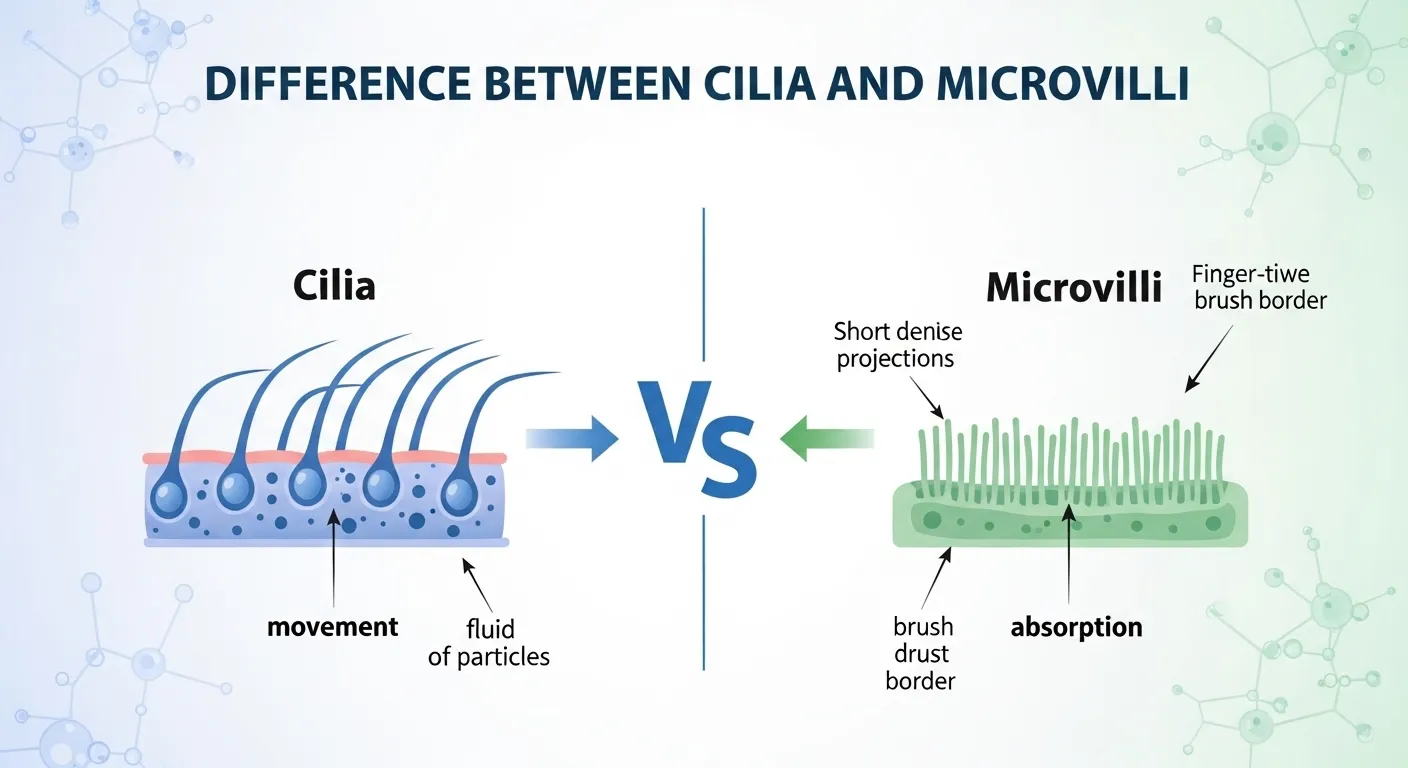
Cilia and microvilli are both tiny structures on cells, but cilia are hair-like projections that move substances, while microvilli are finger-like extensions that increase surface area for absorption.
Understanding the difference between cilia and microvilli is essential in biology, especially when studying how cells function. Imagine tiny structures on the surface of cells, some wave back and forth to move particles, while others stay still but increase the cell’s ability to absorb nutrients.
The difference between cilia and microvilli lies in their structure and function. Cilia are active, motile structures that help move fluids or particles across cell surfaces, while microvilli are non-motile and designed to maximize absorption. Learning the difference between cilia and microvilli helps students and researchers understand how the human body performs vital processes like breathing and digestion. By knowing the difference between cilia and microvilli, you can better grasp how cells interact with their environment.
Pronunciation
Cilia
US: /ˈsɪliə/
Microvilli
US: /ˌmaɪkroʊˈvɪlaɪ/
Key Difference Between the Both
The main difference between cilia and microvilli is that cilia are motile structures that move substances across the cell surface, while microvilli are non-motile structures that increase surface area for absorption.
Why Is Their Difference Necessary to Know for Learners and Experts?
Knowing the difference between cilia and microvilli is important for students, biologists, and medical professionals. For learners, it builds a strong foundation in cell biology. For experts, understanding the difference between cilia and microvilli is crucial for studying diseases and bodily functions.
In real life, these structures play vital roles in respiration and digestion. Misunderstanding the difference between cilia and microvilli can lead to confusion in medical and scientific contexts.
Difference Between Cilia and Microvilli
1. Definition
Cilia are hair-like projections that move. Microvilli are finger-like projections that increase surface area.
Examples
Cilia:
- Found in respiratory tract.
- Move mucus.
Microvilli:
- Found in intestines.
- Absorb nutrients.
2. Function
Cilia help in movement. Microvilli help in absorption.
Examples
Cilia:
- Move dust out of lungs.
- Transport fluids.
Microvilli:
- Absorb nutrients.
- Increase efficiency.
3. Structure
Cilia are longer and flexible. Microvilli are shorter and densely packed.
Examples
Cilia:
- Hair-like.
- Visible under microscope.
Microvilli:
- Brush border appearance.
- Compact structure.
4. Movement
Cilia are motile. Microvilli are non-motile.
Examples
Cilia:
- Beat rhythmically.
- Active movement.
Microvilli:
- Do not move.
- Passive role.
5. Location
Cilia are found in respiratory and reproductive systems. Microvilli are found in the digestive system.
Examples
Cilia:
- Trachea lining.
- Fallopian tubes.
Microvilli:
- Small intestine.
- Kidney tubules.
6. Internal Structure
Cilia have a complex internal arrangement. Microvilli have simpler structure.
Examples
Cilia:
- Microtubules.
- Organized pattern.
Microvilli:
- Actin filaments.
- Simpler design.
7. Length
Cilia are longer. Microvilli are shorter.
Examples
Cilia:
- Extended projections.
- More visible.
Microvilli:
- Tiny projections.
- Dense clusters.
8. Number per Cell
Cells have fewer cilia. Cells have many microvilli.
Examples
Cilia:
- Limited number.
- Spread out.
Microvilli:
- Thousands per cell.
- Packed together.
9. Role in Body
Cilia protect and transport. Microvilli enhance absorption.
Examples
Cilia:
- Remove harmful particles.
- Maintain cleanliness.
Microvilli:
- Aid digestion.
- Improve nutrient intake.
10. Appearance
Cilia look like moving hairs. Microvilli look like a brush border.
Examples
Cilia:
- Wavy motion.
- Distinct movement.
Microvilli:
- Dense lining.
- Static structure.
Nature and Behaviour of Both
Cilia are active and dynamic, constantly moving to transport substances. Microvilli are passive but highly efficient, increasing the cell’s ability to absorb nutrients.
Why People Are Confused About Their Use?
People often confuse cilia and microvilli because both are tiny projections on cells. However, the key difference is that cilia move, while microvilli absorb.
Table Showing Difference and Similarity
| Feature | Cilia | Microvilli | Similarity |
| Function | Movement | Absorption | Cell structures |
| Movement | Motile | Non-motile | Surface projections |
| Length | Long | Short | Microscopic |
| Location | Respiratory | Digestive | Body cells |
| Structure | Complex | Simple | Biological role |
Which Is Better in What Situation?
Cilia
Cilia are better for situations requiring movement, such as clearing mucus from the respiratory tract.
Microvilli
Microvilli are better for absorption, such as nutrient uptake in the intestines.
How the Keywords Are Used in Metaphors and Similes
Examples:
- “The workers moved like cilia, constantly clearing the path.”
- “The system absorbed information like microvilli.”
Connotative Meaning
Cilia
Connotation: Movement, protection.
Example:
“The system acted like cilia, removing obstacles.”
Microvilli
Connotation: Efficiency, absorption.
Example:
“He absorbed knowledge like microvilli.”
Idioms or Proverbs Related to the Words
There are no direct idioms, but similar ideas exist:
Go with the flow
Example:
“The process moved like cilia, going with the flow.”
Works in Literature
Cilia and microvilli are scientific terms mainly discussed in biology textbooks and medical literature.
Movie Names Made on the Keywords
There are no movies directly based on cilia or microvilli as they are microscopic biological structures.
Five Frequently Asked Questions
1. What is the main difference between cilia and microvilli?
Cilia move substances, while microvilli increase absorption.
2. Are both found in the same place?
No, they are found in different body systems.
3. Which is longer?
Cilia are longer.
4. Do microvilli move?
No, they are non-motile.
5. Why are microvilli important?
They increase surface area for absorption.
How Both Are Useful for Surroundings
Cilia and microvilli are essential for maintaining body functions, including breathing and digestion, which support overall health.
Final Words for the Both
Cilia are specialised, hair-like structures that primarily focus on movement and coordination. Whether it’s clearing mucus from the respiratory tract or helping cells move fluids across surfaces, cilia play a vital role in maintaining proper bodily function. Their rhythmic beating and organised structure make them essential for protection, cleaning, and transport within the body.
Microvilli, on the other hand, are tiny, finger-like projections designed for absorption and efficiency. Found mainly in the intestines, they significantly increase surface area, allowing the body to absorb nutrients more effectively. Their structure is perfectly suited for maximizing contact with substances, making them crucial for digestion and nutrient uptake.
Cilia and microvilli are small but vital structures with distinct roles in the body.
Conclusion
The difference between cilia and microvilli lies in their structure and function. Cilia are motile structures that move substances across cell surfaces, while microvilli are non-motile structures that increase surface area for absorption. Understanding the difference between cilia and microvilli helps in learning how the human body functions at the cellular level. By knowing the difference between cilia and microvilli, students and professionals can better understand biological processes and health.

I am a professional SEO content writer specialising in comparison-based and grammar-focused articles. Through my website GrammarCompare.com, I help readers clearly understand the difference between confusing terms with well-researched, easy-to-read content. My expertise lies in focusing on clarity, accuracy, and practical explanations that improve both knowledge and writing skills.