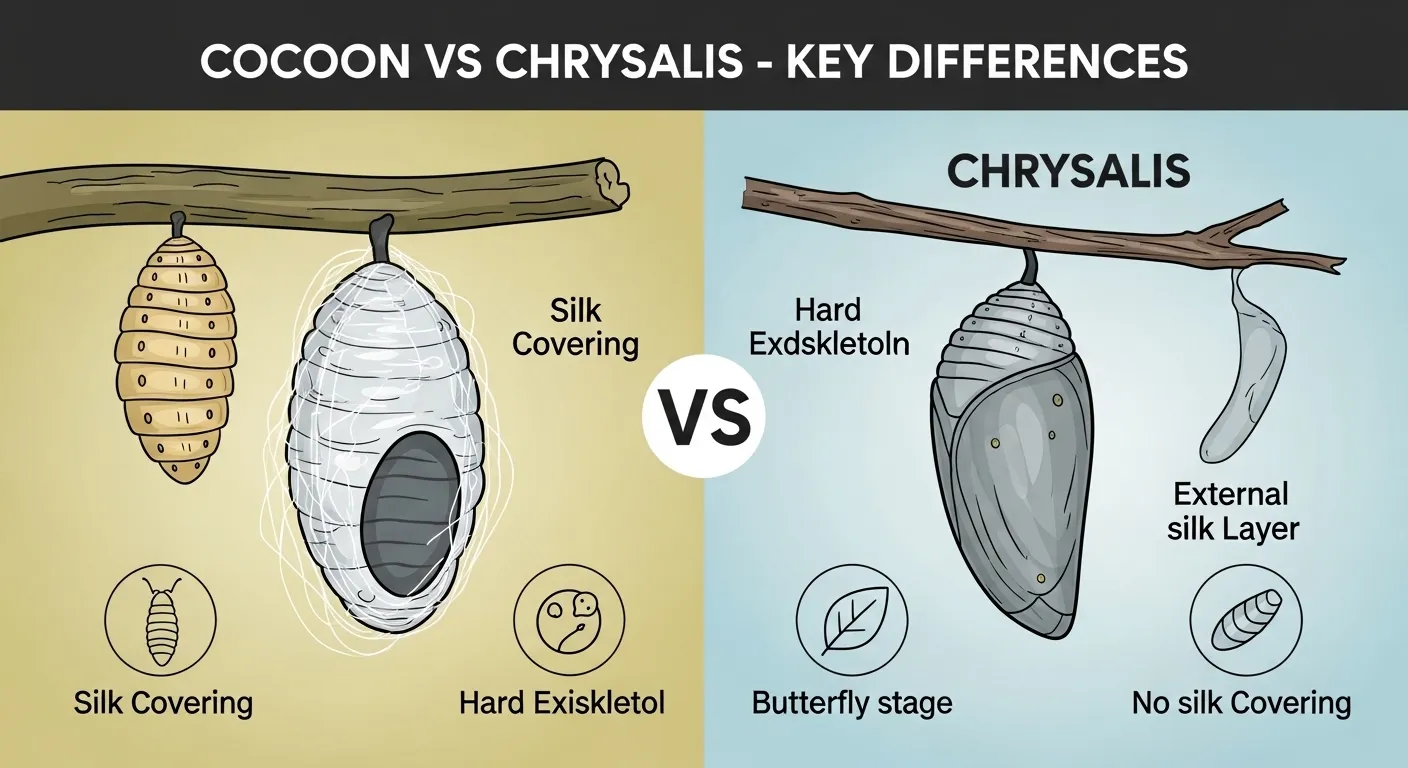
A cocoon is a protective silk covering spun by insects like moths, while a chrysalis is the hardened outer skin of a butterfly during its transformation stage.
Understanding the difference between cocoon and chrysalis helps us explore the fascinating process of insect transformation. Imagine watching a caterpillar preparing for its next stage of life—some wrap themselves in a silky case, while others simply hang and form a hard outer shell. These two processes represent cocoons and chrysalises.
The difference between cocoon and chrysalis lies in how they are formed and which insects use them. While cocoons are external coverings spun from silk, chrysalises are part of the insect’s own body. Learning the difference between cocoon and chrysalis helps students and nature lovers better understand metamorphosis. By knowing the difference between cocoon and chrysalis, you can easily identify whether you are looking at a moth or a butterfly in its transformation stage.
Pronunciation
Cocoon
US: /kəˈkuːn/
Chrysalis
US: /ˈkrɪsəlɪs/
Key Difference Between the Both
The main difference between cocoon and chrysalis is that a cocoon is a silk casing created by insects like moths, while a chrysalis is the actual pupal stage of a butterfly formed from its own body.
Why Is Their Difference Necessary to Know for Learners and Experts?
Knowing the difference between cocoon and chrysalis is important for students, biologists, and nature enthusiasts. For learners, it builds a clear understanding of insect life cycles. For experts, understanding the difference between cocoon and chrysalis helps in accurate classification and study of species.
In society, this knowledge enhances environmental awareness and appreciation of biodiversity. Understanding the difference between cocoon and chrysalis also helps in educational and scientific discussions.
Difference Between Cocoon and Chrysalis
1. Definition
A cocoon is a silk covering spun by certain insects. A chrysalis is the hardened body casing of a butterfly during its pupal stage.
Examples
Cocoon:
- Silk covering around a moth pupa.
- Protective casing made externally.
Chrysalis:
- Butterfly pupa hanging from a branch.
- Formed from the insect’s body.
2. Type of Insect
Cocoons are used by moths and some other insects. Chrysalises are specific to butterflies.
Examples
Cocoon:
- Silk moth.
- Other spinning insects.
Chrysalis:
- Monarch butterfly.
- Swallowtail butterfly.
3. Formation
Cocoons are spun using silk. Chrysalises form without spinning silk.
Examples
Cocoon:
- Caterpillar spins threads.
- Wraps itself completely.
Chrysalis:
- Skin hardens.
- No external material used.
4. Structure
Cocoons are soft and fibrous. Chrysalises are hard and smooth.
Examples
Cocoon:
- Fluffy or rough texture.
- Often opaque.
Chrysalis:
- Solid outer shell.
- May be shiny or patterned.
5. Visibility
Cocoons may hide the pupa completely. Chrysalises often show body shape.
Examples
Cocoon:
- Cannot see inside.
- Fully covered.
Chrysalis:
- Shape of butterfly visible.
- Distinct form.
6. Protection
Both provide protection, but cocoons add an extra layer.
Examples
Cocoon:
- External silk protection.
- Shields from environment.
Chrysalis:
- Natural body casing.
- Protects internally.
7. Location
Cocoons can be found in hidden places. Chrysalises are often visible.
Examples
Cocoon:
- Inside leaves or soil.
- Hidden spots.
Chrysalis:
- Hanging from branches.
- Attached to surfaces.
8. Appearance
Cocoons look like wrapped bundles. Chrysalises look like shaped shells.
Examples
Cocoon:
- Irregular shape.
- Natural fibers.
Chrysalis:
- Smooth and defined.
- Often colorful.
9. Function
Cocoons act as protective coverings. Chrysalises are the transformation stage itself.
Examples
Cocoon:
- Outer layer.
- Not the pupa itself.
Chrysalis:
- Actual pupa.
- Where transformation occurs.
10. Metamorphosis Role
Both are part of metamorphosis but in different ways.
Examples
Cocoon:
- Surrounds the pupa.
- External protection.
Chrysalis:
- Direct stage of change.
- Internal transformation.
Nature and Behaviour of Both
Cocoons are protective, external structures made by insects, while chrysalises are internal body transformations that serve as the pupal stage. Both play essential roles in the life cycle of insects.
Why People Are Confused About Their Use?
People often confuse cocoons and chrysalises because both represent a stage where insects transform. However, the key difference is that a cocoon is a silk covering, while a chrysalis is the actual pupa.
Table Showing Difference and Similarity
| Feature | Cocoon | Chrysalis | Similarity |
| Type | Silk covering | Pupal stage | Part of metamorphosis |
| Insects | Moths | Butterflies | Insect life cycle |
| Structure | Soft/fibrous | Hard/smooth | Protective |
| Formation | Spun externally | Formed internally | Transitional stage |
| Function | Protection | Transformation | Growth stage |
Which Is Better in What Situation?
Cocoon
A cocoon is better for insects that need extra protection from harsh environments during transformation.
Chrysalis
A chrysalis is suitable for butterflies that rely on camouflage and structural protection during metamorphosis.
How the Keywords Are Used in Metaphors and Similes
Examples:
- “She stayed in her cocoon, avoiding the outside world.”
- “He emerged like a butterfly from a chrysalis.”
Connotative Meaning
Cocoon
Connotation: Safety, isolation, protection.
Example:
“He lived in a cocoon of comfort.”
Chrysalis
Connotation: Transformation, growth, change.
Example:
“Her life was a chrysalis before success.”
Idioms or Proverbs Related to the Words
Come out of your shell
Example:
“He finally came out of his shell, like a butterfly from a chrysalis.”
Works in Literature
- The Very Hungry Caterpillar – Children’s book by Eric Carle (features chrysalis stage)
- Various biology textbooks discussing insect metamorphosis
Movie Names Made on the Keywords
- The Butterfly Effect (2004, USA) – metaphorically linked to transformation
- Nature documentaries featuring insect life cycles
Five Frequently Asked Questions
1. What is the main difference between cocoon and chrysalis?
A cocoon is a silk covering, while a chrysalis is the actual pupal stage.
2. Do butterflies make cocoons?
No, butterflies form chrysalises.
3. Which insects use cocoons?
Moths and some other insects.
4. Is a chrysalis inside a cocoon?
No, they are different structures.
5. Are both part of metamorphosis?
Yes, both play roles in transformation.
How Both Are Useful for Surroundings
Cocoons and chrysalises contribute to biodiversity and ecological balance by supporting insect life cycles, which are essential for pollination and food chains.
Final Words for the Both
Cocoons and chrysalises may seem similar but serve different roles in nature’s transformation process.
Conclusion
The difference between cocoon and chrysalis lies in their structure and function. A cocoon is a protective silk covering created by insects like moths, while a chrysalis is the actual pupal stage of a butterfly formed from its own body. Understanding the difference between cocoon and chrysalis helps us appreciate the complexity of insect life cycles. By learning the difference between cocoon and chrysalis, we gain deeper insight into nature and transformation.

I am a professional SEO content writer specialising in comparison-based and grammar-focused articles. Through my website GrammarCompare.com, I help readers clearly understand the difference between confusing terms with well-researched, easy-to-read content. My expertise lies in focusing on clarity, accuracy, and practical explanations that improve both knowledge and writing skills.