Difference between fast and quick is a common question for English learners and even for fluent speakers. Imagine a morning when a student is rushing to school. The bus moves fast on the highway, covering long distances at high speed. Meanwhile, the student quickly grabs breakfast and leaves the house in a quick hurry. Both words seem similar, yet they describe slightly different ideas.
The difference between fast and quick mainly lies in how we describe speed and time. “Fast” usually refers to high speed or something moving rapidly over a distance, while “quick” often refers to something happening in a short time. Understanding the difference between fast and quick helps speakers choose the right word in daily communication. For writers, students, and professionals, knowing the difference between fast and quick improves clarity and precision in language.
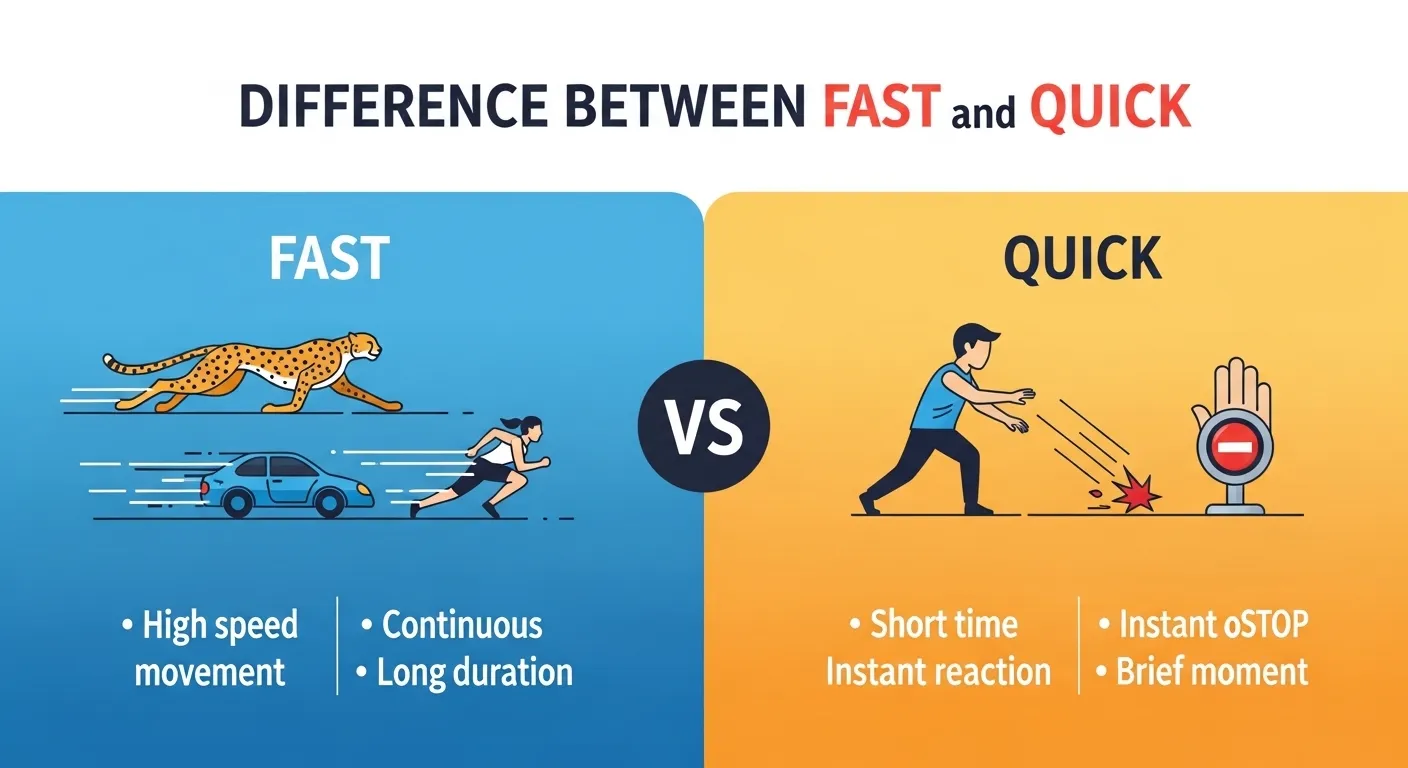
The main difference is that fast focuses on speed of movement, while quick focuses on short duration or immediate action.
Key Difference Between the Both
Why Is Their Difference Necessary to Know for Learners and Experts?
Understanding the difference between fast and quick is important because precise language improves communication in education, business, media, and daily conversation. Students learning English need clear word choices to write better essays and speak confidently. Writers and journalists must use the correct terms to convey accurate meanings. In professional fields like sports, technology, and transportation, describing speed correctly can change the meaning of a statement. Therefore, knowing the difference between fast and quick helps individuals communicate effectively and avoid confusion in society.
Pronunciation (US & UK)
| Word | US Pronunciation | UK Pronunciation |
| Fast | /fæst/ | /fɑːst/ |
| Quick | /kwɪk/ | /kwɪk/ |
Linking Hook:
Now that we understand the meanings and importance of these words, let us explore the difference between fast and quick in detail through clear points and examples.
Difference Between Fast and Quick
1. Speed vs Time Duration
Fast refers to high speed, while quick refers to something done in a short time.
Example of Fast
- The train is very fast on this route.
- She bought a fast sports car.
Example of Quick
- He took a quick shower before work.
- She gave a quick answer.
2. Physical Movement vs Immediate Action
Fast often describes movement, while quick describes a rapid action.
Fast Examples
- The cheetah runs fast.
- The river flows fast after rain.
Quick Examples
- She made a quick decision.
- He gave a quick smile.
3. Continuous Speed vs Short Activity
Fast usually continues over distance or time, while quick happens briefly.
Fast Examples
- The airplane flies fast across the sky.
- The athlete runs fast during the race.
Quick Examples
- I had a quick chat with my teacher.
- They took a quick break.
4. Common in Sports and Vehicles vs Daily Actions
Fast is often used with vehicles and sports performance, while quick appears in daily tasks.
Fast Examples
- This bike is fast on the highway.
- The runner is extremely fast.
Quick Examples
- Let’s have a quick meeting.
5. Speed Measurement vs Reaction
Fast can be measured in speed units, while quick relates to reaction time.
Fast Examples
- The car moves at a fast speed of 120 km/h.
- That train is faster than the previous one.
Quick Examples
- The goalkeeper made a quick save.
- She has quick reflexes.
6. Describing Machines vs Human Responses
Fast is often used for machines or systems.
Fast Examples
- This computer processor is fast.
- The internet connection is fast.
Quick Examples
- He gave a quick reply to the email.
- She made a quick correction.
7. Adjective vs Adverb Use
Fast can function as both adjective and adverb, while quick mainly acts as an adjective.
Fast Examples
- He runs fast.
- It is a fast train.
Quick Examples
- She made a quick move.
- That was a quick decision.
8. Emotional Tone
Quick sometimes suggests intelligence or sharpness.
Fast Examples
- He drives fast on highways.
- The wind moves fast today.
Quick Examples
- She is quick to understand problems.
- He gave a quick reaction.
9. Context of Competition vs Task Completion
Fast is often used in races, while quick is used in finishing tasks.
Fast Examples
- He is the fastest runner in school.
- The horse runs fast.
Quick Examples
- She finished the task quickly.
- They had a quick lunch.
10. Duration vs Performance
Fast focuses on performance speed; quick focuses on short duration.
Fast Examples
- The internet speed is fast today.
- The engine runs fast.
Quick Examples
- I need a quick answer.
- They had a quick look.
Nature and Behaviour of the Words
Fast
- Describes speed or rapid motion
- Often linked with vehicles, technology, and sports
- Suggests continuous high velocity
Quick
- Describes short time or immediate reaction
- Often linked with actions, decisions, and responses
- Suggests efficiency and promptness
Why People Are Confused About Their Use
People confuse these words because both relate to speed and are often used interchangeably in casual conversation. In everyday speech, speakers may say “quick car” instead of “fast car,” even though “fast” is more accurate. Another reason is translation from other languages where one word may represent both ideas. Without understanding the context, learners assume both words mean exactly the same thing.
Difference and Similarity Table
| Feature | Fast | Quick | Similarity |
| Main Meaning | High speed | Short time | Both relate to speed |
| Usage | Movement or performance | Action or reaction | Used in daily English |
| Context | Vehicles, sports | Tasks, decisions | Describe rapid events |
| Grammar | Adjective & adverb | Mostly adjective | Both modify nouns |
| Focus | Distance and velocity | Duration of action | Express rapid activity |
Which Is Better in What Situation?
Fast
The word “fast” is better when describing physical speed or movement over distance. It is commonly used for vehicles, animals, machines, or athletes. For example, when talking about internet speed, racing cars, trains, or runners, “fast” is the correct word. It emphasizes power, velocity, and performance. In professional or technical contexts such as sports commentary or engineering discussions, “fast” accurately expresses measurable speed and efficiency.
Quick
The word “quick” is better when describing something done in a short time. It is ideal for actions like decisions, responses, meetings, or tasks. For instance, people say “a quick reply,” “a quick look,” or “a quick break.” It highlights promptness and efficiency rather than physical speed. In everyday communication and workplace situations, it conveys urgency and immediate action.
Use in Metaphors and Similes
Fast
- As fast as lightning
- As fast as the wind
Example
- The athlete ran as fast as lightning.
Quick
- Quick as a flash
- Quick as a wink
Example
- The child disappeared as quick as a flash.
Connotative Meanings
Fast
Positive
- Fast progress in technology
Negative
- Fast lifestyle causing stress
Neutral
- Fast train arriving at the station
Quick
Positive
- Quick thinking saved the team
Negative
- Quick temper can cause problems
Neutral
- Quick response from the system
Idioms and Proverbs
Fast
- Hold fast (remain firm)
Example: The captain told the crew to hold fast during the storm. - Fast and furious
Example: The debate continued fast and furious.
Quick
- Quick on the draw
Example: She was quick on the draw with her answer. - Quick fix
Example: The manager wanted a quick fix for the issue.
Works in Literature
Fast
- Fast Food Nation, Non-fiction, Eric Schlosser, 2001.
- Fast Times at Ridgemont High, Novel, Cameron Crowe, 1981.
Quick
- The Quick and the Dead, Western novel, Louis L’Amour, 1973.
- Quick Curtain, Mystery novel, Alan Melville,1934.
Movies Based on the Keywords
Fast
- Fast & Furious, 2009, USA.
- Fast Five, 2011, USA.
Quick
- The Quick and the Dead – 1995 – USA
- Quick Change – 1990 – USA
Frequently Asked Questions
1. What is the main difference between fast and quick?
Fast refers to high speed, while quick refers to something done in a short time.
2. Can fast and quick be used interchangeably?
Sometimes in casual speech, but their meanings differ depending on context.
3. Which word is used for vehicles?
Fast is usually used for vehicles and movement.
4. Which word describes reactions?
Quick is commonly used for reactions or responses.
5. Is fast an adverb?
Yes, fast can act as both an adjective and an adverb.
How Both Are Useful for Surroundings
Both words help people describe speed and efficiency in everyday life. “Fast” helps explain movement in transportation, sports, and technology, such as fast internet or fast trains. “Quick” helps describe prompt actions like quick decisions, quick responses, and quick services. Together, they allow speakers to communicate clearly about time, speed, and performance in daily environments.
Final Words for Both
Fast and quick may appear similar, but each word has its own role in English communication. Fast highlights speed and power, while later one highlights promptness and short duration. Choosing the correct word improves clarity and makes communication more precise.
Conclusion
Understanding the difference between fast and quick is essential for anyone learning or using English effectively. While both words relate to speed, they emphasise different aspects of it. “Fast” focuses on physical speed and movement, often used for vehicles, athletes, and machines. “Quick,” on the other hand, highlights actions completed in a short time or rapid responses. By learning the contexts in which each word is used, speakers can avoid confusion and express ideas more accurately. Whether in everyday conversation, writing, or professional communication, recognising the difference between fast and quick helps build clearer and more confident language skills.

I am a professional SEO content writer specialising in comparison-based and grammar-focused articles. Through my website GrammarCompare.com, I help readers clearly understand the difference between confusing terms with well-researched, easy-to-read content. My expertise lies in focusing on clarity, accuracy, and practical explanations that improve both knowledge and writing skills.