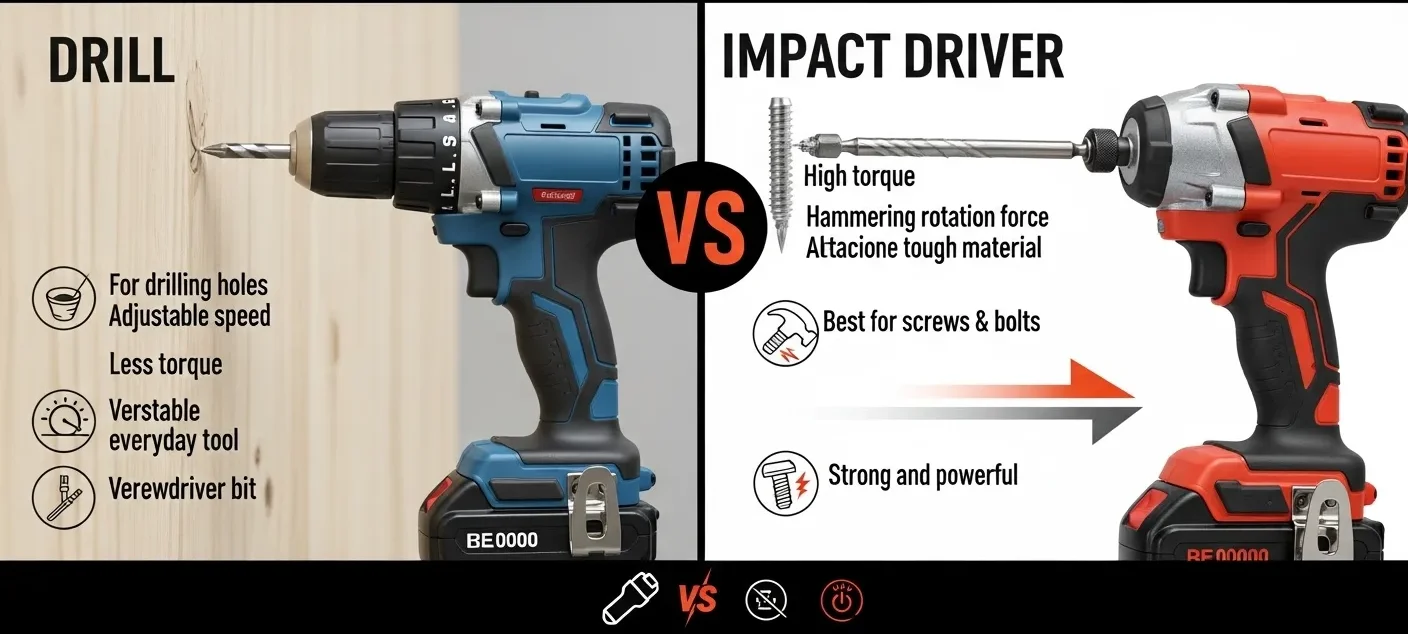
An impact driver and a drill are both power tools, but a drill is designed for drilling holes and light fastening, while an impact driver delivers high torque for driving screws and heavy-duty fastening.
Understanding the difference between impact and drill is essential for anyone working with tools, whether you’re a DIY enthusiast or a professional. Imagine assembling furniture or building a wooden deck—you might start with a drill to create holes, but when it comes to tightening long screws, an impact driver becomes more effective.
The difference between impact and drill lies in their power, function, and design. While a drill is versatile and commonly used for everyday tasks, an impact driver is specialized for high-torque applications. Learning the difference between impact and drill helps you choose the right tool for the job, improving efficiency and results. By understanding the difference between impact and drill, you can avoid damage to materials and complete tasks more easily.
Pronunciation
Impact Driver
US: /ˈɪmpækt ˈdraɪvər/
Drill
US: /drɪl/
Key Difference Between the Both
The main difference between impact and drill is that a drill rotates smoothly to make holes and drive screws, while an impact driver uses rotational force combined with rapid impacts to drive screws with greater power.
Why Is Their Difference Necessary to Know for Learners and Experts?
Knowing the difference between impact and drill is important for DIY users, carpenters, and construction professionals. For beginners, it ensures proper tool selection. For experts, understanding the difference between impact and drill improves precision, efficiency, and safety.
In real-world situations, using the wrong tool can damage materials or reduce performance. Therefore, understanding the difference between impact and drill leads to better results and longer tool life.
Difference Between Impact and Drill
1. Primary Function
A drill is used for drilling holes and light fastening. An impact driver is used mainly for driving screws and bolts.
Examples
Drill:
- Drilling holes in wood or metal.
- Light screw driving.
Impact Driver:
- Driving long screws.
- Tightening bolts.
2. Torque
Impact drivers provide higher torque. Drills provide lower torque.
Examples
Drill:
- Suitable for small screws.
- Limited power.
Impact Driver:
- Handles large fasteners.
- Strong force output.
3. Mechanism
Drills rotate continuously. Impact drivers combine rotation with hammering action.
Examples
Drill:
- Smooth rotation.
- Controlled drilling.
Impact Driver:
- Rapid bursts of force.
- Increased efficiency.
4. Speed Control
Drills offer better speed control. Impact drivers are more force-focused.
Examples
Drill:
- Adjustable speeds.
- Precision tasks.
Impact Driver:
- Less fine control.
- Power over precision.
5. Noise Level
Impact drivers are noisier. Drills are quieter.
Examples
Drill:
- Smooth sound.
- Less vibration.
Impact Driver:
- Loud hammering noise.
- Strong vibration.
6. Chuck Type
Drills have adjustable chucks. Impact drivers use quick-release hex chucks.
Examples
Drill:
- Holds various bit sizes.
- Versatile.
Impact Driver:
- Uses hex-shank bits.
- Quick bit changes.
7. Ease of Use
Drills are easier for beginners. Impact drivers require some experience.
Examples
Drill:
- Simple operation.
- Beginner-friendly.
Impact Driver:
- Strong kickback.
- Needs control.
8. Versatility
Drills are more versatile. Impact drivers are specialized.
Examples
Drill:
- Drilling and fastening.
- Multiple uses.
Impact Driver:
- Best for screws and bolts.
- Limited functions.
9. Battery Usage
Impact drivers are more efficient in driving screws. Drills may drain faster in heavy tasks.
Examples
Drill:
- Consumes more power under load.
- Suitable for light work.
Impact Driver:
- Efficient torque delivery.
- Longer runtime for heavy tasks.
10. Applications
Drills are used in general tasks. Impact drivers are used in construction and heavy-duty work.
Examples
Drill:
- Home repairs.
- Furniture assembly.
Impact Driver:
- Deck building.
- Structural work.
Nature and Behaviour of Both
Drills are versatile, controlled, and suitable for precision work. Impact drivers are powerful, aggressive, and designed for heavy-duty fastening tasks.
Why People Are Confused About Their Use?
People often confuse impact drivers and drills because both look similar and can drive screws. However, their internal mechanisms and power output differ significantly.
Table Showing Difference and Similarity
| Feature | Drill | Impact Driver | Similarity |
| Function | Drilling & light fastening | Heavy fastening | Both power tools |
| Torque | Low to medium | High | Used with bits |
| Mechanism | Smooth rotation | Impact + rotation | Motor-driven |
| Noise | Quiet | Loud | Handheld tools |
| Usage | General | Heavy-duty | DIY & professional |
Which Is Better in What Situation?
Drill
A drill is better for tasks that require precision, such as drilling holes or working with delicate materials.
Impact Driver
An impact driver is better for heavy-duty fastening, especially when working with long screws or tough materials.
How the Keywords Are Used in Metaphors and Similes
Examples:
- “He worked like a drill—steady and precise.”
- “She handled the task like an impact driver—powerful and efficient.”
Connotative Meaning
Drill
Connotation: Precision, control, versatility.
Example:
“He approached the task with drill-like accuracy.”
Impact Driver
Connotation: Power, strength, efficiency.
Example:
“Her approach hit like an impact driver—fast and strong.”
Idioms or Proverbs Related to the Words
Hit the nail on the head
Example:
“He hit the nail on the head using the right tool.”
Works in Literature
Impact drivers and drills are mainly referenced in technical manuals, DIY guides, and construction-related literature.
Movie Names Made on the Keywords
There are no movies directly based on drills or impact drivers, as they are tools.
Five Frequently Asked Questions
1. What is the main difference between impact and drill?
A drill is for drilling and light tasks, while an impact driver is for high-torque fastening.
2. Can I use a drill instead of an impact driver?
Yes, but it may struggle with heavy tasks.
3. Which tool is better for beginners?
A drill is easier to use.
4. Is an impact driver stronger?
Yes, it provides more torque.
5. Do I need both tools?
For best results, yes—each serves different purposes.
How Both Are Useful for Surroundings
Both tools help in construction, repairs, and DIY projects, making tasks faster and more efficient.
Final Words for the Both
Drills and impact drivers are essential tools with different strengths. Choosing the right one depends on the task.
Conclusion
The difference between impact and drill lies in their function, power, and application. A drill is versatile and ideal for precision tasks, while an impact driver is powerful and designed for heavy-duty fastening. Understanding the difference between impact and drill helps you choose the right tool, improve efficiency, and achieve better results. By learning the difference between impact and drill, you can handle projects with confidence and ease.

I am a professional SEO content writer specialising in comparison-based and grammar-focused articles. Through my website GrammarCompare.com, I help readers clearly understand the difference between confusing terms with well-researched, easy-to-read content. My expertise lies in focusing on clarity, accuracy, and practical explanations that improve both knowledge and writing skills.