Difference between interpreting and translating often becomes clear when we observe real-life communication situations. Imagine an international business meeting where a speaker talks in Spanish while a professional instantly explains the message in English to the audience. This process is called interpreting. Later, the same speech might be converted into written English for a report, and that process is called translating.
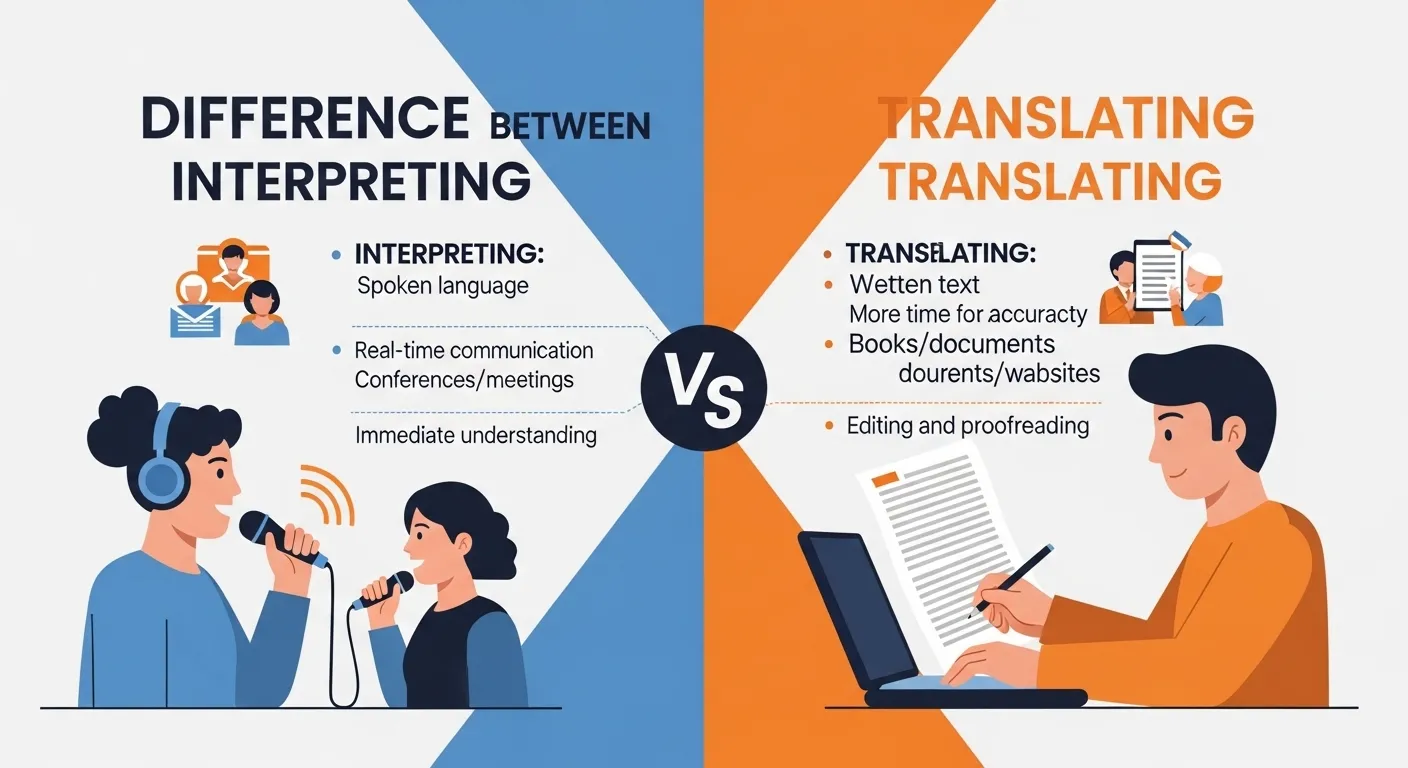
The difference between interpreting and translating lies mainly in how language is converted from one form to another. Interpreting usually deals with spoken language in real time, while translating focuses on written text. Understanding the difference between interpreting and translating helps learners, language professionals, and global businesses communicate effectively. In many multilingual societies, the difference between interpreting and translating becomes important for education, diplomacy, and international cooperation.
Pronunciation of the Words
| Word | US Pronunciation | UK Pronunciation |
| Interpreting | /ɪnˈtɝː.prə.tɪŋ/ | /ɪnˈtɜː.prɪ.tɪŋ/ |
| Translating | /trænzˈleɪ.tɪŋ/ | /trænzˈleɪ.tɪŋ/ |
Before exploring the details, it is helpful to clearly understand how interpreting and translating differ in their purpose, process, and real-world use.
Key Difference Between the Both
The main difference is the medium of communication. Interpreting converts spoken language into another spoken language instantly, while translating converts written text from one language into another.
Why Their Difference Is Necessary to Know for Learners and Experts
Understanding the difference between interpreting and translating is important in modern society. Students studying languages must know which skill they want to develop. Interpreters require quick thinking and listening skills, while translators need strong writing and research abilities.
For professionals, this distinction is essential in fields like diplomacy, healthcare, education, and international business. A medical appointment with foreign patients requires interpreting, while translating is necessary for medical reports or legal documents. Knowing the correct service improves communication accuracy and prevents misunderstandings.
In global societies, both interpreting and translating help connect cultures, share knowledge, and support cooperation between people who speak different languages.
Difference Between Interpreting and Translating
1. Form of Language
Interpreting: Works with spoken language.
Example 1: A diplomat speaks French and the interpreter explains it in English immediately.
Example 2: A tourist guide interprets a speech for foreign visitors.
Translating: Works with written language.
Example 1: A translator converts a Spanish novel into English.
Example 2: A company translates product manuals into multiple languages.
2. Speed of Work
Interpreting: Happens instantly during communication.
Example 1: Conference interpreting during international meetings.
Example 2: Court interpreters translating testimony in real time.
Translating: Usually takes more time.
Example 1: Translating academic papers carefully.
Example 2: Editing translated books before publishing.
3. Tools Used
Interpreting: Mostly relies on listening skills and memory.
Example 1: Simultaneous interpreters using headsets.
Example 2: Consecutive interpreters taking quick notes.
Translating: Uses dictionaries and translation software.
Example 1: Using digital dictionaries for accuracy.
Example 2: Translation tools helping with large documents.
4. Work Environment
Interpreting: Happens in meetings or events.
Example 1: United Nations conferences.
Example 2: International business negotiations.
Translating: Usually done in offices or remotely.
Example 1: Freelance translators working from home.
Example 2: Publishing companies translating books.
5. Level of Preparation
Interpreting: Requires quick thinking with little preparation.
Example 1: Emergency interpreting in hospitals.
Example 2: Interpreting during live interviews.
Translating: Allows time for research and revision.
Example 1: Translating legal contracts carefully.
Example 2: Translating historical documents.
6. Skills Required
Interpreting: Strong listening and speaking skills.
Example 1: Understanding accents quickly.
Example 2: Speaking fluently in multiple languages.
Translating: Strong reading and writing skills.
Example 1: Writing clear translated articles.
Example 2: Adapting tone in translated novels.
7. Accuracy Method
Interpreting: Focuses on conveying the main idea quickly.
Example 1: Explaining a speech summary in another language.
Example 2: Interpreting casual conversation for travelers.
Translating: Focuses on precise word choice.
Example 1: Legal translation requiring exact terms.
Example 2: Scientific translations needing accuracy.
8. Revision Possibility
Interpreting: Cannot be edited after speaking.
Example 1: Conference interpretation is immediate.
Example 2: Court interpretation during testimony.
Translating: Can be edited many times.
Example 1: Proofreading translated articles.
Example 2: Revising translated research papers.
9. Memory vs Documentation
Interpreting: Relies heavily on memory.
Example 1: Interpreters remembering long speeches.
Example 2: Note-taking during presentations.
Translating: Relies on documents.
Example 1: Translating written reports.
Example 2: Translating books or articles.
10. Output Format
Interpreting: Spoken output.
Example 1: Live translation in conferences.
Example 2: Interpreting TV interviews.
Translating: Written output.
Example 1: Translated news articles.
Example 2: Translated subtitles for films.
Nature and Behaviour of Both
Interpreting:
Interpreting is dynamic, immediate, and interactive. It requires quick mental processing and the ability to capture meaning instantly.
Translating:
Translating is analytical and structured. It allows time for editing, researching vocabulary, and improving accuracy.
Why People Are Confused About Their Use
People often confuse interpreting and translating because both involve converting one language into another. In everyday conversation, people sometimes use the word “translate” for both spoken and written communication. Media and informal speech also mix these terms, which increases the confusion.
Table Showing Difference and Similarity
| Feature | Interpreting | Translating | Similarity |
| Medium | Spoken language | Written language | Both convert languages |
| Speed | Immediate | Slower process | Both require language expertise |
| Skills | Listening and speaking | Reading and writing | Both need cultural knowledge |
| Revision | Not possible | Possible | Both aim for accurate meaning |
| Environment | Meetings and conferences | Offices or publishing | Both support global communication |
Which Is Better in What Situation?
Interpreting:
Interpreting is better when communication must happen instantly. International meetings, diplomatic discussions, medical consultations, and live conferences require interpreters. In these situations, people cannot wait for written translations. The interpreter quickly transfers meaning from one language to another, ensuring smooth conversation and understanding between speakers.
Translating:
Translating is better when dealing with written materials. Books, research papers, contracts, and official documents require translation because accuracy and clarity are essential. Translators can review the text, check dictionaries, and refine the wording to maintain the original meaning.
Use in Metaphors and Similes
Interpreting
- “She interpreted his silence like a hidden message.”
- “He interpreted the signs like a detective solving clues.”
Translating
- “Her smile translated into kindness.”
- “His actions translated like a clear promise.”
Connotative Meaning
Interpreting
- Positive: Understanding meaning deeply
- Neutral: Explaining language
- Negative: Misinterpreting intentions
Example: “She interpreted his words as criticism.”
Translating
- Positive: Sharing knowledge between cultures
- Neutral: Converting language
- Negative: Losing meaning during translation
Example: “Some jokes lose humor when translated.”
Idioms or Proverbs Related to the Words
- Lost in translation – meaning something misunderstood when translated.
Example: “The humor was lost in translation.” - Read between the lines – interpret hidden meaning.
Example: “You must read between the lines to understand the message.” - Actions speak louder than words – actions translate meaning clearly.
Example: “His help translated his kindness.”
Works in Literature Using the Keywords
- The Interpreter of Maladies – Short story collection, Jhumpa Lahiri, 1999
- Translating Poetry – Literary criticism, André Lefevere, 1975
- Is That a Fish in Your Ear? Translation and the Meaning of Everything – Nonfiction, David Bellos, 2011
Movies Related to Language Interpretation or Translation
- The Interpreter – 2005, USA
- Arrival – 2016, USA (focuses on language translation with aliens)
- Lost in Translation – 2003, USA/Japan
Frequently Asked Questions
1. What is the main difference between interpreting and translating?
Interpreting deals with spoken language, while translating deals with written text.
2. Do interpreters and translators need the same skills?
Both need language knowledge, but interpreters focus on listening and speaking, while translators focus on reading and writing.
3. Which job is more difficult?
Both are challenging in different ways. Interpreting requires quick thinking, while translating requires careful accuracy.
4. Can one person do both jobs?
Yes, many language professionals are trained in both interpreting and translating.
5. Where are interpreters commonly used?
They are used in conferences, hospitals, courts, and international meetings.
How Both Are Useful for Surroundings
Interpreting and translating make communication possible between people from different linguistic backgrounds. They help in education, tourism, diplomacy, healthcare, and business. Without them, international cooperation and cultural exchange would be very difficult.
Final Words for Both
Interpreting: A skill that connects people instantly through spoken language.
Translating: A craft that preserves meaning through written words.
Conclusion
The difference between interpreting and translating mainly lies in the form of communication they handle. Interpreting focuses on spoken language and happens in real time, while translating works with written text and allows more time for accuracy and editing. Both professions require deep knowledge of languages and cultures, but their skills and working environments differ significantly.
Understanding the difference between interpreting and translating helps learners choose the right career path and helps organisations use the correct service for effective communication. In a globalised world where people from different linguistic backgrounds interact daily, interpreting and translating remain essential tools that bridge cultural gaps and promote understanding among nations.

I am a professional SEO content writer specialising in comparison-based and grammar-focused articles. Through my website GrammarCompare.com, I help readers clearly understand the difference between confusing terms with well-researched, easy-to-read content. My expertise lies in focusing on clarity, accuracy, and practical explanations that improve both knowledge and writing skills.