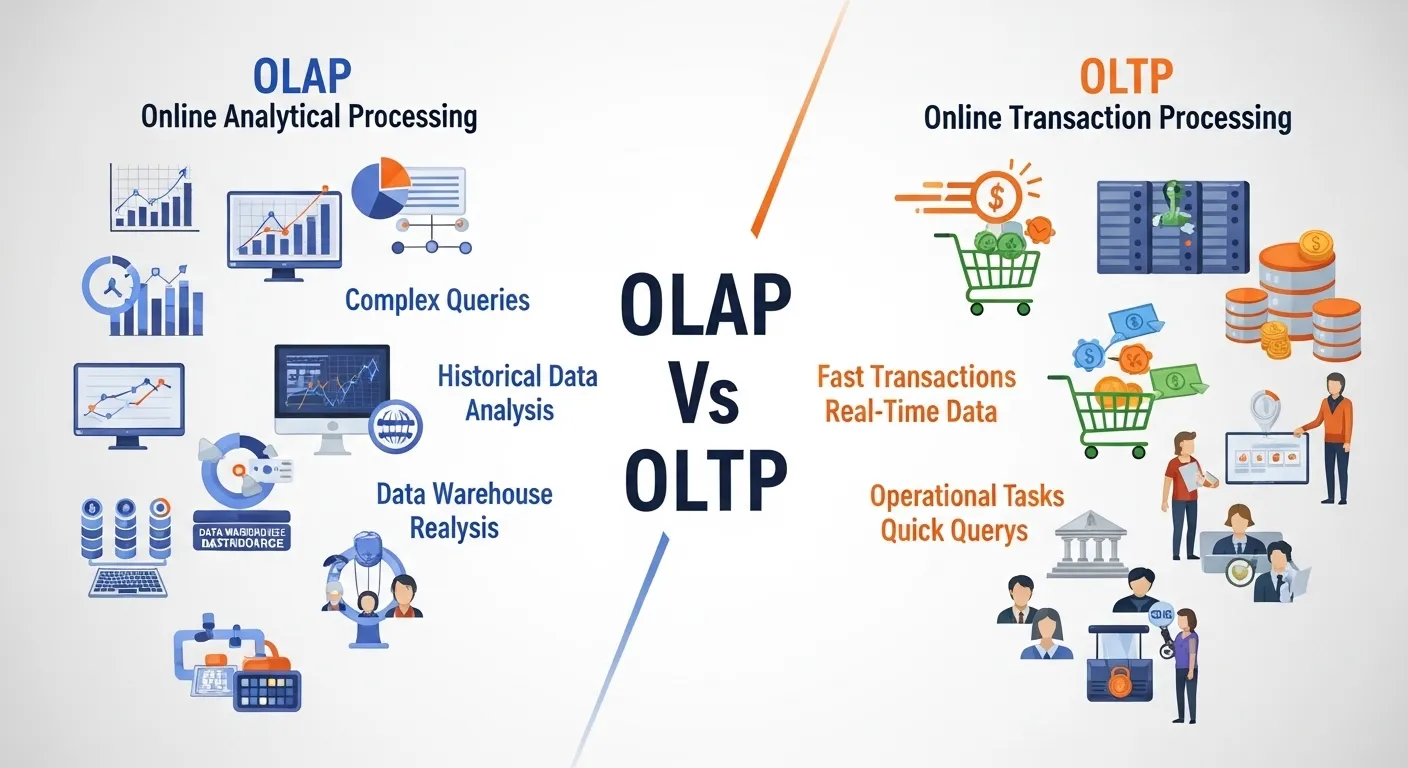
OLAP and OLTP are both database systems, but OLTP is designed for real-time transaction processing, while OLAP is used for data analysis and decision-making.
Understanding the difference between OLAP and OLTP is essential in today’s data-driven world. Imagine you’re using an online shopping app when you place an order, the system instantly records your transaction. This is handled by OLTP. Later, when a company analyzes sales trends to decide which products are performing best, it uses OLAP.
The difference between OLAP and OLTP lies in their purpose, design, and usage. OLTP focuses on handling day-to-day operations quickly and accurately, while OLAP helps businesses analyse large amounts of data to make strategic decisions. Learning the difference between OLAP and OLTP helps students, developers, and data professionals understand how modern databases work. By mastering the difference between OLAP and OLTP, you can better grasp how data is processed, stored, and analysed in real-world systems.
Pronunciation
OLTP (Online Transaction Processing)
US: /ˌoʊ ɛl tiː ˈpiː/
OLAP (Online Analytical Processing)
US: /ˌoʊ ɛl æp/
Key Difference Between the Both
The main difference between OLAP and OLTP is that OLTP manages real-time transactions like inserts and updates, while OLAP processes large volumes of historical data for analysis and reporting.
Why Is Their Difference Necessary to Know for Learners and Experts?
Knowing the difference between OLAP and OLTP is crucial for students of computer science, data analysts, and IT professionals. For learners, it builds a strong foundation in database systems. For experts, understanding the difference between OLAP and OLTP helps in designing efficient systems for both operations and analytics.
In real-world applications, businesses rely on OLTP systems to run daily operations and OLAP systems to make informed decisions. Therefore, understanding the difference between OLAP and OLTP ensures better system design and data management.
Difference Between OLAP and OLTP
1. Definition
OLTP is a system designed for managing transactional data in real time. OLAP is a system designed for analyzing and querying large datasets.
Examples
OLTP:
- Processing online orders.
- Banking transactions.
OLAP:
- Sales trend analysis.
- Business intelligence reports.
2. Purpose
OLTP focuses on daily operations, while OLAP focuses on data analysis and decision-making.
Examples
OLTP:
- Recording customer purchases.
- Updating account balances.
OLAP:
- Analyzing yearly sales data.
- Generating reports for management.
3. Data Type
OLTP handles current, real-time data. OLAP works with historical and aggregated data.
Examples
OLTP:
- Current orders and transactions.
- Live customer data.
OLAP:
- Past sales records.
- Summarized business data.
4. Query Complexity
OLTP uses simple and short queries. OLAP uses complex queries involving calculations and aggregations.
Examples
OLTP:
- Insert or update a record.
- Retrieve a single transaction.
OLAP:
- Analyze trends over years.
- Perform multi-dimensional queries.
5. Performance Focus
OLTP is optimized for speed and efficiency in transactions. OLAP is optimized for fast query performance on large datasets.
Examples
OLTP:
- Fast transaction processing.
- High concurrency.
OLAP:
- Fast data retrieval for analysis.
- Optimized for reporting.
6. Database Design
OLTP uses normalized databases. OLAP uses denormalized databases like data warehouses.
Examples
OLTP:
- Multiple related tables.
- Reduces data redundancy.
OLAP:
- Data warehouses and cubes.
- Stores aggregated data.
7. Users
OLTP is used by front-end users and customers. OLAP is used by analysts and managers.
Examples
OLTP:
- Bank customers.
- E-commerce users.
OLAP:
- Data analysts.
- Business executives.
8. Operations
OLTP performs frequent insert, update, and delete operations. OLAP mainly performs read and query operations.
Examples
OLTP:
- Adding new orders.
- Updating records.
OLAP:
- Reading large datasets.
- Running reports.
9. Data Volume
OLTP handles smaller amounts of data per transaction. OLAP handles large volumes of data.
Examples
OLTP:
- Individual transactions.
- Limited data per query.
OLAP:
- Massive datasets.
- Bulk data analysis.
10. Backup and Recovery
OLTP requires frequent backups due to constant updates. OLAP requires less frequent backups.
Examples
OLTP:
- Regular backups for safety.
- Critical for real-time systems.
OLAP:
- Periodic backups.
- Focus on historical data.
Nature and Behaviour of Both
OLTP systems are fast, transactional, and user-focused. They ensure accuracy and speed in daily operations. OLAP systems are analytical, data-heavy, and decision-oriented, helping organizations understand patterns and trends.
Why People Are Confused About Their Use?
People often confuse OLAP and OLTP because both deal with databases. However, the key difference is that OLTP handles real-time operations, while OLAP focuses on analyzing data for insights.
Table Showing Difference and Similarity
| Feature | OLTP | OLAP | Similarity |
| Purpose | Transactions | Analysis | Both manage data |
| Data | Real-time | Historical | Used in databases |
| Queries | Simple | Complex | Query-based systems |
| Users | Customers | Analysts | Support business |
| Design | Normalized | Denormalized | Data storage systems |
Which Is Better in What Situation?
OLTP
OLTP is better for applications that require real-time data processing, such as banking systems, e-commerce platforms, and reservation systems.
OLAP
OLAP is better for analyzing large datasets, generating reports, and supporting business intelligence and decision-making.
How the Keywords Are Used in Metaphors and Similes
Examples:
- “The system worked like an OLTP engine, handling tasks instantly.”
- “Her analysis approach was like OLAP, digging deep into data.”
Connotative Meaning
OLTP
Connotation: Fast, efficient, and operational.
Example:
“OLTP systems keep businesses running smoothly.”
OLAP
Connotation: Insightful, analytical, and strategic.
Example:
“OLAP tools help uncover hidden patterns.”
Idioms or Proverbs Related to the Words
Time is money
Example:
“In OLTP systems, time is money, speed is critical.”
Works in Literature
Both are technical terms and are mainly found in academic and professional IT literature, such as database textbooks and research papers.
Movie Names Made on the Keywords
There are no movies directly related to the keyword, as they are technical database concepts.
Five Frequently Asked Questions
1. What is the main difference between OLAP and OLTP?
OLTP handles transactions, while OLAP analyzes data.
2. Which is faster?
OLTP is faster for transactions, while OLAP is optimized for analysis.
3. Can both systems be used together?
Yes, many organizations use both.
4. Who uses OLAP systems?
Analysts and decision-makers.
5. Is OLAP used in real-time?
No, it mainly works with historical data.
How Both Are Useful for Surroundings
OLTP systems keep daily operations running efficiently, while OLAP systems help organizations make better decisions. Together, they improve productivity and business success.
Final Words for the Both
Both are essentials in modern data systems. While OLTP ensures smooth operations, OLAP provides valuable insights.
Conclusion
The difference between OLAP and OLTP lies in their purpose, design, and usage. OLTP is designed for real-time transaction processing, while OLAP is focused on analyzing large datasets for decision-making. Understanding the difference between OLAP and OLTP helps learners and professionals build efficient systems and make informed decisions. By mastering the difference between OLAP and OLTP, you can better understand how data powers modern businesses.

I am a professional SEO content writer specialising in comparison-based and grammar-focused articles. Through my website GrammarCompare.com, I help readers clearly understand the difference between confusing terms with well-researched, easy-to-read content. My expertise lies in focusing on clarity, accuracy, and practical explanations that improve both knowledge and writing skills.