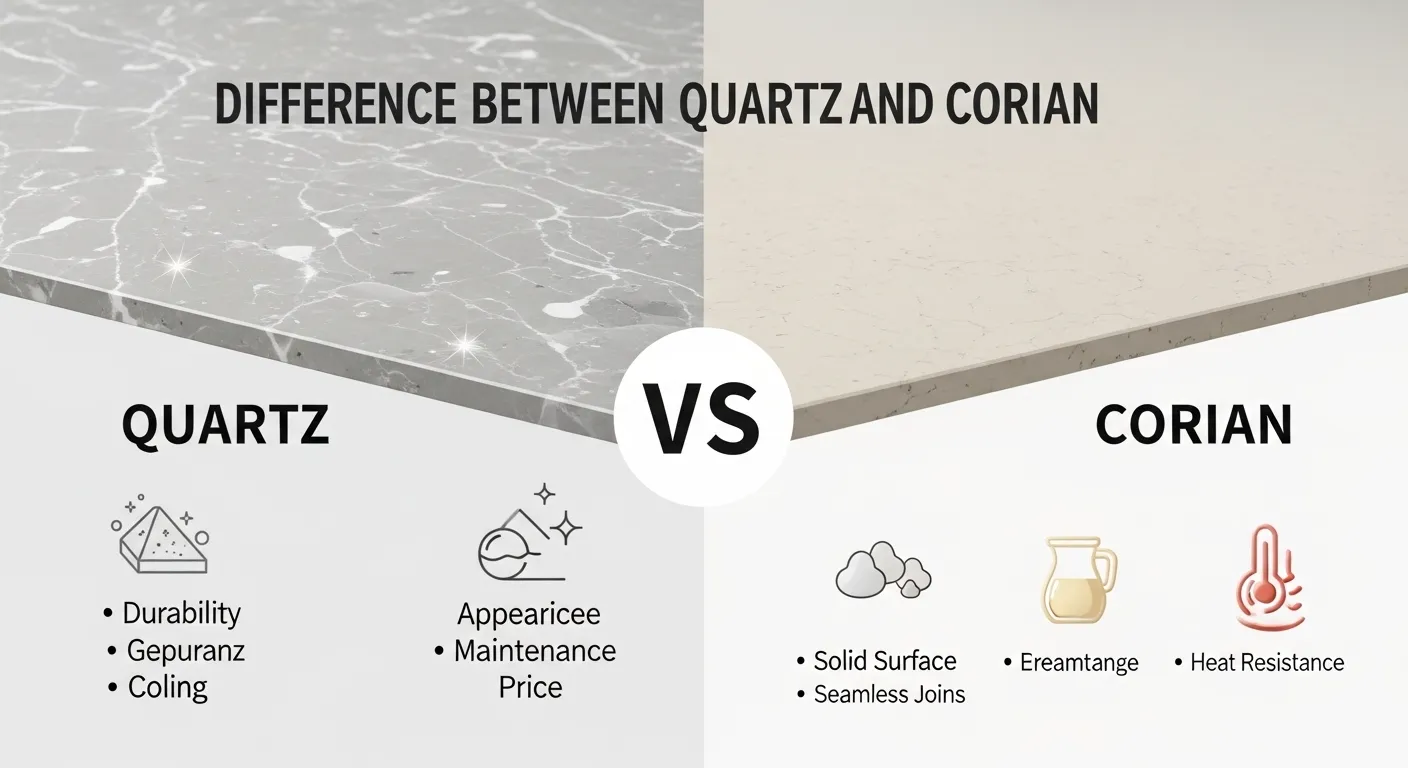
Quartz and Corian are both popular countertop materials, but quartz is an engineered stone made with natural minerals, while Corian is a solid surface made from acrylic resin and minerals.
Understanding the difference between quartz and Corian is essential when choosing materials for kitchens, bathrooms, or work spaces. Imagine renovating your home and selecting a countertop that not only looks beautiful but also lasts for years. You may come across quartz and Corian, two widely used materials that look similar at first but differ in performance and composition.
The difference between quartz and Corian lies in their durability, appearance, maintenance, and cost. Quartz offers a natural stone-like feel with high resistance to scratches, while Corian provides a smooth, seamless surface that is easy to repair. Learning the difference between quartz and Corian helps homeowners, designers, and builders make informed decisions. By understanding the difference between quartz and Corian, you can choose the best option based on your lifestyle and design needs.
Pronunciation
Quartz
US: /kwɔːrts/
UK: /kwɔːts/
Corian
US: /ˈkɔːriən/
UK: /ˈkɔːriən/
Key Difference Between the Both
The main difference between quartz and Corian is that quartz is a hard, engineered stone surface made mostly from natural quartz, while Corian is a softer, synthetic solid surface made from acrylic resin and minerals.
Why Is Their Difference Necessary to Know for Learners and Experts?
Knowing the difference between quartz and Corian is important for homeowners, interior designers, and construction professionals. For beginners, it helps in selecting the right material for everyday use. For experts, understanding the difference between quartz and Corian allows better planning for durability, aesthetics, and cost.
In real life, countertops are a long-term investment. Choosing the wrong material can lead to maintenance issues or damage. Therefore, understanding the difference between quartz and Corian ensures better value and performance.
Difference Between Quartz and Corian
1. Composition
Quartz is made from crushed natural quartz mixed with resin. Corian is made from acrylic resin and natural minerals.
Examples
Quartz:
- Engineered stone slabs.
- High mineral content.
Corian:
- Synthetic solid surface.
- Acrylic-based material.
2. Durability
Quartz is harder and more resistant to scratches. Corian is softer and can scratch more easily.
Examples
Quartz:
- Resists knife scratches.
- Long-lasting surface.
Corian:
- Can get scratches over time.
- Needs careful use.
3. Appearance
Quartz often looks like natural stone. Corian has a more uniform and seamless appearance.
Examples
Quartz:
- Marble-like patterns.
- Natural variations.
Corian:
- Smooth and consistent color.
- Seamless joints.
4. Maintenance
Quartz requires minimal maintenance. Corian may need occasional polishing.
Examples
Quartz:
- Easy cleaning with mild soap.
- No sealing required.
Corian:
- Can be sanded to remove scratches.
- Requires more care.
5. Heat Resistance
Quartz is more heat-resistant than Corian but still needs protection. Corian is more sensitive to heat.
Examples
Quartz:
- Can handle moderate heat.
- Use trivets for safety.
Corian:
- Can warp with high heat.
- Avoid hot pans directly.
6. Repairability
Corian is easier to repair than quartz. Quartz repairs are more difficult.
Examples
Quartz:
- Hard to fix chips.
- May require replacement.
Corian:
- Scratches can be buffed out.
- Easy to restore.
7. Seam Visibility
Quartz may show seams depending on installation. Corian offers nearly invisible seams.
Examples
Quartz:
- Visible joints in large areas.
- Professional installation needed.
Corian:
- Seamless look.
- Smooth finish across surfaces.
8. Cost
Quartz is generally more expensive. Corian is often more affordable.
Examples
Quartz:
- Premium pricing.
- Higher installation cost.
Corian:
- Budget-friendly option.
- Lower installation cost.
9. Stain Resistance
Quartz is highly stain-resistant. Corian is also resistant but may stain over time.
Examples
Quartz:
- Resists spills like coffee or wine.
- Non-porous surface.
Corian:
- Resists stains but needs quick cleaning.
- May discolor if neglected.
10. Usage
Quartz is popular in high-traffic kitchens. Corian is used in homes and commercial spaces.
Examples
Quartz:
- Kitchen countertops.
- Heavy-use areas.
Corian:
- Bathroom counters.
- Office surfaces.
Nature and Behaviour of Both
Quartz is strong, durable, and stone-like, making it ideal for heavy use. Corian is softer, flexible, and repairable, offering a smooth and modern look.
Why People Are Confused About Their Use?
People often confuse quartz and Corian because both are engineered surfaces and look similar. However, their composition and durability differ significantly.
Table Showing Difference and Similarity
| Feature | Quartz | Corian | Similarity |
| Material | Engineered stone | Solid surface | Both synthetic |
| Durability | High | Moderate | Long-lasting |
| Appearance | Natural look | Uniform look | Stylish |
| Maintenance | Low | Moderate | Easy cleaning |
| Cost | Higher | Lower | Home use |
Which Is Better in What Situation?
Quartz
Quartz is better for busy kitchens and high-traffic areas where durability and low maintenance are important.
Corian
Corian is better for areas where a seamless look and easy repair are priorities, such as bathrooms or modern interiors.
How the Keywords Are Used in Metaphors and Similes
Examples:
- “His work ethic was as strong as quartz.”
- “The design flowed smoothly like Corian.”
Connotative Meaning
Quartz
Connotation: Strong, durable, premium.
Example:
“Quartz countertops represent strength and elegance.”
Corian
Connotation: Smooth, modern, flexible.
Example:
“Corian surfaces give a clean, modern feel.”
Idioms or Proverbs Related to the Words
Solid as a rock
Example:
“The countertop was as solid as a rock, like quartz.”
Works in Literature
Quartz appears in geology and science texts, while Corian is mainly referenced in design and architectural materials literature.
Movie Names Made on the Keywords
There are no movies directly based on quartz or Corian as they are material-related terms.
Five Frequently Asked Questions
1. What is the main difference between quartz and Corian?
Quartz is harder and stone-based, while Corian is softer and acrylic-based.
2. Which is more durable?
Quartz is more durable.
3. Can Corian be repaired easily?
Yes, it can be sanded and restored.
4. Is quartz more expensive?
Yes, generally quartz costs more.
5. Which is better for kitchens?
Quartz is usually better for heavy-use kitchens.
How Both Are Useful for Surroundings
Quartz and Corian enhance interior design, improve functionality, and add value to homes and workspaces.
Final Words for the Both
Both quartz and Corian are excellent countertop materials, each with unique advantages depending on your needs.
Conclusion
The difference between quartz and Corian lies in their composition, durability, and maintenance. Quartz is a strong, stone-like material ideal for heavy use, while Corian is a softer, seamless surface that is easy to repair. Understanding the difference between quartz and Corian helps homeowners and designers choose the right material for their spaces. By learning the difference between quartz and Corian, you can make a smart and long-lasting investment in your home.

I am a professional SEO content writer specialising in comparison-based and grammar-focused articles. Through my website GrammarCompare.com, I help readers clearly understand the difference between confusing terms with well-researched, easy-to-read content. My expertise lies in focusing on clarity, accuracy, and practical explanations that improve both knowledge and writing skills.