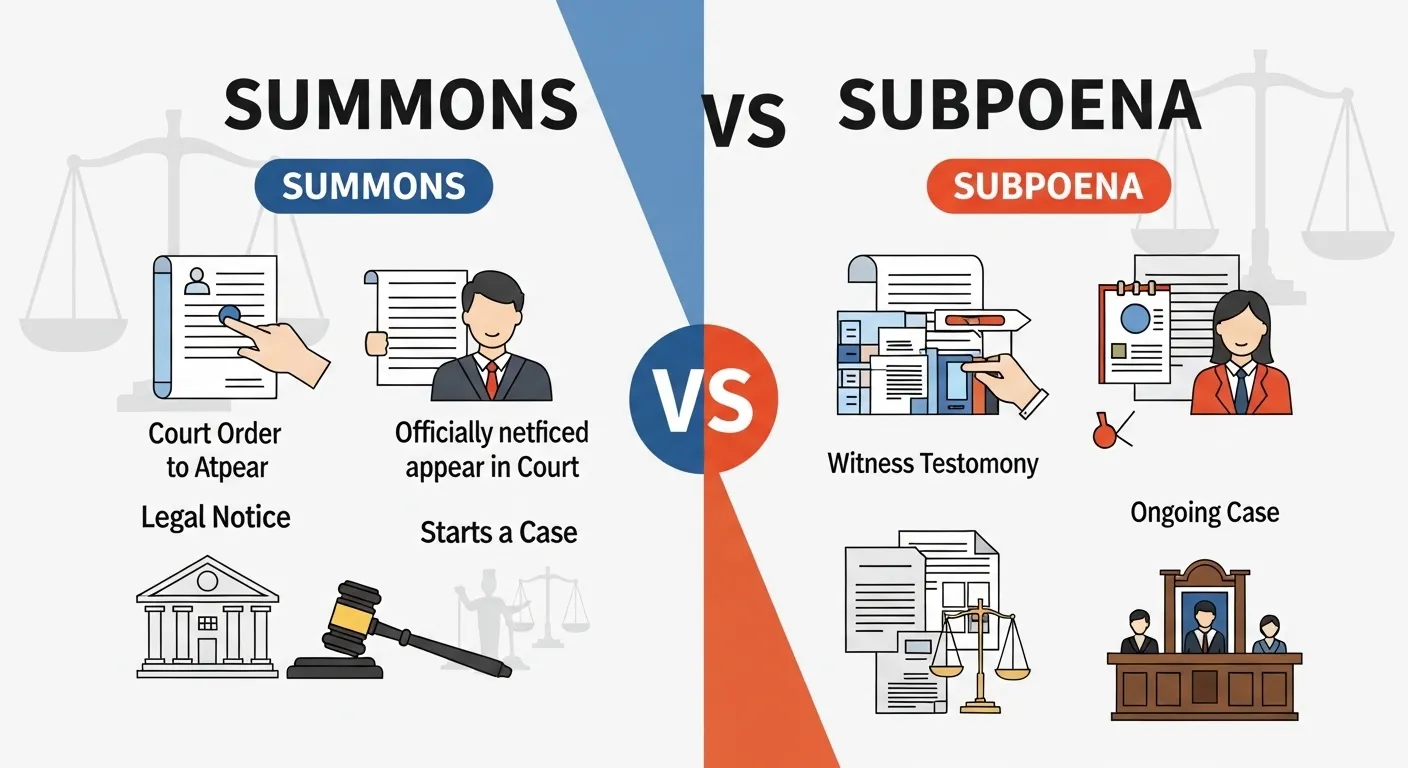
A summons is a legal notice ordering a person to appear in court as a party to a case, while a subpoena compels a person to testify or provide evidence in a legal proceeding.
Understanding the difference between summons and subpoena is essential in legal contexts, whether you are a student, professional, or simply curious about how courts operate. Imagine receiving an official document requiring your presence in court—sometimes it means you are involved in the case, and other times it means your testimony or evidence is needed.
The difference between summons and subpoena lies in their purpose and the role of the person receiving them. A summons notifies a defendant about a legal action and requires a response, while a subpoena is used to gather evidence or witness testimony. Learning the difference between summons and subpoena helps individuals respond appropriately to legal obligations. By understanding the difference between summons and subpoena, you can avoid confusion and comply with legal requirements correctly.
Pronunciation
Summons
US: /ˈsʌmənz/
Subpoena
US: /səˈpiːnə/
Key Difference Between the Both
The main difference between summons and subpoena is that a summons requires a person to appear in court as a party to a case, while a subpoena requires a person to provide testimony or documents as evidence.
Why Is Their Difference Necessary to Know for Learners and Experts?
Knowing the difference between summons and subpoena is important for law students, legal professionals, and the general public. For learners, it builds a clear understanding of legal procedures. For experts, understanding the difference between summons and subpoena ensures proper handling of legal documents.
In society, legal notices carry serious consequences. Misunderstanding the difference between summons and subpoena can lead to penalties or legal issues. Therefore, this knowledge is essential for compliance and awareness.
Difference Between Summons and Subpoena
1. Definition
A summons is a legal notice to appear in court as a party. A subpoena is an order to testify or produce evidence.
Examples
Summons:
- A defendant receives a court notice.
- Required to respond to a lawsuit.
Subpoena:
- A witness is called to testify.
- Asked to bring documents.
2. Purpose
A summons starts a legal case. A subpoena gathers evidence.
Examples
Summons:
- Initiates legal proceedings.
- Notifies of charges.
Subpoena:
- Collects testimony.
- Requests records.
3. Recipient
A summons is sent to defendants. A subpoena is sent to witnesses or third parties.
Examples
Summons:
- Person accused in a case.
- Legal party.
Subpoena:
- Witnesses.
- Experts or institutions.
4. Legal Role
A summons involves participation in a case. A subpoena involves supporting a case.
Examples
Summons:
- Must defend or respond.
- Direct involvement.
Subpoena:
- Provides information.
- Indirect involvement.
5. Timing
A summons is issued at the beginning of a case. A subpoena can be issued anytime during proceedings.
Examples
Summons:
- Start of lawsuit.
- Initial notice.
Subpoena:
- During trial.
- During investigation.
6. Requirement
A summons requires appearance or response. A subpoena requires testimony or document submission.
Examples
Summons:
- Attend court hearing.
- File a response.
Subpoena:
- Appear as witness.
- Submit evidence.
7. Consequences
Ignoring a summons may result in a default judgment. Ignoring a subpoena may lead to penalties or contempt of court.
Examples
Summons:
- Case proceeds without you.
- Legal disadvantage.
Subpoena:
- Fines or arrest.
- Court sanctions.
8. Type of Document
A summons is a notice of legal action. A subpoena is an evidence-gathering order.
Examples
Summons:
- Civil or criminal notice.
- Official court document.
Subpoena:
- Witness order.
- Evidence request.
9. Scope
A summons covers the entire case. A subpoena focuses on specific information.
Examples
Summons:
- Full legal matter.
- Broad scope.
Subpoena:
- Specific testimony.
- Limited scope.
10. Authority
Both are issued by courts, but serve different functions.
Examples
Summons:
- Issued by court clerk.
- Legal notification.
Subpoena:
- Issued by court or attorney.
- Legal demand.
Nature and Behaviour of Both
A summons is formal, initiating, and involves direct participation in a case. A subpoena is investigative, supportive, and focuses on gathering information.
Why People Are Confused About Their Use?
People often confuse summons and subpoena because both are legal documents requiring court involvement. However, the key difference is that a summons involves being a party to a case, while a subpoena involves providing evidence.
Table Showing Difference and Similarity
| Feature | Summons | Subpoena | Similarity |
| Purpose | Start case | Gather evidence | Legal documents |
| Recipient | Defendant | Witness/third party | Court-issued |
| Role | Direct involvement | Supporting role | Legal obligation |
| Timing | Beginning | Anytime | Binding orders |
| Requirement | Appear/respond | Testify/produce docs | Must comply |
Which Is Better in What Situation?
Summons
A summons is used when a person must be formally notified of a legal case and required to respond or appear in court.
Subpoena
A subpoena is used when testimony or evidence is needed from a witness or third party during a legal proceeding.
How the Keywords Are Used in Metaphors and Similes
Examples:
- “The letter felt like a summons to responsibility.”
- “He treated the request like a subpoena—serious and unavoidable.”
Connotative Meaning
Summons
Connotation: Authority, obligation, urgency.
Example:
“He answered the summons of duty.”
Subpoena
Connotation: Compulsion, seriousness, legal force.
Example:
“The request came with subpoena-like pressure.”
Idioms or Proverbs Related to the Words
Answer the call
Example:
“She answered the call like responding to a summons.”
Works in Literature
Summons and subpoena appear in legal dramas, courtroom novels, and law-related texts.
Movie Names Made on the Keywords
- A Few Good Men (1992, USA) – courtroom drama involving subpoenas
- The Lincoln Lawyer (2011, USA) – legal proceedings with summons and subpoenas
Five Frequently Asked Questions
1. What is the main difference between summons and subpoena?
A summons requires court appearance as a party, while a subpoena requires testimony or evidence.
2. Can you ignore a summons?
No, it may lead to legal consequences.
3. Who receives a subpoena?
Witnesses or third parties.
4. Is a subpoena more serious than a summons?
Both are serious but serve different purposes.
5. Are both legally binding?
Yes, both must be followed.
How Both Are Useful for Surroundings
Both summons and subpoenas ensure justice by bringing parties and evidence into the legal process, supporting fair trials and legal order.
Final Words for the Both
Summons and subpoena are essential legal tools with different roles but equal importance in the justice system.
Conclusion
The difference between summons and subpoena lies in their purpose and role in legal proceedings. A summons notifies a person to appear in court as a party, while a subpoena compels a person to provide testimony or evidence. Understanding the difference between summons and subpoena helps individuals respond correctly and avoid legal issues. By learning the difference between summons and subpoena, you can navigate legal situations with confidence and clarity.

I am a professional SEO content writer specialising in comparison-based and grammar-focused articles. Through my website GrammarCompare.com, I help readers clearly understand the difference between confusing terms with well-researched, easy-to-read content. My expertise lies in focusing on clarity, accuracy, and practical explanations that improve both knowledge and writing skills.