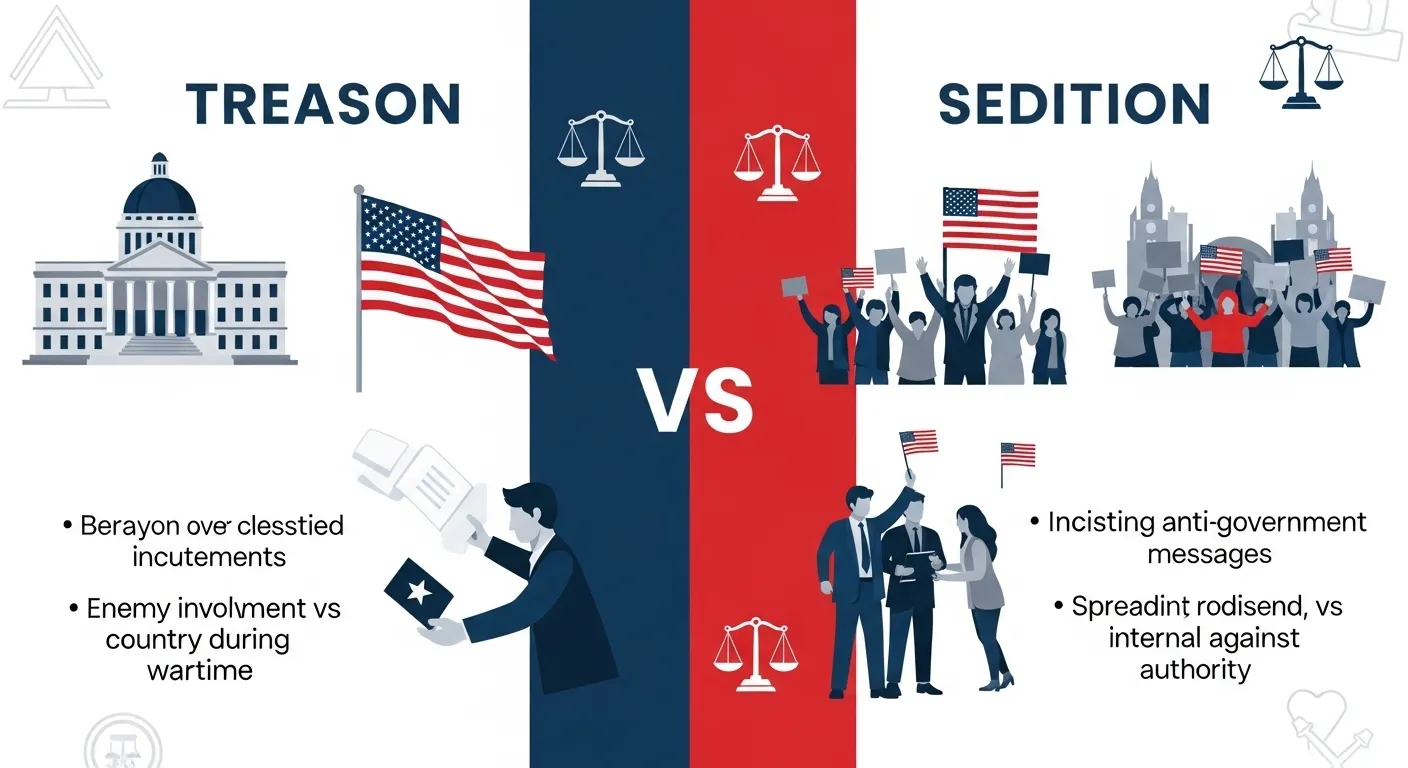
Treason is the act of betraying one’s country, often by aiding enemies, while sedition involves encouraging rebellion or resistance against the government without necessarily betraying it to an enemy.
Understanding the difference between treason and sedition is essential in legal, political, and historical contexts. Imagine a situation where someone openly speaks against the government and encourages people to protest or revolt. This could be considered sedition. Now imagine another person secretly sharing national secrets with an enemy during wartime, this is treason. These two acts may seem similar because both challenge authority, but they are very different in seriousness and legal definition.
The difference between treason and sedition lies in the nature of the act and the level of threat to the state. Treason is considered one of the most serious crimes because it directly harms the nation, while sedition involves speech or actions that incite unrest or rebellion. Knowing the difference between treason and sedition helps students, legal professionals, and citizens better understand their rights and responsibilities. By learning the difference between treason and sedition, individuals can recognize the boundaries between lawful criticism and unlawful actions against the state.
Pronunciation
Treason
US: /ˈtriːzən/
UK: /ˈtriːzən/
Sedition
US: /sɪˈdɪʃən/
UK: /sɪˈdɪʃən/
Before exploring deeper legal meanings, it is important to clearly understand the difference between treason and sedition in detail.
Key Difference Between the Both
The main difference between treason and sedition is that treason involves betraying the country, often by helping its enemies, while sedition involves encouraging rebellion or unrest against the government without necessarily aiding an external enemy.
Why Is Their Difference Necessary to Know for Learners and Experts?
Knowing the difference between treason and sedition is crucial for students of law, history, and political science. For learners, it helps distinguish between lawful dissent and criminal acts. For legal experts, understanding the difference between treason and sedition is essential when interpreting laws, handling cases, and protecting civil rights.
In society, this distinction plays a major role in balancing freedom of speech with national security. Citizens have the right to criticize their government, but actions that cross into sedition or treason can threaten stability. Therefore, understanding the difference between treason and sedition promotes responsible expression and awareness of legal boundaries.
Difference Between Treason and Sedition
1. Definition
Treason is the act of betraying one’s country, especially by helping its enemies or attempting to overthrow the government. Sedition refers to actions or speech that incite rebellion or resistance against authority.
Examples
Treason:
- Sharing military secrets with an enemy nation.
- Assisting foreign forces during war.
Sedition:
- Encouraging people to revolt against the government.
- Spreading messages that incite public unrest.
2. Nature of the Crime
Treason is a direct act against the state’s security. Sedition is an indirect challenge through speech or encouragement.
Examples
Treason:
- Providing intelligence to enemies.
- Joining forces with hostile countries.
Sedition:
- Organizing protests that turn into rebellion.
- Publishing writings against the government.
3. Involvement of Enemies
Treason often involves aiding foreign enemies. Sedition does not necessarily involve external forces.
Examples
Treason:
- Giving classified information to another country.
- Supporting enemy armies.
Sedition:
- Calling for overthrow of government internally.
- Encouraging disobedience among citizens.
4. Severity of Punishment
Treason usually carries the most severe punishment under law. Sedition also has penalties but is generally less severe.
Examples
Treason:
- Life imprisonment or death penalty in some countries.
- Harsh national security charges.
Sedition:
- Fines or imprisonment.
- Legal action for inciting unrest.
5. Type of Action
Treason involves concrete actions that harm the nation. Sedition often involves speech, writing, or symbolic acts.
Examples
Treason:
- Sabotaging national defense systems.
- Helping enemies invade.
Sedition:
- Delivering speeches against the government.
- Writing articles encouraging rebellion.
6. Intent
Treason intends to betray or destroy the country. Sedition intends to challenge or weaken government authority.
Examples
Treason:
- Planning to overthrow the government with enemy help.
- Aiding in wartime attacks.
Sedition:
- Motivating people to protest violently.
- Calling for resistance against laws.
7. Legal Definition
Treason is strictly defined in many constitutions and laws. Sedition is often defined more broadly.
Examples
Treason:
- Defined clearly in national constitutions.
- Requires strong evidence.
Sedition:
- Defined in criminal law statutes.
- Includes a wide range of activities.
8. Evidence Required
Treason usually requires strong and clear proof, often multiple witnesses. Sedition may be proven through speech or writings.
Examples
Treason:
- Documented communication with enemies.
- Witness testimony of betrayal.
Sedition:
- Recorded speeches inciting rebellion.
- Published materials encouraging unrest.
9. Historical Context
Treason is often associated with wartime betrayal. Sedition is commonly linked to political movements or protests.
Examples
Treason:
- Betraying a nation during war.
- Assisting invading armies.
Sedition:
- Revolutionary speeches in history.
- Political uprisings.
10. Impact on Society
Treason directly threatens national survival. Sedition disrupts public order and political stability.
Examples
Treason:
- Weakening national defense.
- Endangering citizens.
Sedition:
- Causing riots or unrest.
- Creating political instability.
Nature and Behaviour of Both
Treason is seen as the ultimate betrayal of loyalty to one’s country. It involves deliberate actions that harm national security.
Sedition is more related to expression and influence. It involves encouraging others to challenge authority, which may or may not lead to violence.
Why People Are Confused About Their Use?
People often confuse treason and sedition because both involve opposition to the government. However, the key difference is that treason includes betrayal and often involves enemies, while sedition focuses on inciting rebellion without necessarily aiding an enemy.
Table Showing Difference and Similarity
| Feature | Treason | Sedition | Similarity |
| Meaning | Betrayal of country | Inciting rebellion | Both oppose authority |
| Involvement | Often foreign enemies | Internal actions | Both threaten stability |
| Severity | Very severe | Less severe | Both punishable by law |
| Action | Direct harm | Speech or influence | Both can disrupt society |
| Intent | Betray country | Challenge government | Both involve opposition |
Which Is Better in What Situation?
Treason
Treason is never justified in lawful societies because it directly harms national security and sovereignty. It is considered one of the gravest crimes due to its potential to endanger the entire nation.
Sedition
Sedition is also illegal in many contexts, but it is often debated because it can overlap with freedom of speech. Peaceful criticism of government is allowed in many countries, but when it crosses into inciting violence or rebellion, it becomes unlawful.
How the Keywords Are Used in Metaphors and Similes
Examples:
- “His betrayal felt like treason to his closest friends.”
- “Her rebellious words sounded like sedition against tradition.”
Connotative Meaning
Treason
Connotation: Strongly negative, associated with betrayal and disloyalty.
Example:
“He was accused of treason for helping the enemy.”
Sedition
Connotation: Negative or sometimes neutral depending on context.
Example:
“The speech was seen as sedition by the authorities.”
Idioms or Proverbs Related to the Words
Bite the hand that feeds you
Example:
“Helping the enemy was like biting the hand that feeds you.”
Stir the pot
Example:
“He was accused of stirring the pot with his controversial speech.”
Works in Literature
- Julius Caesar – Tragedy, William Shakespeare, 1599 (themes of treason)
- 1984 – Dystopian novel, George Orwell, 1949 (themes of sedition and rebellion)
- A Tale of Two Cities – Novel, Charles Dickens, 1859 (political unrest and sedition)
Movie Names Made on the Keywords
- The Traitor – 2019, Italy (theme of treason)
- V for Vendetta – 2005, USA/UK (themes of sedition and rebellion)
- The Patriot – 2000, USA (themes of loyalty and betrayal)
Five Frequently Asked Questions
1. What is the main difference between treason and sedition?
Treason involves betraying the country, while sedition involves encouraging rebellion against the government.
2. Is sedition as serious as treason?
No, treason is generally considered more serious.
3. Can speech alone be considered treason?
Usually no; treason requires actions like aiding enemies.
4. Is criticizing the government sedition?
No, peaceful criticism is generally allowed; sedition involves inciting rebellion.
5. Can someone be charged with both crimes?
Yes, in some cases actions may involve both betrayal and incitement.
How Both Are Useful for Surroundings
Understanding these concepts helps maintain law, order, and national security. It ensures that people exercise their rights responsibly while respecting the stability of society.
Final Words for the Both
Treason and sedition are serious legal concepts that define limits of acceptable behaviour toward the state. Both highlight the importance of loyalty, responsibility, and lawful expression.
Conclusion
The difference between treason and sedition lies in their intent, severity, and nature. Treason involves direct betrayal of one’s country, often by aiding enemies, and is considered one of the most serious crimes. Sedition, on the other hand, involves inciting rebellion or unrest against the government, usually through speech or influence. Understanding the difference between treason and sedition helps individuals respect legal boundaries while exercising their rights. By recognising the difference between treason and sedition, people can balance freedom of expression with responsibility toward their nation and society.

I am a professional SEO content writer specialising in comparison-based and grammar-focused articles. Through my website GrammarCompare.com, I help readers clearly understand the difference between confusing terms with well-researched, easy-to-read content. My expertise lies in focusing on clarity, accuracy, and practical explanations that improve both knowledge and writing skills.