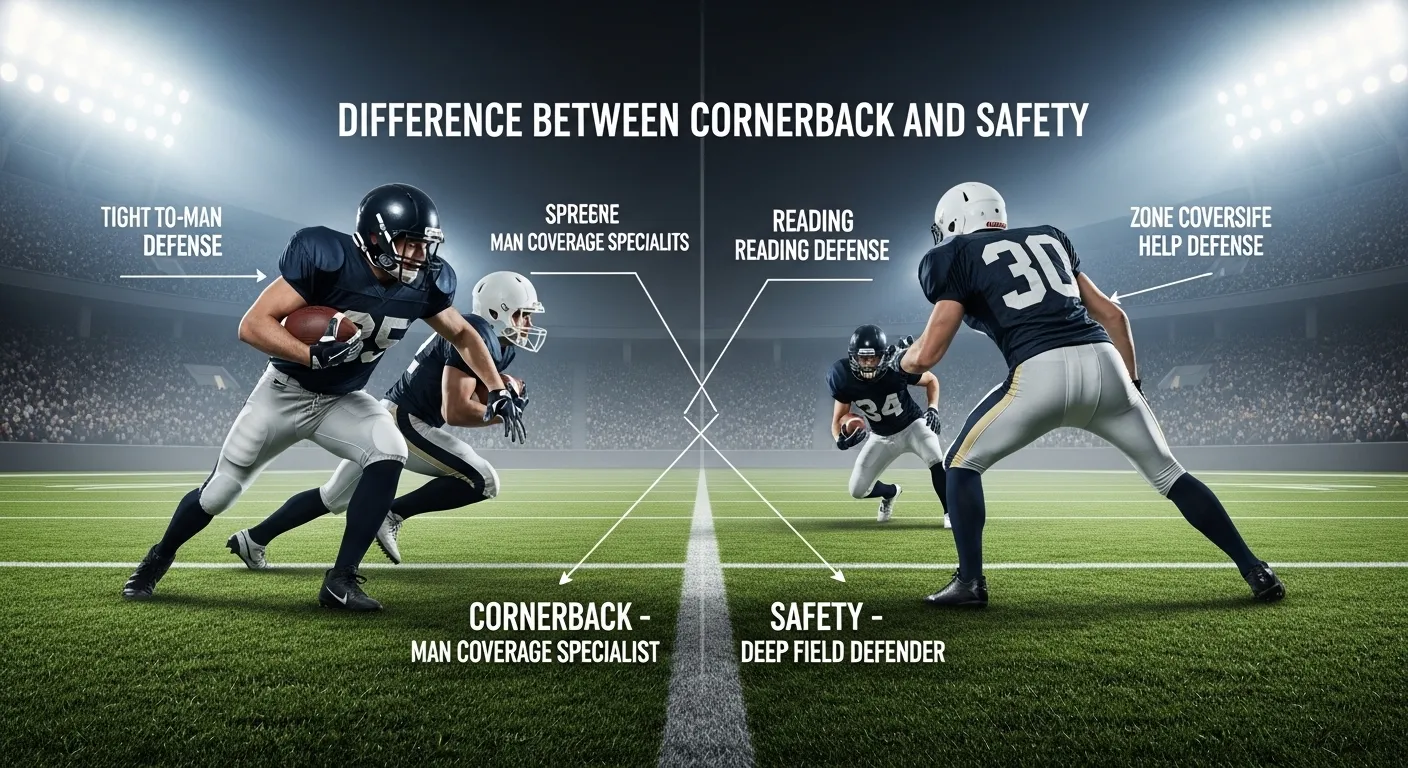
During a thrilling game in the National Football League, Ahmed noticed two defenders making crucial plays. One stayed close to wide receivers, blocking passes, while the other moved across the field, stopping big plays. Curious, he asked his friend about the difference between cornerback and safety. His friend explained that both positions are part of the defensive backfield but serve different roles.
The difference between cornerback and safety is essential for understanding football strategy. While both defend against passing plays, their positioning and responsibilities vary greatly. Many fans often confuse these roles, making the difference between cornerback and safety an important concept to learn. Knowing the difference between cornerback and safety not only enhances game knowledge but also deepens appreciation for defensive tactics.
Key Difference Between the Both
The key difference is that a cornerback primarily covers wide receivers, while a safety provides deeper field coverage and supports both pass and run defense.
Why Is Their Difference Necessary to Know?
Understanding this difference is important for learners who want to grasp football basics and for experts analyzing game strategies. In society, sports education builds teamwork, discipline, and analytical thinking. Knowing player roles enhances fan engagement and sports literacy.
Pronunciation
- Cornerback:
- US: /ˈkɔːrnərˌbæk/
- UK: /ˈkɔːnəˌbæk/
- Safety:
- US: /ˈseɪfti/
- UK: /ˈseɪfti/
Let’s now explore their differences in detail.
Difference Between Cornerback and Safety
1. Primary Role
Cornerback: Covers wide receivers.
Example 1: Blocking a pass to a receiver.
Example 2: Staying close during routes.
Safety: Provides deep coverage.
Example 1: Preventing long passes.
Example 2: Acting as last defender.
2. Field Position
Cornerback: Lines up near sidelines.
Example 1: Guarding outside receivers.
Example 2: Covering short routes.
Safety: Positioned deeper in the field.
Example 1: Standing behind linebackers.
Example 2: Covering central zones.
3. Defensive Style
Cornerback: Man-to-man coverage.
Example 1: Following one player.
Example 2: Blocking specific routes.
Safety: Zone coverage.
Example 1: Guarding an area.
Example 2: Reading quarterback moves.
4. Physical Requirements
Cornerback: Speed and agility.
Example 1: Sprinting with receivers.
Example 2: Quick direction changes.
Safety: Strength and awareness.
Example 1: Tackling runners.
Example 2: Reading plays.
5. Tackling Role
Cornerback: Less tackling focus.
Example 1: Occasional tackles.
Example 2: Avoiding missed coverage.
Safety: Strong tackling role.
Example 1: Stopping running backs.
Example 2: Preventing touchdowns.
6. Risk Level
Cornerback: High-risk position.
Example 1: Mistake leads to big play.
Example 2: One-on-one pressure.
Safety: Lower risk but critical backup.
Example 1: Covers mistakes.
Example 2: Supports defense.
7. Types of Players
Cornerback: Specialists in coverage.
Example 1: Lockdown defenders.
Example 2: Pass blockers.
Safety: Versatile players.
Example 1: Run and pass defense.
Example 2: Field leadership.
8. Visibility in Game
Cornerback: Active in every pass play.
Example 1: Guarding receivers.
Example 2: Breaking passes.
Safety: Visible in big plays.
Example 1: Interceptions.
Example 2: Game-saving tackles.
9. Skill Focus
Cornerback: Reaction speed.
Example 1: Quick jumps.
Example 2: Route anticipation.
Safety: Game awareness.
Example 1: Reading formations.
Example 2: Predicting plays.
10. Leadership Role
Cornerback: Limited leadership.
Example 1: Focus on individual matchups.
Example 2: Less communication.
Safety: Defensive leader.
Example 1: Calling plays.
Example 2: Organizing defense.
Nature and Behaviour
Cornerbacks are aggressive, fast, and highly focused on individual opponents. They rely on quick reflexes and confidence.
Safeties are strategic, observant, and versatile. They act as protectors of the entire defense and often guide teammates.
Why People Are Confused
People confuse cornerbacks and safeties because both are defensive backs and defend against passes. Their roles overlap in coverage, making it hard for beginners to distinguish between them.
Table: Difference and Similarity
| Aspect | Cornerback | Safety | Similarity |
| Role | Covers receivers | Deep defense | Both defend passes |
| Position | Sidelines | Deep field | Part of defense |
| Skills | Speed | Awareness | Require agility |
| Tackling | Less | More | Defensive role |
| Coverage | Man-to-man | Zone | Stop offense |
Which Is Better in What Situation?
Cornerback is better in situations where the offense relies heavily on wide receivers. Their speed and ability to cover players closely make them essential in stopping quick passes and short routes.
Safety is better in situations where long passes or strong running plays are expected. Their ability to read the game and provide backup defense makes them crucial for preventing big plays.
Metaphors and Similes
- Cornerback is like “a shadow following its target.”
- Safety is like “a guardian watching over the field.”
Connotative Meanings
- Cornerback: Positive (speed, precision)
- Example: “He played like a true cornerback, never leaving his mark.”
- Safety: Positive (protection, intelligence)
- Example: “She acted as the safety of the team, preventing every risk.”
Idioms and Proverbs
- “Watch your back”
- Example: The safety always watches your back on defense.
- “Stay on someone’s tail”
- Example: The cornerback stayed on the receiver’s tail all game.
Works in Literature
- Friday Night Lights Sports non-fiction, H.G. Bissinger, 1990
- Paper Lion Sports memoir, George Plimpton, 1966
Movies Related to Football
- Remember the Titans (2000, USA)
- The Blind Side (2009, USA)
FAQs
1. Is a cornerback faster than a safety?
Usually yes, as they cover receivers closely.
2. Who tackles more?
Safeties generally tackle more.
3. Can a player switch roles?
Yes, some players can play both positions.
4. Which position is harder?
Both are challenging in different ways.
5. Do both defend passes?
Yes, but in different areas of the field.
How Both Are Useful for Surroundings
Both roles contribute to team defense, teamwork, and strategy. They promote discipline and coordination, which are valuable skills beyond sports.
Final Words for Both
Cornerbacks bring speed and precision, while safeties bring intelligence and protection. Both are essential for a strong defense.
Conclusion
Understanding the difference between cornerback and safety helps fans and players appreciate the complexity of football defense. Cornerbacks specialize in covering receivers with speed and agility, while safeties provide deeper coverage and strategic support. Both roles are vital and complement each other on the field. By learning their differences, one can better understand game strategies and enjoy football at a deeper level.
To build on that conclusion, the separation between a cornerback (CB) and a safety (S) represents the tactical line between man-to-man warfare on the perimeter and spatial traffic control in the deep secondary.
Both positions are categorized under the umbrella of “defensive backs” (DBs). However, their real-world alignment on the field, the physical attributes required to play them, and their proximity to the heavy hitting of the running game set them worlds apart.
1. The Alignment and Spatial Divide
Where these defenders physically stand before the ball is snapped dictates their defensive perspective.
                                  [ FREE SAFETY ] (Deepest)
                                        │
[ CORNERBACK ] (Sideline)               │               [ CORNERBACK ] (Sideline)
      │                                 ▼                     │
      ▼                        [ STRONG SAFETY ]              ▼
───────────────────────────────────────────────────────────────────────────
      WR                               TE                     WR
                              (Line of Scrimmage)
Cornerbacks: Bound to the Boundary
- The Placement: Cornerbacks line up on the extreme left and right outside boundaries of the field, directly face-to-face with the offense’s widest, most explosive wide receivers (WRs).
- The Point of Attack: They usually stand anywhere from directly on the line of scrimmage (in aggressive “press” coverage) to 5–7 yards off the receiver.
- The View: Their focus is highly narrow. They are locked onto a single athlete’s hips and feet, responsible for preventing that specific individual from making a downfield catch.
Safeties: The Aerial Overlords
- The Placement: Safeties are the literal “safety net” of the defense. They line up centrally in the backfield, standing 10 to 15 yards deep behind the linebackers.
- The View: They operate as the “defensive quarterbacks”. Facing the entire offensive matrix, they must read the quarterback’s eyes, diagnose the overall play design (run vs. pass) as it unfolds, and shout alignment adjustments to their teammates before the snap.
2. The Biomechanical Profiles: Speed vs. Stature
Because their positional tasks are so fundamentally different, coaches recruit entirely different body types and athletic profiles for each role.
3. The Structural Branching of the Safety Position
While cornerbacks are generally divided simply by which side of the field they cover, the two safety spots are highly specialized, asymmetrical roles:
- The Free Safety (FS): This is the pure, ultimate pass-defender. The free safety is “free” to read the quarterback and float across the deep center of the field. Their primary job is to provide over-the-top deep zone help. If a cornerback gets beaten off the line of scrimmage by a blazing wide receiver, the free safety is responsible for swooping in to break up the deep touchdown pass.
- The Strong Safety (SS): This player aligns on the “strong side” of the offensive formation—whichever side features the tight end. The strong safety operates as a hybrid between a defensive back and a linebacker. They play much closer to the line of scrimmage and are heavily relied upon to crash downward into the gaps to plug up running lanes and tackle rushing running backs.

I am a professional SEO content writer specialising in comparison-based and grammar-focused articles. Through my website GrammarCompare.com, I help readers clearly understand the difference between confusing terms with well-researched, easy-to-read content. My expertise lies in focusing on clarity, accuracy, and practical explanations that improve both knowledge and writing skills.