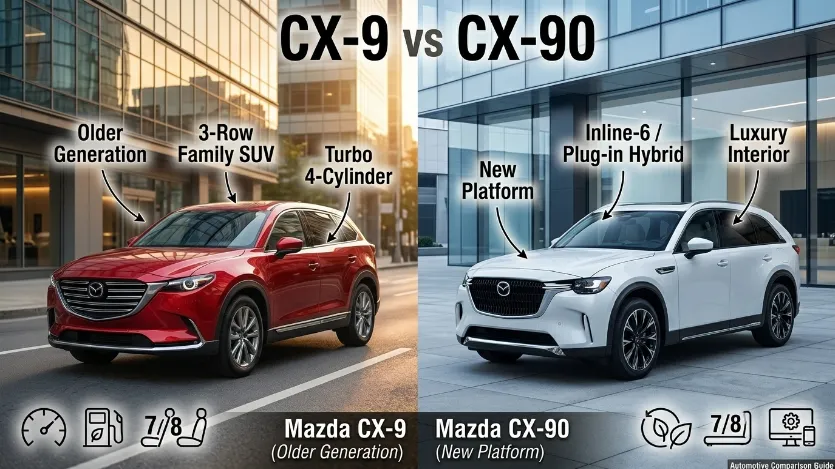
A few years ago, a family I knew upgraded their SUV for better comfort and safety. They were torn between the familiar Mazda CX-9 and the newer Mazda CX-90. At first glance, both seemed similar sleek design, premium feel, and Mazda reliability. But as they dug deeper, the difference between CX9 and CX90 became more obvious. The difference between CX9 and CX90 is not just about size it reflects innovation, performance, and modern needs. Understanding the difference between CX9 and CX90 helps buyers choose wisely, while experts analyze how the automotive industry evolves. Clearly, the difference between CX9 and CX90 is more than a simple upgrade it’s a shift in design philosophy.
1. From Practical Family Moving to Premium Performance
The most significant difference between the two lies right under the surface.
- The CX-9 Approach: Built on a front-wheel-drive platform, the CX-9 was engineered to be a safe, incredibly dependable, and predictable family crossover. It handled well for its size, but its core focus was conservative utility.
- The CX-90 Approach: Built from the ground up on a brand-new, rear-wheel-drive-biased platform. This is the exact architectural layout used by high-end German luxury brands. It pushes the front wheels forward and gives the vehicle a sports-sedan-like handling balance that completely transforms the driving experience.
2. A Revolution Under the Hood
The family would have noticed a massive change in how these two vehicles move.
- The CX-9 relied on a hard-working, turbocharged 4-cylinder engine. It was efficient and simple, but it lacked the effortless power needed when the SUV was fully loaded with passengers and cargo.
- The CX-90 introduced an entirely new era of engineering for Mazda. It features a silky-smooth, powerful Inline-6 engine with mild-hybrid technology, offering effortless acceleration. Additionally, it introduced Mazda’s first-ever Plug-In Hybrid (PHEV) powertrain, allowing families to do their daily school runs and grocery trips entirely on electric power.
3. Space and Modern Luxury
While both SUVs share Mazda’s signature “Kodo” design language giving them that sleek, premium look the way they use space inside is vastly different.
- The CX-9 was often criticized for having a cramped third row and limited cargo space behind the rear seats. It felt upscale, but it was ultimately designed around traditional, simpler layouts.
- The CX-90 used its longer architecture to maximize space, offering comfortable room for up to 8 passengers. Inside, the design language moved from “mainstream comfort” to “modern luxury,” incorporating Japanese design elements like hanging stitches, maple wood, and woven textiles that compete directly with dedicated luxury brands.
Key Difference Between the Both
The main difference lies in platform, engine technology, and size. CX-9 is older with a transverse engine, while CX-90 is newer with a longitudinal engine and advanced hybrid options.
Why Is Their Difference Important?
Understanding the difference helps learners and experts evaluate technological progress, environmental impact, and consumer needs. It also reflects how society is moving toward efficiency, sustainability, and luxury in daily transportation.
Pronunciation
- CX-9
- US: /ˌsiː ɛks ˈnaɪn/
- UK: /ˌsiː ɛks ˈnaɪn/
- CX-90
- US: /ˌsiː ɛks ˈnaɪnti/
- UK: /ˌsiː ɛks ˈnaɪnti/
Now that the basics are clear, let’s explore the detailed comparison.
Difference Between the Keywords
1. Platform
CX-9 uses an older platform, while CX-90 uses a new rear-wheel-drive-based platform.
- Example 1: CX-9 feels stable but traditional.
- Example 2: CX-90 offers better balance and handling.
2. Engine Type
CX-9 has a turbocharged 4-cylinder engine. CX-90 offers inline-6 and hybrid options.
- Example 1: CX-9 suits daily commuting.
- Example 2: CX-90 suits power lovers.
3. Size
CX-90 is larger than CX-9.
- Example 1: CX-9 fits small families.
- Example 2: CX-90 suits bigger families.
4. Fuel Efficiency
CX-90 offers hybrid efficiency. CX-9 does not.
- Example 1: CX-9 consumes more fuel.
- Example 2: CX-90 saves fuel in cities.
5. Interior Design
CX-90 has a more premium interior.
- Example 1: CX-9 has a simple luxury feel.
- Example 2: CX-90 feels modern and high-end.
6. Technology
CX-90 includes newer tech features.
- Example 1: CX-9 has basic infotainment.
- Example 2: CX-90 includes advanced driver assistance.
7. Performance
CX-90 delivers stronger performance.
- Example 1: CX-9 is smooth but moderate.
- Example 2: CX-90 is powerful and responsive.
8. Towing Capacity
CX-90 can tow more weight.
- Example 1: CX-9 is good for light towing.
- Example 2: CX-90 handles heavy trailers.
9. Price
CX-90 is generally more expensive.
- Example 1: CX-9 is budget-friendly.
- Example 2: CX-90 targets premium buyers.
10. Future Relevance
CX-90 represents future trends.
- Example 1: CX-9 is being phased out.
- Example 2: CX-90 aligns with modern standards.
Nature and Behaviour
CX-9 is reliable, practical, and conservative. It focuses on comfort and simplicity.
CX-90 is bold, innovative, and performance-driven. It reflects modern engineering and luxury.
The Core Philosophies
- The CX-9 (The Practical Standard): It doesn’t try to reinvent the wheel. Instead, it focuses on being a highly refined, time-tested family vehicle. It prioritizes predictable maintenance, intuitive physical controls, and a cozy, unpretentious cabin environment.
- The CX-90 (The Premium Leap): It is a statement piece. It represents Mazda’s ambition to compete directly with high-end European luxury brands. It trades conservative choices for a bold rear-wheel-drive architecture, cutting-edge hybrid powertrains, and an upscale, minimalist design language.
Why People Are Confused
People confuse them because of similar naming, design language, and brand identity. Both look alike externally, making differences less obvious at first glance.
Comparison Table
| Feature | CX-9 | CX-90 | Similarity |
| Platform | Old | New | Mazda build quality |
| Engine | 4-cylinder | Inline-6/Hybrid | Smooth drive |
| Size | Smaller | Larger | 3-row SUV |
| Tech | Basic | Advanced | Safety features |
| Price | Lower | Higher | Premium feel |
Which Is Better in What Situation?
CX-9:
If you want a reliable, affordable SUV for daily use, CX-9 is better. It is ideal for small families and city driving. It offers comfort without complexity.
CX-90:
If you want modern technology, power, and luxury, CX-90 is the better choice. It suits long drives, large families, and premium experiences.
Metaphors and Similes
- CX-9 is like a “trusted old friend.”
- CX-90 is like a “next-generation leader.”
- CX-9 runs like a calm river.
- CX-90 moves like a powerful wave.
Connotative Meaning
- CX-9: Neutral to positive (reliable, steady)
- Example: “He chose CX-9 for peace of mind.”
- CX-90: Positive (advanced, luxurious)
- Example: “CX-90 represents modern success.”
Idioms and Proverbs
- “Old is gold” → CX-9 reliability
- Example: CX-9 proves that old is gold.
- “Ahead of the curve” → CX-90 innovation
- Example: CX-90 is ahead of the curve.
Works in Literature
(No direct literary works exist, but similar themes appear in:)
- The Machine Stops – Sci-fi, E.M. Forster, 1909
- Brave New World – Dystopian, Aldous Huxley, 1932
Movies Related to Themes
- Ford v Ferrari (2019, USA)
- Rush (2013, UK/USA)
FAQs
1. Is CX-90 replacing CX-9?
Yes, CX-90 is the newer replacement.
2. Which is more fuel efficient?
CX-90, especially hybrid models.
3. Is CX-9 still worth buying?
Yes, if you want affordability and reliability.
4. Which is more powerful?
CX-90 offers more power.
5. Which is better for families?
CX-90 for large families, CX-9 for smaller ones.
Usefulness in Surroundings
Both vehicles improve mobility, comfort, and safety. CX-9 supports everyday needs, while CX-90 supports modern, eco-friendly transportation.
Final Words
CX-9 stands for reliability and simplicity. CX-90 represents innovation and future mobility.
Conclusion
The difference between CX9 and CX90 highlights how the automotive world evolves with time. While CX-9 remains a dependable choice, CX-90 introduces advanced engineering, better performance, and modern luxury. Choosing between them depends on your priorities budget versus innovation, simplicity versus technology. Understanding these differences helps buyers make informed decisions and appreciate how far automotive design has progressed. Both models serve unique purposes, making them valuable in their own ways.
1. The Architectural Flip (Platform & Drivetrain)
The most profound shift between these two models is invisible from the outside, hidden beneath the sheet metal.
- Mazda CX-9: Built on a traditional Front-Wheel Drive (FWD) biased transverse platform (though equipped with standard AWD). The engine sits sideways, a layout optimized for packaging efficiency but inherently limited in sporty driving dynamics.
- Mazda CX-90: Built on an all-new Rear-Wheel Drive (RWD) biased longitudinal architecture. By mounting the engine lengthwise, Mazda achieved near-perfect weight distribution, significantly reducing body roll and mimicking the handling characteristics of high-end European luxury SUVs.
2. A Massive Leap in Powertrain Technology
Under the hood, Mazda completely changed its philosophy, swapping a modest four-cylinder for performance-oriented options.
- Mazda CX-9: Relied solely on a 2.5-liter Turbocharged 4-cylinder engine generating up to 250 horsepower and 320 lb-ft of torque on premium fuel. It is punchy in the city but works hard when fully loaded.
- Mazda CX-90: Replaces the inline-4 with a standard 3.3-liter Turbocharged Inline-6 engine featuring a mild-hybrid setup, delivering either 280 or a staggering 340 horsepower depending on the trim. Crucially, the CX-90 also introduced a Plug-In Hybrid (PHEV) option that provides 26 miles of pure electric driving for daily commutes.
3. Footprint, Cabin Space, and Capacity
The change in platform allowed Mazda to scale up the exterior dimensions, fixing one of the oldest complaints about the CX-9’s tight third row.
- Mazda CX-9: Maximized its seating at 6 or 7 passengers. The total cargo room with all seats folded topped out at 71.2 cubic feet.
- Mazda CX-90: Is longer, wider, and boasts a much longer wheelbase. This allows flexible configurations that can hold up to 8 passengers. Cargo volume expands to 74.2 cubic feet, offering a significantly lower load floor for easier lifting.
4. Technology and Premium Amenities
The CX-90 elevates standard tech to match its premium driving dynamics.
- Mazda CX-9: Equipped with a standard 10.25-inch center display that required wired connections for Apple CarPlay and Android Auto.
- Mazda CX-90: Upgrades the cockpit with an available 12.3-inch display, completely wireless smartphone integration, and improved driver-assist safety systems that reduce false alarms in stop-and-go traffic.

I am a professional SEO content writer specialising in comparison-based and grammar-focused articles. Through my website GrammarCompare.com, I help readers clearly understand the difference between confusing terms with well-researched, easy-to-read content. My expertise lies in focusing on clarity, accuracy, and practical explanations that improve both knowledge and writing skills.