Imagine you are planning a road trip with your friends. You check the map, and one app shows the distance in miles while another shows it in kilometers. Suddenly, confusion arises—how far is the journey actually? This is where understanding the difference between miles and kilometers becomes essential.
Miles and kilometers are both units used to measure distance, but they belong to different measurement systems. The difference between miles and kilometers often creates confusion, especially for travelers, students, and professionals. In everyday life, knowing the difference between miles and kilometers helps in navigation, fitness tracking, and even academic work. Clearly understanding the difference between miles and kilometers makes communication easier across countries that use different systems.
Key Difference Between the Both
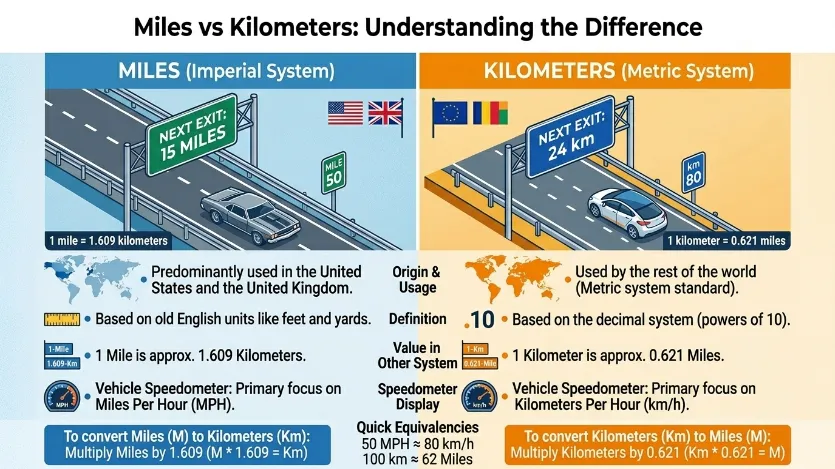
The main difference lies in their measurement systems: miles belong to the imperial system, while kilometers belong to the metric system.
Why Is Their Difference Necessary to Know?
Understanding these units is important for students, travelers, engineers, and scientists. It helps in global communication, accurate calculations, and prevents costly mistakes in fields like transportation and aviation.
Pronunciation
- Miles
- US: /maɪlz/
- UK: /maɪlz/
- Kilometers
- US: /kɪˈlɑː.mə.t̬ɚz/
- UK: /kɪˈlɒm.ɪ.təz/
Now that we understand the basics, let’s explore the detailed difference between miles and kilometers.
Difference Between Miles and Kilometers
1. Measurement System
Miles are part of the imperial system, while kilometers belong to the metric system.
- Example 1: The USA uses miles for road distances.
- Example 2: Most European countries use kilometers.
2. Length Value
One mile equals approximately 1.609 kilometers.
- Example 1: 5 miles ≈ 8.05 kilometers.
- Example 2: 10 kilometers ≈ 6.21 miles.
3. Usage by Countries
Miles are used mainly in a few countries, while kilometers are used worldwide.
- Example 1: UK uses miles on roads.
- Example 2: Pakistan uses kilometers.
4. Scientific Preference
Kilometers are preferred in science and research.
- Example 1: Physics formulas use kilometers.
- Example 2: Space distances are measured in metric units.
5. Ease of Conversion
Kilometers are easier to convert due to the decimal system.
- Example 1: 1 km = 1000 meters.
- Example 2: 2.5 km = 2500 meters.
6. Daily Use
Miles are common in informal speech in certain regions.
- Example 1: “It’s 3 miles away.”
- Example 2: “Walk a mile in my shoes.”
7. Road Signs
Road signs differ depending on the unit system.
- Example 1: US signs show miles.
- Example 2: European signs show kilometers.
8. Speed Measurement
Speed limits vary by unit.
- Example 1: 60 miles per hour (mph).
- Example 2: 100 kilometers per hour (km/h).
9. Educational Systems
Schools teach different units depending on region.
- Example 1: US schools teach miles.
- Example 2: International schools teach kilometers.
10. Global Standardization
Kilometers are part of the global standard (SI units).
- Example 1: International sports use kilometers.
- Example 2: Scientific data uses metric units.
Nature and Behaviour
Miles are traditional and culturally rooted, often linked with older systems. They are less flexible in calculations.
Kilometers are modern, standardized, and widely accepted globally. They are easier to use in calculations and scientific contexts.
Why People Are Confused
People get confused because both units measure the same thing but use different values. Media, travel apps, and education systems mix these units, leading to misunderstanding.
Table: Difference and Similarity
| Feature | Miles | Kilometers | Similarity |
| System | Imperial | Metric | Both measure distance |
| Value | Longer unit | Shorter unit | Used globally |
| Usage | Limited countries | Worldwide | Used in travel |
| Conversion | Complex | Easy | Convertible |
| Scientific Use | Rare | Common | Accurate measurement |
Which Is Better in What Situation?
Miles are better in regions where they are traditionally used, such as the US and UK. They are useful for local communication and understanding road signs. People living in these areas feel more comfortable using miles because they are familiar with them.
Kilometers are better for global use, education, and science. They provide consistency and are easier to convert. For international travel, research, and academic work, kilometers are more practical and widely accepted.
Metaphors and Similes
- “His journey felt like a thousand miles” (long struggle).
- “Progress was measured in kilometers, steady and precise.”
- “Life is not a sprint but a long mile.”
- “Her growth moved like kilometers on a map clear and measurable.”
Connotative Meanings
- Miles:
- Positive: Long experience (“miles ahead”)
- Negative: Distance or difficulty (“miles away from success”)
- Neutral: Measurement
- Kilometers:
- Positive: Precision and modernity
- Neutral: Scientific measurement
- Rarely negative
Idioms and Proverbs
- “Go the extra mile”
- Example: She went the extra mile to help her friend.
- “Miles apart”
- Example: Their opinions are miles apart.
- “A journey of a thousand miles begins with a single step”
- Example: Learning starts small but grows big.
Works in Literature
- The Thousand Mile Walk to the Gulf (Travel, John Muir, 1916)
- A Walk Across America (Memoir, Peter Jenkins, 1979)
Movies Related to Distance Themes
- The Green Mile (1999, USA)
- 8 Mile (2002, USA)
FAQs
1. What is the main difference between miles and kilometers?
Miles belong to the imperial system, while kilometers belong to the metric system.
2. Which unit is longer?
A mile is longer than a kilometer.
3. Why do countries use different units?
Because of historical and cultural differences.
4. Which is easier to use?
Kilometers are easier due to the decimal system.
5. Can I convert miles to kilometers easily?
Yes, multiply miles by 1.609.
How Both Are Useful for Surroundings
Miles help in understanding distances in countries where they are commonly used. Kilometers help in global communication, education, and scientific work. Together, they make travel and measurement more flexible.
Final Words
Miles represent tradition and cultural identity, while kilometers represent global standardization and precision. Both are important in their own contexts.
Conclusion
The difference between miles and kilometers may seem simple, but it plays a significant role in daily life, education, and global communication. While miles reflect traditional systems still used in some countries, kilometers offer a universal and scientific approach to measurement. Understanding both helps individuals navigate the world more effectively, whether traveling, studying, or working professionally. By learning the difference between miles and kilometers, we bridge gaps between systems and ensure clearer communication across borders. Ultimately, both units serve the same purpose helping us measure and understand distance in a meaningful way. The difference between the mile and the kilometer is far more than a simple preference for different numbers on a dashboard it represents a historical, political, and philosophical division between two fundamentally different ways of measuring the physical world: the Imperial (or U.S. Customary) system and the Metric system.
To truly understand how these two units function globally, it helps to examine the engineering, mathematical efficiency, and geopolitical realities that define them.
1. Mathematical DNA: Fixed History vs. Universal Physics
The core difference between the two units lies in how they were invented and how they scale mathematically.
The Mile: Rooted in Human Anatomy and History
The standard international mile used today (the land or “statute” mile) is equal to exactly 5,280 feet or 1,760 yards.
- The Origin: The word “mile” comes from the Latin mille passus, meaning “a thousand paces”originally measured by the Roman legions marching across Europe (where a pace was two steps).
- The Scaling Problem: Because the Imperial system grew organically out of historical trade, human body parts (feet, thumbs/inches), and agricultural land plots, scaling up or down requires memorizing arbitrary numbers. If you want to know how many inches are in a mile, you have to multiply $12 \times 3 \times 1,760$, which equals 63,360 inches. It is an archaic system built on accumulation rather than clean logic.
The Kilometer: Rooted in the Earth and Base-10 Logic
The kilometer is equal to exactly 1,000 meters and is part of the International System of Units (SI).
- The Origin: Invented during the French Revolution, the meter was scientifically calculated as one ten-millionth of the distance from the Earth’s equator to the North Pole.
- The Base-10 Advantage: The metric system is entirely decimal-based. Scaling up or down requires nothing more than shifting a decimal point. There are 100 centimeters in a meter, and 1,000 meters in a kilometer. Therefore, a kilometer contains exactly 100,000 centimeters. This makes the kilometer infinitely superior for scientific calculations, engineering, and rapid mental math.
2. Geopolitical Reality: The Global Divide
The global map of who uses miles versus kilometers is heavily lopsided, reflecting historical colonial ties and political resistance to standardization.
[ Kilometers (Metric System) ] ──> Used by 95% of the world (Europe, Asia, Americas, Africa)
[ Miles (Imperial System) ]    ──> Used by the United States, United Kingdom, Liberia, Myanmar
- The Global Standard (Kilometers): Roughly 95% of the world’s population uses kilometers for daily life, road signs, navigation, and commerce. It is the official legal standard for international trade, aviation weather, and athletic events (e.g., a 5K or 10K race).
- The American Holdout (Miles): The United States is the only major industrialized nation that completely retains the mile for daily transport. While the U.S. signed the Metric Conversion Act in 1975, implementation was made voluntary, and public pushback, combined with the massive financial cost of replacing millions of road signs, stalled the transition indefinitely.
- The British Hybrid (Miles): The United Kingdom exists in a unique middle ground. While they officially adopted the metric system for science and most commerce decades ago, their road networks, speed limits, and distance signs remain stubbornly calculated in miles.
3. Real-World Conversion Mechanics
When traveling or working internationally, navigating between these two units requires a quick mental conversion framework.
$$1 \text{ mile} \approx 1.609 \text{ kilometers}$$
$$1 \text{ kilometer} \approx 0.621 \text{ miles}$$
Because the exact conversion multiplier ($1.60934$) is clunky for rapid everyday use, professionals and travelers rely on three practical shorthand methods:
- The “Rough Fraction” Method: To change miles to kilometers, multiply by 8 and divide by 5 (e.g., $50 \text{ miles} \times \frac{8}{5} = 80 \text{ km}$). To go backward, do the inverse.
- The “Add a Half” Hack: For quick driving adjustments while traveling, you can get a rough estimate of kilometers by taking the mile count, cutting it in half, and adding it to the original number (e.g., $60 \text{ miles} \rightarrow \text{half is } 30 \rightarrow 60 + 30 = 90 \text{ km}$. The exact math is $96.5 \text{ km}$, but it keeps you safely in the ballpark).
- The Fibonacci Sequence Secret: Incredibly, because the golden ratio ($\approx 1.618$) is strikingly close to the mile-to-kilometer conversion factor ($1.609$), consecutive numbers in the Fibonacci sequence ($1, 2, 3, 5, 8, 13, 21…$) serve as an instant conversion tool. Look at any two consecutive numbers: $5 \text{ miles}$ is roughly $8 \text{ kilometers}$. $8 \text{ miles}$ is roughly $13 \text{ kilometers}$.

I am a professional SEO content writer specialising in comparison-based and grammar-focused articles. Through my website GrammarCompare.com, I help readers clearly understand the difference between confusing terms with well-researched, easy-to-read content. My expertise lies in focusing on clarity, accuracy, and practical explanations that improve both knowledge and writing skills.