In a university lab, a student once mixed two sugar samples labeled “Aldose” and “Ketose” during a carbohydrate experiment. Both looked similar white, crystalline, and sweet but their chemical behavior surprised her. One reacted quickly in a test, while the other behaved differently under the same conditions. This is where the difference between aldose and ketose becomes important. In biochemistry, the difference between aldose and ketose lies in their carbonyl group position. The difference between aldose and ketose also affects how they react in biological systems and energy production. Understanding the difference between aldose and ketose helps students, researchers, and health experts make sense of sugar metabolism in living organisms.
- Aldose: A monosaccharide with an aldehyde group (-CHO).
- Ketose: A monosaccharide with a ketone group (C=O inside chain).
Pronunciation
- Aldose: US /ˈæl.doʊs/ | UK /ˈæl.dəʊs/
- Ketose: US /ˈkiː.toʊs/ | UK /ˈkiː.təʊs/
Key Difference Between Aldose and Ketose
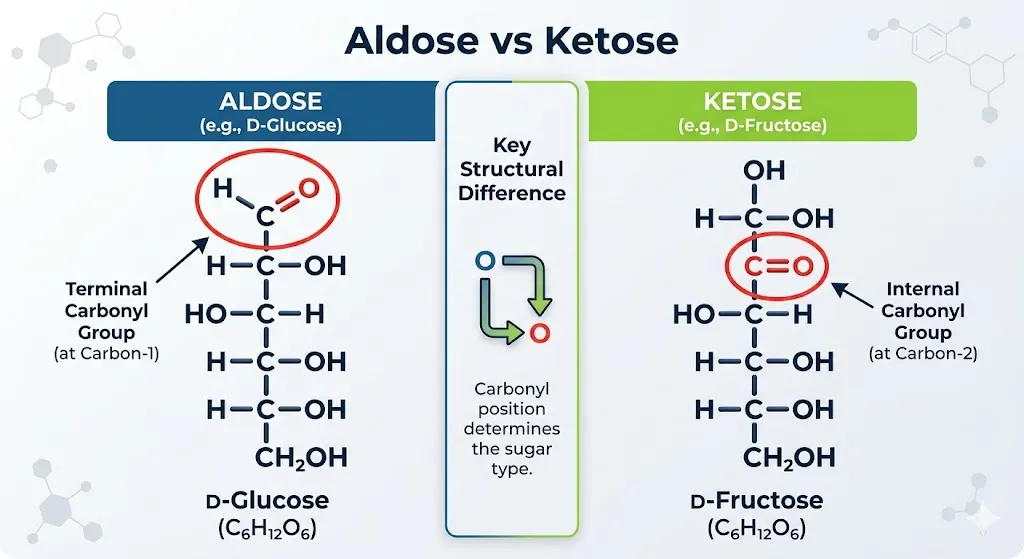
The key difference is the position of the carbonyl group:
- Aldose has the carbonyl group at the end of the carbon chain.
- Ketose has the carbonyl group in the middle of the carbon chain.
Why Their Difference Is Important
Knowing the difference between aldose and ketose is crucial in biology, medicine, and nutrition. It helps in understanding how sugars are digested and how energy is produced in the body. Scientists use this knowledge in drug development, diabetes research, and food chemistry. In society, it supports better dietary planning and health awareness. Without understanding the difference between aldose and ketose, it becomes difficult to study metabolism and biochemical reactions accurately.
Linking Hook
Now let’s explore the difference between aldose and ketose in detail through scientific and practical comparisons.
H2: Difference Between Aldose and Ketose
1. Functional Group
- Aldose: Contains aldehyde group (-CHO).
- Example 1: Glucose
- Example 2: Galactose
- Ketose: Contains ketone group (C=O).
- Example 1: Fructose
- Example 2: Ribulose
2. Position of Carbonyl Group
- Aldose: At the terminal carbon.
- Example: Glucose (C1 position)
- Example: Ribose (C1 position)
- Ketose: At internal carbon.
- Example: Fructose (C2 position)
- Example: Xylulose
3. Number of Carbon Atoms
- Aldose: Can vary (3–7 carbons).
- Example: Triose sugar glyceraldehyde
- Example: Hexose glucose
- Ketose: Also varies but fewer stable types.
- Example: Fructose (hexose)
- Example: Sedoheptulose (heptose)
4. Chemical Reactivity
- Aldose: More reactive due to aldehyde group.
- Example: Glucose reacts in Benedict’s test
- Example: Maltose shows reducing properties
- Ketose: Less reactive but can isomerize.
- Example: Fructose gives positive test after rearrangement
- Example: Ketopentoses in lab reactions
5. Reducing Nature
- Aldose: Always reducing sugar.
- Example: Glucose reduces Cu²⁺ in tests
- Example: Galactose shows reducing ability
- Ketose: Not directly reducing but becomes reducing.
- Example: Fructose under alkaline conditions
- Example: Sorbose in lab tests
6. Taste
- Aldose: Mild sweetness.
- Example: Glucose in fruits
- Example: Galactose in milk
- Ketose: Sweeter taste.
- Example: Fructose in honey
- Example: Fruit sugar in apples
7. Role in Metabolism
- Aldose: Energy source in glycolysis.
- Example: Glucose in ATP production
- Example: Ribose in nucleic acids
- Ketose: Intermediate in metabolic pathways.
- Example: Fructose metabolism in liver
- Example: Xylulose in pentose phosphate pathway
8. Structural Isomerism
- Aldose: Forms ketose via isomerization.
- Example: Glucose → Fructose conversion
- Example: Mannose rearrangement
- Ketose: Can convert to aldose.
- Example: Fructose → Glucose
- Example: Ketopentose rearrangement
9. Biological Presence
- Aldose: Common in plants and animals.
- Example: Glucose in blood
- Example: Ribose in DNA
- Ketose: Mostly in fruits and plants.
- Example: Fructose in fruits
- Example: Inulin breakdown products
10. Role in Diseases
- Aldose: Linked to blood sugar levels.
- Example: Diabetes glucose monitoring
- Example: Glycation of proteins
- Ketose: Less directly linked but important.
- Example: Fructose metabolism disorders
- Example: Liver fat accumulation
Nature and Behaviour
- Aldose: Stable, reactive, and essential for energy metabolism. It behaves as a primary energy sugar.
- Ketose: More flexible in structure, sweeter, and often involved in intermediate biochemical pathways.
Why People Are Confused
People confuse aldose and ketose because both are simple sugars (monosaccharides) and often have similar molecular formulas. In lab tests, ketose sugars can behave like aldoses after rearrangement, making identification difficult.
Table: Difference and Similarity Between Aldose and Ketose
| Feature | Aldose | Ketose |
| Functional group | Aldehyde | Ketone |
| Carbonyl position | Terminal | Internal |
| Sweetness | Moderate | Sweeter |
| Reactivity | High | Moderate |
| Example | Glucose | Fructose |
| Biological role | Energy source | Intermediate sugar |
Which Is Better in What Situation?
Aldose sugars are better when quick energy release is needed in the body. For example, glucose (an aldose) is the primary fuel for brain function and cellular respiration. It provides immediate ATP production, making it essential during physical activity and brain activity. Aldoses are therefore more suitable for energy-demanding biological processes.
Ketose sugars are better in situations where sweetness and metabolic flexibility are required. For example, fructose (a ketose) is widely used in fruits and sweeteners. It is metabolized differently in the liver and provides a slower energy release. Ketoses are useful in food industries and natural sweetness sources, making them important in dietary products and flavor enhancement.
Aldose and Ketose in Metaphors and Similes
- Aldose is like a quick-burning fuel engine.
- Ketose is like a slow-release energy battery.
- Aldose behaves like a straight road, while ketose is like a curved path.
Connotative Meaning
- Aldose: Positive (energy, stability, life-supporting)
- Example: “Aldose fuels our body like steady firewood.”
- Ketose: Neutral to positive (sweetness, flexibility, transformation)
- Example: “Ketose brings sweetness like nature’s gift.”
Idioms or Proverbs (Applied Use)
- “Fuel for life”
- Example: Glucose (aldose) is fuel for life in cells.
- “Sweetness comes in many forms”
- Example: Fructose (ketose) gives natural sweetness in fruits.
Works in Literature (Scientific References)
- “Biochemistry of Carbohydrates” – Academic Text, Lehninger, 2017
- “Molecular Biology of the Cell” – Bruce Alberts, 2015
- “Principles of Biochemistry” – Nelson & Cox, 2021
Movies on Related Themes
- Osmosis Jones (2001, USA) – biological systems inside the body
- Fantastic Voyage (1966, USA) – exploration of human body systems
- Cells at Work! (2018, Japan) – animated biological processes
Frequently Asked Questions
1. What is the main difference between aldose and ketose?
Aldose has an aldehyde group; ketose has a ketone group.
2. Is glucose an aldose or ketose?
Glucose is an aldose.
3. Is fructose aldose or ketose?
Fructose is a ketose.
4. Why are ketoses sweeter?
Due to their molecular structure and taste receptor interaction.
5. Can aldose convert to ketose?
Yes, through isomerization reactions.
How Both Are Useful for Surroundings
Both aldose and ketose sugars are essential for life. They support energy production, plant growth, food nutrition, and biological balance in ecosystems. Without them, life processes would not function properly.
Final Words
Aldose and ketose are not just chemical terms they are fundamental building blocks of life. Their differences shape how energy flows in living organisms. Understanding both helps in science, health, and nutrition. Together, they maintain balance in biological systems and sustain life on Earth.
Conclusion (100–150 words)
The difference between aldose and ketose is a key concept in biochemistry that explains how simple sugars function in living organisms. Aldoses contain an aldehyde group at the end of the carbon chain, while ketoses contain a ketone group within the chain. This structural variation affects their chemical behavior, sweetness, and role in metabolism. Aldoses like glucose are primary energy sources, while ketoses like fructose contribute to sweetness and metabolic pathways. Understanding the difference between aldose and ketose helps students, researchers, and healthcare professionals interpret biological reactions more accurately. It also plays a vital role in nutrition science, medicine, and food chemistry. In short, both sugar types are essential for life, working together to maintain energy balance and biological stability. As isomers meaning they share the exact same chemical formula ($C_6H_{12}O_6$ in the case of hexoses) their entire behavioral difference hinges on the location of a single double-bonded oxygen atom ($C=O$), known as the carbonyl group.
The Chemical Blueprint
The positioning of that carbonyl group alters how these sugars behave in a test tube and inside your cells:
- Aldoses (The Terminal Leaders): In an aldose like D-Glucose or D-Galactose, the carbonyl group is located at the very end of the carbon chain (Carbon-1). This forms an aldehyde group ($-CHO$). Because this reactive oxygen is exposed right at the tip, aldoses act as strong reducing agents and readily undergo oxidation.
- Ketoses (The Internal Anchors): In a ketose like D-Fructose, the carbonyl group is buried inside the chain, usually at Carbon-2. This forms a ketone group ($-C=O-$). Because the reactive center is flanked by other carbons, it requires an extra step (isomerization) to react in the same way an aldose does.
Key Functional Differences
Biological Roles and Metabolism
This structural tweak drastically impacts how our bodies process these sugars:
Glucose (Aldose) is the universal currency. Because of its aldose structure, glucose is highly stable in its cyclic form and less prone to randomly reacting with proteins in the body (glycation). It enters glycolysis directly, serving as the immediate primary fuel source for your brain, muscles, and organs.
Fructose (Ketose) is the metabolic bypass. Fructose bypasses the main regulatory checkpoints of glycolysis in the liver. Because it enters the metabolic pathway further downstream, an abundance of fructose can be rapidly converted into fatty acids. This unique ketose pathway explains why high-fructose diets impact liver metabolism differently than pure glucose.Understanding this single shift in atomic geometry helps unlock everything from how food scientists formulate low-glycemic sweeteners to how clinicians monitor blood sugar levels.

I am a professional SEO content writer specialising in comparison-based and grammar-focused articles. Through my website GrammarCompare.com, I help readers clearly understand the difference between confusing terms with well-researched, easy-to-read content. My expertise lies in focusing on clarity, accuracy, and practical explanations that improve both knowledge and writing skills.