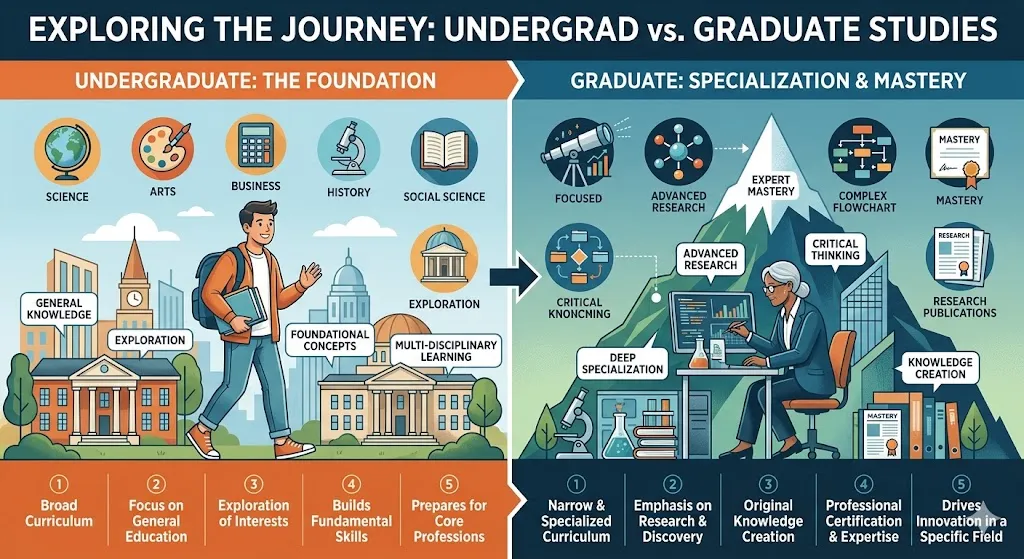
Imagine a student named Ali walking into his first university class, excited but confused when he hears seniors talking about “grad school research” while he is still an “undergrad.” He wonders what this difference really means in real life. In simple terms, difference between grad and undergrad refers to two major stages of higher education: undergraduate studies (first level of university education) and graduate studies (advanced, specialized education after a bachelor’s degree). Many students do not clearly understand the difference between grad and undergrad, and this often affects their academic planning. In universities, the difference between grad and undergrad shapes everything from coursework difficulty to career paths.
Undergraduate students focus on foundational learning, while graduate students focus on specialization and research. Understanding the difference between grad and undergrad helps students make informed choices about their future.
Pronunciation (US & UK)
- Grad: /ɡræd/ (US & UK same)
- Undergrad: /ˈʌn.dɚ.ɡræd/ (US), /ˈʌn.də.ɡræd/ (UK)
Now let’s explore the deeper academic structure behind these two levels.
Difference Between Grad and Undergrad
1. Level of Study
- Undergrad: First stage after school.
- Example 1: Bachelor of Science student.
- Example 2: BA English student.
- Grad: Advanced study after bachelor’s.
- Example 1: Master’s in Physics.
- Example 2: PhD in Literature.
2. Academic Depth
- Undergrad: Basic and broad knowledge.
- Example 1: Intro to Biology.
- Example 2: General Mathematics.
- Grad: Deep specialization.
- Example 1: Molecular Genetics.
- Example 2: Quantum Mechanics research.
3. Purpose
- Undergrad: Learning fundamentals.
- Example 1: Building communication skills.
- Example 2: Understanding core subjects.
- Grad: Producing research and expertise.
- Example 1: Publishing thesis.
- Example 2: Solving industry problems.
4. Duration
- Undergrad: Usually 3–4 years.
- Example 1: BA 4 years.
- Example 2: BSc 3–4 years.
- Grad: 1–6 years depending on program.
- Example 1: Master’s 2 years.
- Example 2: PhD 4–6 years.
5. Admission Requirements
- Undergrad: Requires high school certificate.
- Example 1: Intermediate pass.
- Example 2: A-levels.
- Grad: Requires bachelor’s degree.
- Example 1: BS in Chemistry.
- Example 2: BA in Economics.
6. Teaching Style
- Undergrad: Classroom lectures.
- Example 1: Teacher-led learning.
- Example 2: Fixed syllabus exams.
- Grad: Research-based learning.
- Example 1: Lab experiments.
- Example 2: Thesis discussions.
7. Student Independence
- Undergrad: Guided learning.
- Example 1: Structured assignments.
- Example 2: Fixed timetable.
- Grad: Independent research.
- Example 1: Self-designed thesis.
- Example 2: Research proposal writing.
8. Assessment Method
- Undergrad: Exams and quizzes.
- Example 1: Midterms.
- Example 2: Final exams.
- Grad: Research papers and defense.
- Example 1: Thesis submission.
- Example 2: Oral defense.
9. Career Focus
- Undergrad: Entry-level jobs.
- Example 1: Junior accountant.
- Example 2: Assistant teacher.
- Grad: Expert-level careers.
- Example 1: Research scientist.
- Example 2: University professor.
10. Cost and Investment
- Undergrad: Generally lower cost.
- Example 1: Public university fees.
- Example 2: Scholarships available.
- Grad: Often higher investment.
- Example 1: Research funding needs.
- Example 2: Specialized lab costs.
Nature and Behaviour
Undergraduate programs are structured, guided, and exploratory. They behave like a “learning foundation stage” where students explore multiple subjects before choosing a direction.
Graduate programs are focused, analytical, and research-driven. They behave like a “knowledge refinement stage,” where students contribute new ideas to their field.
Why People Are Confused
People confuse grad and undergrad because both exist in universities, both involve degrees, and both use similar academic terms like “classes” and “credits.” Additionally, some countries use different naming systems, making the difference between grad and undergrad harder to understand for international students.
Table: Difference and Similarity
| Feature | Undergrad | Grad |
| Level | First degree | Advanced degree |
| Focus | General education | Specialization |
| Duration | 3–4 years | 1–6 years |
| Research | Minimal | High |
| Similarity | Both are university programs requiring study, exams, and academic discipline |
Which is Better and When?
Undergraduate study is better for students starting their academic journey. It builds the foundation of knowledge and helps learners explore different fields before deciding their career path. Without undergrad education, students cannot access advanced learning opportunities.
Graduate study is better for those who already have a clear direction. It is ideal for careers in research, teaching, or specialized industries like medicine, engineering, or data science. Grad programs provide depth, authority, and professional recognition. Both are essential, but the choice depends on timing and career goals.
Metaphors and Similes
- Undergrad is like planting seeds in a garden of knowledge.
- Grad is like harvesting and refining the fruits of knowledge.
- Undergrad is a wide river, while grad is a deep ocean.
Connotative Meaning
- Undergrad: Neutral-positive (foundation, growth, learning)
- Example: “She is in her undergrad phase of exploration.”
- Grad: Positive (expertise, achievement, authority)
- Example: “He is working on grad-level research in AI.”
Idioms or Proverbs (Related Use)
- “Learn the ropes” (Undergrad stage)
- Example: “In undergrad, students learn the ropes of university life.”
- “Master of the craft” (Grad stage)
- Example: “After graduation, she became a master of the craft in biology.”
Literature References
- “The Academic Journey” (Educational Essay, John Dewey, 1938)
- “Graduate Minds” (Research Philosophy, Michel Foucault-inspired works, 1970s academic discourse)
- “The Student Experience” (Sociology Study, 2005, UK Education Journal)
Movie References
- Good Will Hunting (1997, USA)
- The Graduate (1967, USA)
- 3 Idiots (2009, India)
Frequently Asked Questions
1. What is the main difference between grad and undergrad?
Undergrad is the first degree; grad is advanced study after a bachelor’s.
2. Can I do grad without undergrad?
No, a bachelor’s degree is required first.
3. Which is harder, grad or undergrad?
Grad is generally more difficult due to research demands.
4. Do both have exams?
Yes, but grad focuses more on research than exams.
5. Which is better for jobs?
Undergrad for entry jobs, grad for specialized careers.
How Both Are Useful for Surroundings
Undergraduate education builds a skilled workforce by producing graduates ready for basic professional roles. Graduate education improves society through research, innovation, and leadership. Together, they balance knowledge creation and practical application in industries, education, and science.
Final Words
Undergrad and grad are not competitors but connected stages of academic growth. One builds the base, while the other builds expertise. Understanding both helps students plan smarter futures.
Conclusion
The difference between grad and undergrad is essential for every student planning higher education. Undergrad studies focus on general learning, exploration, and foundational knowledge, while grad studies focus on specialization, research, and professional mastery. Both stages serve different but equally important purposes in shaping a successful academic and career journey. Without undergrad, grad study is impossible; without grad, advanced expertise remains limited. Recognizing this difference helps students choose the right academic path at the right time. Ultimately, both levels work together to build a knowledgeable, skilled, and innovative society that drives progress across all fields. To dive deep into the specific operational, academic, and practical differences between these two levels, we have to look at how a student’s daily reality, financial investment, and intellectual output completely shift when transitioning from undergraduate to graduate school.
1. Academic Depth and Paradigm Shifts
The most profound difference isn’t just the difficulty of the material it is a fundamental shift in how knowledge is consumed and created.
- Undergraduate (Consuming Knowledge): The primary goal is to build a broad foundational framework. Students take general education requirements alongside major-specific courses. Success is largely measured by how well you absorb, retain, and synthesize established facts, theories, and existing literature.
- Graduate (Creating Knowledge): The paradigm shifts from consumption to contribution. Especially at the doctoral level, students are expected to discover or produce new knowledge, methodologies, or applications. Classrooms function less as lecture halls and more as collaborative research labs or peer-led seminars where existing literature is actively debated and challenged.
2. Structural and Functional Differences
The day-to-day lifestyle, class dynamics, and evaluation metrics are distinct at each tier.
Class Sizes and Peer Interaction
- Undergraduate: Classes can range from large lecture halls of 100 to 300+ students (especially in foundational introductory courses) to smaller seminars of 20 to 30 students in upper-level major courses. Interaction with professors is often formal and structured around office hours.
- Graduate: Cohorts are highly selective and small, frequently ranging from 5 to 15 students per class. The dynamic shifts from a student-teacher relationship to a junior colleague-mentor relationship. Professors expect students to drive the discussion.
Grading and Milestone Evaluation
- Undergraduate: Evaluation is highly decentralized across multiple quizzes, midterms, finals, essays, and participation grades. Maintaining a steady GPA is a continuous, multi-assignment effort.
- Graduate: Grading is often holistic, focusing on comprehensive term papers, major research projects, presentations, or practicum hours. Furthermore, graduate programs require students to pass high-stakes, programmatic milestones to graduate, such as:
- Comprehensive Exams (“Comps”): Multi-day written or oral exams testing complete mastery over the field’s literature.
- Thesis/Dissertation Defense: An intense oral examination by a faculty committee defending original, independent research.
3. Financial Structures and Assistantships
How these programs are funded represents a massive structural divide in higher education.
Research Assistantships (RA): Funded by external faculty grants, paying the student to work directly on specific laboratory or academic research initiatives.
Undergraduate Funding: Primarily funded out-of-pocket, via federal/private student loans, need-based grants, or merit-based scholarships. Students are outright consumers paying tuition for an educational service.
Graduate Funding (The Employment Split): While professional graduate degrees (like an MBA, JD, or MD) are typically self-funded via specialized loans, academic graduate programs (especially research-focused Masters and PhDs) often operate on an employment model:
Teaching Assistantships (TA): The university waives tuition and pays a stipend in exchange for the graduate student grading papers, leading discussion sections, or teaching introductory undergraduate classes.

I am a professional SEO content writer specialising in comparison-based and grammar-focused articles. Through my website GrammarCompare.com, I help readers clearly understand the difference between confusing terms with well-researched, easy-to-read content. My expertise lies in focusing on clarity, accuracy, and practical explanations that improve both knowledge and writing skills.