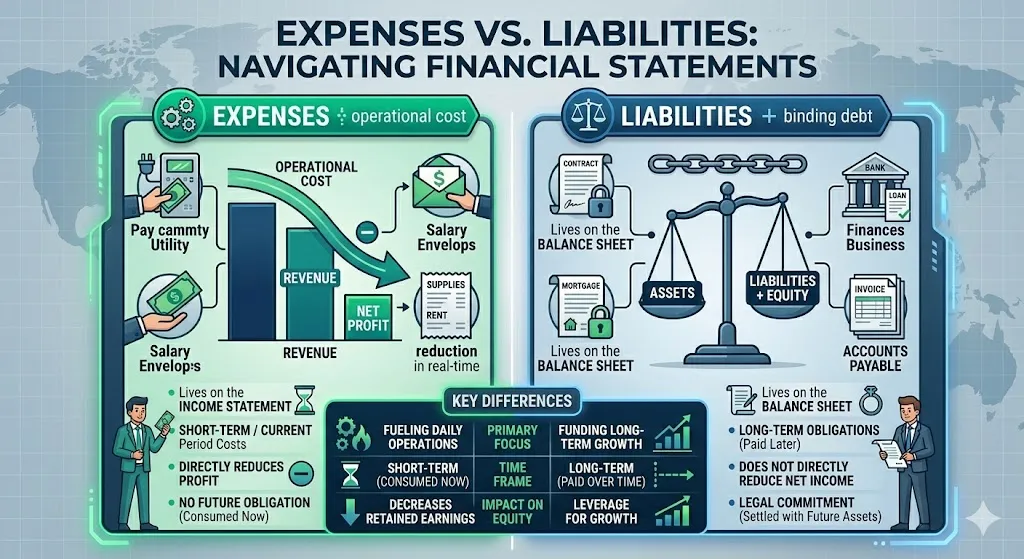
Imagine a young shop owner in a busy market. Every day he pays electricity bills, salaries, and rent—these are his expenses. At the same time, he takes a loan from a bank to expand his business—this becomes his liability. Many beginners confuse these two and often mix them in accounting records. Understanding the difference between expenses and liabilities is essential for financial clarity. In fact, the difference between expenses and liabilities helps individuals and businesses make smarter money decisions. The difference between expenses and liabilities also plays a key role in budgeting, planning, and long-term stability.
Expenses represent daily costs, while liabilities represent future obligations. Knowing the difference between expenses and liabilities prevents financial mistakes.
Key Difference Between the Both
Expenses reduce income immediately, while liabilities are debts that must be paid later.
Why Their Difference is Important
Understanding the difference between expenses and liabilities is crucial for learners, accountants, and business owners because it ensures accurate financial reporting and better economic decisions in society.
Pronunciation
- Expenses: US /ɪkˈspen.sɪz/ | UK /ɪkˈspen.sɪz/
- Liabilities: US /ˌlaɪ.əˈbɪl.ə.tiz/ | UK /ˌlaɪ.əˈbɪl.ɪ.tiz/
Linking Hook
Now let’s move deeper into the structured comparison and understand how these two financial terms differ in real accounting practice.
Difference Between Expenses and Liabilities
1. Meaning
- Expenses: Costs incurred in daily operations.
Example 1: Paying electricity bills.
Example 2: Office rent payment. - Liabilities: Financial obligations to be paid later.
Example 1: Bank loan.
Example 2: Credit card debt.
2. Time of Impact
- Expenses: Affect income immediately.
Example 1: Salary payment this month.
Example 2: Utility bill payment today. - Liabilities: Affect future finances.
Example 1: Loan repayment next year.
Example 2: Mortgage due over 20 years.
3. Nature
- Expenses: Short-term consumption.
Example 1: Stationery purchase.
Example 2: Fuel cost. - Liabilities: Long-term obligations.
Example 1: Business loan.
Example 2: Bonds issued.
4. Accounting Treatment
- Expenses: Recorded in income statement.
Example 1: Advertising cost.
Example 2: Maintenance cost. - Liabilities: Recorded in balance sheet.
Example 1: Bank overdraft.
Example 2: Accounts payable.
5. Effect on Profit
- Expenses: Reduce profit.
Example 1: Staff salary.
Example 2: Office supplies. - Liabilities: Do not directly reduce profit.
Example 1: Loan received.
Example 2: Deferred payment.
6. Cash Flow
- Expenses: Immediate cash outflow.
Example 1: Rent payment.
Example 2: Utility bills. - Liabilities: Future cash outflow.
Example 1: Installment loan.
Example 2: Deferred tax.
7. Purpose
- Expenses: Support daily operations.
Example 1: Employee wages.
Example 2: Office maintenance. - Liabilities: Fund growth or obligations.
Example 1: Business expansion loan.
Example 2: Equipment financing.
8. Duration
- Expenses: Short-lived.
Example 1: Daily transport cost.
Example 2: Food cost. - Liabilities: Long-lasting.
Example 1: 10-year loan.
Example 2: Lease obligation.
9. Financial Control
- Expenses: Controlled by budgeting.
Example 1: Monthly spending plan.
Example 2: Cost-cutting measures. - Liabilities: Controlled by repayment schedules.
Example 1: EMI plan.
Example 2: Debt restructuring.
10. Economic Role
- Expenses: Maintain business activity.
Example 1: Office operations.
Example 2: Marketing campaigns. - Liabilities: Enable financing and growth.
Example 1: Startup funding.
Example 2: Infrastructure loans.
Nature and Behavior
Expenses are continuous, operational, and recurring. They behave like daily energy consumption in a system. They vanish once paid.
Liabilities are structural, long-term, and binding. They behave like financial commitments that stay until fully repaid.
Why People Get Confused
People confuse them because both involve money outflow. Also, some liabilities eventually turn into expenses when paid. In small businesses, both often appear in similar financial records, increasing misunderstanding.
Table: Difference and Similarity
| Feature | Expenses | Liabilities |
| Nature | Operational cost | Financial obligation |
| Duration | Short-term | Long-term |
| Impact | Reduces profit | Creates future obligation |
| Statement | Income statement | Balance sheet |
| Similarity | Both involve money usage | Both affect financial planning |
Which is Better in What Situation?
Expenses are better when focusing on daily operations and maintaining smooth business flow. They ensure that everything runs without interruption, such as paying salaries or bills on time.
Liabilities are better when immediate funding is needed for expansion or investment. They help businesses grow by providing access to large capital. For example, taking a loan to open a new branch is a liability, but necessary for growth. Both are essential, but their usefulness depends on timing and financial goals.
Metaphors and Similes
- Expenses are like “water dripping from a tap”continuous and necessary.
- Liabilities are like “a backpack of stones”carried until repaid.
Connotative Meanings
- Expenses: Neutral to negative (money going out).
Example: “High expenses reduced profit.” - Liabilities: Negative but strategic (future burden).
Example: “Loans are liabilities but help growth.”
Idioms or Proverbs
- “Cut your coat according to your cloth” (control expenses).
Example: A business reduced expenses during loss. - “Debt is a heavy burden” (liabilities).
Example: Too many liabilities slowed company growth.
Works in Literature
- “Accounting Principles” (Educational genre, Weygandt, 2019)
- “Financial Statements” (Non-fiction, Kieso, 2020)
Movies Related to Finance Themes
- The Big Short (2015, USA)
- Wall Street (1987, USA)
Frequently Asked Questions
1. What is the main difference between expenses and liabilities?
Expenses are daily costs, while liabilities are future obligations.
2. Are liabilities considered expenses?
No, but repayment of liabilities may include expenses.
3. Which affects profit more?
Expenses directly reduce profit.
4. Can a loan be an expense?
No, a loan is a liability.
5. Why is it important to separate them?
It ensures accurate financial reporting.
How Both Are Useful for Surroundings
Expenses keep daily systems running smoothly, such as salaries and services. Liabilities support development projects, infrastructure, and business expansion. Together, they maintain economic balance and growth in society.
Final Words
Both expenses and liabilities are essential elements of financial life. One ensures survival of daily operations, while the other ensures future growth. Understanding both helps individuals and businesses maintain financial discipline and long-term stability.
Conclusion (100–150 words)
The difference between expenses and liabilities is fundamental in accounting and financial management. Expenses are short-term costs that directly reduce income, while liabilities are long-term obligations that represent future payments. Understanding the difference between expenses and liabilities helps businesses avoid financial errors and improve decision-making. The difference between expenses and liabilities also ensures better budgeting, clearer financial statements, and stronger economic planning. Without this knowledge, individuals may misinterpret financial health and make poor investment choices. In modern business environments, separating these two concepts is essential for accuracy and growth. Ultimately, mastering the difference between expenses and liabilities empowers learners, entrepreneurs, and professionals to manage money more effectively and build sustainable financial systems.
The distinction between expenses and liabilities is one of the most vital foundations of accounting, yet it is frequently misunderstood by new entrepreneurs and individuals alike. Confusing the two can severely distort your perception of financial health, leading to flawed budgeting and inaccurate tax reporting.
To put it in the simplest terms: Expenses represent money that has already departed to fuel your current operations, while liabilities represent a promise to pay money in the future.
1. Expenses: The Cost of Doing Business
An expense is an ongoing, operational cost incurred during the normal course of running a business or household.
- Financial Statement Location: Expenses live exclusively on the Income Statement (Profit & Loss). They are directly subtracted from your revenues to determine your net profit ($Net\ Income = Revenue – Expenses$).
- Time Horizon: They are short-term and represent consumption within the current accounting period (usually monthly or annually). Once an expense is paid, that economic value is gone.
- Core Purpose: They are necessary to generate immediate revenue.
- Examples: Rent, utility bills, employee salaries, marketing costs, office supplies, and web hosting fees.
2. Liabilities: What You Owe to Others
A liability is a legal, financial obligation or debt that a person or company owes to an outside party.
- Financial Statement Location: Liabilities live exclusively on the Balance Sheet. They represent how a business finances its assets alongside owner equity ($Assets = Liabilities + Equity$).
- Time Horizon: They are often long-term obligations settled over multiple accounting periods through future sacrifices of economic benefits (usually cash payments).
- Core Purpose: They are utilized to fund long-term growth, purchase major assets, or leverage capital.
- Examples: Bank loans, mortgages, corporate bonds, deferred taxes, and Accounts Payable (money owed to suppliers for goods already received).
The Intersection: How They Interact
While they are entirely different accounts, expenses and liabilities interact constantly in day-to-day bookkeeping. This interaction usually happens in one of two ways:
A. Buying on Credit (Accounts Payable)
When you receive a utility bill or buy office supplies but don’t pay the cash immediately, you simultaneously create an expense (the cost of the service) and a liability (the promise to pay the vendor later).
- The Journal Entry: You debit the Expense account and credit Accounts Payable (a liability). When you finally pay the bill, your liability drops, and your cash drops, but the expense remains in the past.
B. Servicing a Debt
When you make a monthly payment on a bank loan or a business mortgage, your payment is split:
- Principal Reduction: Part of the money goes toward lowering your overall liability (the debt itself).
- Interest Cost: The rest of the money goes toward the interest fee, which is categorized as an expense because it is the ongoing cost of borrowing that capital for the month.

I am a professional SEO content writer specialising in comparison-based and grammar-focused articles. Through my website GrammarCompare.com, I help readers clearly understand the difference between confusing terms with well-researched, easy-to-read content. My expertise lies in focusing on clarity, accuracy, and practical explanations that improve both knowledge and writing skills.