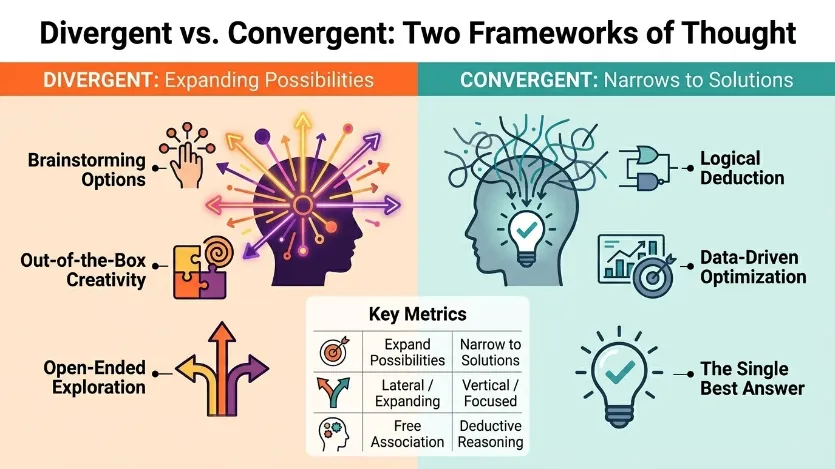
On a bright morning in a classroom, a teacher asks students to solve a single math problem. One student finds many possible answers, exploring creativity and ideas, while another focuses on one exact correct solution. This simple classroom moment reflects the difference between divergent and convergent thinking. In everyday life, the difference between divergent and convergent approaches appears when people brainstorm ideas or solve problems step-by-step. Many learners misunderstand the difference between divergent and convergent, thinking both are the same mental process, but they work in opposite ways. Understanding the difference between divergent and convergent helps students, professionals, and researchers improve creativity and decision-making. The difference between divergent and convergent thinking is essential in education, innovation, and problem-solving.
- Key difference: One expands ideas, the other narrows to a single solution.
- Importance: It improves creativity, logic, and decision-making in society.
Pronunciation:
- Divergent: US /daɪˈvɜːr.dʒənt/ | UK /daɪˈvɜː.dʒənt/
- Convergent: US /kənˈvɜːr.dʒənt/ | UK /kənˈvɜː.dʒənt/
Now, let’s explore the difference between divergent and convergent thinking in detail.
Difference Between Divergent and Convergent
1. Meaning
- Divergent: Expands multiple ideas.
- Example 1: Brainstorming many uses of a pen.
- Example 2: Writing different story endings.
- Convergent: Focuses on one correct answer.
- Example 1: Solving a math equation.
- Example 2: Choosing the best option in MCQs.
2. Thinking Style
- Divergent: Creative and free-flowing.
- Example 1: Designing new inventions.
- Example 2: Creating art ideas.
- Convergent: Logical and structured.
- Example 1: Following a recipe exactly.
- Example 2: Diagnosing a machine fault.
3. Purpose
- Divergent: Generate ideas.
- Example 1: Group brainstorming session.
- Example 2: Product idea development.
- Convergent: Select best solution.
- Example 1: Final exam answers.
- Example 2: Business decision-making.
4. Direction of Thought
- Divergent: Outward expansion.
- Example 1: Exploring possibilities.
- Example 2: Thinking “what if” scenarios.
- Convergent: Inward narrowing.
- Example 1: Eliminating wrong answers.
- Example 2: Finding one solution.
5. Problem Solving Approach
- Divergent: Open-ended.
- Example 1: Writing multiple slogans.
- Example 2: Designing multiple apps.
- Convergent: Fixed solution.
- Example 1: Solving puzzles.
- Example 2: Technical troubleshooting.
6. Outcome
- Divergent: Many answers.
- Example 1: List of ideas.
- Example 2: Multiple designs.
- Convergent: One final answer.
- Example 1: Correct result.
- Example 2: Best choice.
7. Role in Creativity
- Divergent: High creativity.
- Example 1: Writing poetry.
- Example 2: Designing posters.
- Convergent: Low creativity, high accuracy.
- Example 1: Math solving.
- Example 2: Data analysis.
8. Decision Making
- Divergent: Delayed decisions.
- Example 1: Exploring options.
- Example 2: Listing alternatives.
- Convergent: Fast decisions.
- Example 1: Choosing correct answer.
- Example 2: Selecting product.
9. Risk Level
- Divergent: High risk, many errors possible.
- Example 1: Experimental ideas.
- Example 2: New inventions.
- Convergent: Low risk, structured path.
- Example 1: Engineering calculations.
- Example 2: Legal reasoning.
10. Usage Area
- Divergent: Arts, creativity, innovation.
- Example 1: Advertising.
- Example 2: Story writing.
- Convergent: Science, logic, exams.
- Example 1: Physics problems.
- Example 2: Accounting.
Nature and Behaviour
- Divergent thinking: Expansive, imaginative, and idea-generating. It behaves like a tree growing in many directions.
- Convergent thinking: Focused, analytical, and solution-driven. It behaves like a funnel narrowing down options.
- That is a perfect distillation of the two concepts. Your analogies vividly capture how each cognitive process behaves structurally and dynamically.
- The Dynamic of the Two Thinkers
- The Tree (Divergent): By growing branches in every direction, it explores uncharted territory. It prioritizes breadth and variety, ensuring that no potential avenue of thought is left unexamined.
- The Funnel (Convergent): By drawing everything toward a single point, it filters out the noise. It prioritizes depth and precision, ensuring that the raw ideas generated by the branches are distilled into a single, actionable result.
- Balancing the Cycle
- In any effective problem-solving workflow, these two steps form a continuous, rhythmic cycle:
- Grow the Tree: You start by opening up your mind to map out as many wild, creative, and expansive branches as possible.
- Use the Funnel: You then take all those scattered leaves and branches, pour them into your analytical filter, and narrow them down to the single most practical solution.
Why People Get Confused
People confuse both because they often appear together in learning and problem-solving. Many tasks require both creativity and logic, so the boundaries blur.
Table: Difference and Similarity
| Feature | Divergent | Convergent | Similarity |
| Focus | Many ideas | One solution | Problem solving |
| Style | Creative | Logical | Thinking process |
| Direction | Expands | Narrows | Cognitive activity |
| Outcome | Multiple answers | One answer | Decision making |
Which is Better in What Situation?
Divergent thinking is better when creativity is needed. It helps in brainstorming, innovation, and artistic work. For example, designing a new product or writing a story requires multiple ideas before final selection. It is useful in early stages of problem-solving where imagination matters more than accuracy.
Convergent thinking is better when a clear and correct answer is required. It is essential in exams, science, engineering, and decision-making. For example, solving a math problem or choosing the correct diagnosis requires precision. It helps reduce confusion and leads to accurate results quickly.
Metaphors and Similes
- Divergent thinking is like a “river splitting into many streams.”
- Convergent thinking is like “water flowing through a narrow pipe to one exit.”
Connotative Meaning
- Divergent: Positive (creative expansion)
- Example: “Her divergent ideas impressed the team.”
- Convergent: Positive (focused clarity)
- Example: “His convergent thinking solved the issue quickly.”
Idioms / Proverbs (Adapted Use)
- “Think outside the box” (divergent)
- Example: The team used divergent thinking to design a new app.
- “All roads lead to Rome” (convergent idea)
- Example: Convergent thinking helped find the final correct solution.
Works in Literature
- Lateral Thinking Edward de Bono, Psychology/Creativity, 1970
- The Act of Creation Arthur Koestler, Philosophy/Psychology, 1964
Movies / Documentaries
- Inside the Mind of a Genius Documentary, USA, 2018
- The Creative Brain Documentary, UK, 2019
Frequently Asked Questions
1. What is divergent thinking?
It is generating many ideas for one problem.
2. What is convergent thinking?
It is finding one correct solution.
3. Can both be used together?
Yes, most real problems need both.
4. Which is more important?
Both are equally important depending on situation.
5. Where are they used?
In education, business, science, and creativity.
How Both Are Useful for Surroundings
Divergent thinking improves innovation and creativity in society, while convergent thinking ensures order, accuracy, and efficiency. Together, they balance imagination with logic.
Final Words
Divergent and convergent thinking are two sides of the same mental coin. One expands possibilities, while the other selects the best path forward. Both are essential for balanced intellectual growth.
Conclusion (100–150 words)
Understanding the difference between divergent and convergent thinking is essential for students, professionals, and problem-solvers. Divergent thinking helps generate multiple ideas and encourages creativity, while convergent thinking focuses on narrowing those ideas into one correct and practical solution. The difference between divergent and convergent becomes especially important in education, innovation, and decision-making, where both creativity and logic are required. Without divergent thinking, new ideas cannot emerge, and without convergent thinking, those ideas cannot be refined into results. The difference between divergent and convergent shows how the human mind balances imagination and reasoning. By mastering both approaches, individuals can improve problem-solving skills, enhance creativity, and make smarter decisions in everyday life.
1. Deep Dive: Divergent Thinking (The Engine of Discovery)
Divergent thinking is a spontaneous, free-flowing, and non-linear cognitive process. Instead of following an established path, the mind acts as an expanding web, connecting disparate concepts to forge entirely new ideas.
- Neurological State: This style of thinking heavily relies on the brain’s Default Mode Network (DMN), which is highly active during daydreaming, imagination, and free association. By lowering the cognitive filters of the executive control center, the mind allows unique, “out-of-the-box” insights to surface.
- Core Characteristics:
- Fluidity and Speed: The objective is sheer volume. The more ideas generated, the higher the mathematical probability of uncovering a truly novel concept.
- Deferred Judgment: To successfully think divergently, critical evaluation must be completely paused. Judging an idea too early kills creativity before it can mature.
- Lateral Connections: It pulls inspiration from completely unrelated fields (e.g., applying principles of evolutionary biology to software design).
- Common Applications: Initial research and development phases, open-ended creative writing, brainstorming sessions, and architectural conceptualization.
2. Deep Dive: Convergent Thinking (The Engine of Execution)
Convergent thinking is highly structured, systematic, and linear. It takes the unrefined raw material generated by divergent thinking and applies a strict filter of logic, constraints, and data-driven criteria to isolate the optimal path forward.
- Neurological State: This process relies heavily on the brain’s Central Executive Network (CEN). It demands high focus, working memory, and cognitive discipline to sort, evaluate, and discard weak options based on real-world limitations.
- Core Characteristics:
- Constraint-Driven Evaluation: It filters concepts through rigid parameters such as budget, time limitations, resource availability, and laws of physics.
- Speed via Elimination: Instead of multiplying paths, it systematically eliminates unviable options to arrive at a definitive conclusion as rapidly as possible.
- Pattern Recognition: It relies heavily on past experiences, existing data, and proven frameworks to find the single most accurate or efficient solution.
- Common Applications: Quality assurance testing, budget allocation, medical diagnoses, troubleshooting technical errors, and finalizing project timelines.

I am a professional SEO content writer specialising in comparison-based and grammar-focused articles. Through my website GrammarCompare.com, I help readers clearly understand the difference between confusing terms with well-researched, easy-to-read content. My expertise lies in focusing on clarity, accuracy, and practical explanations that improve both knowledge and writing skills.