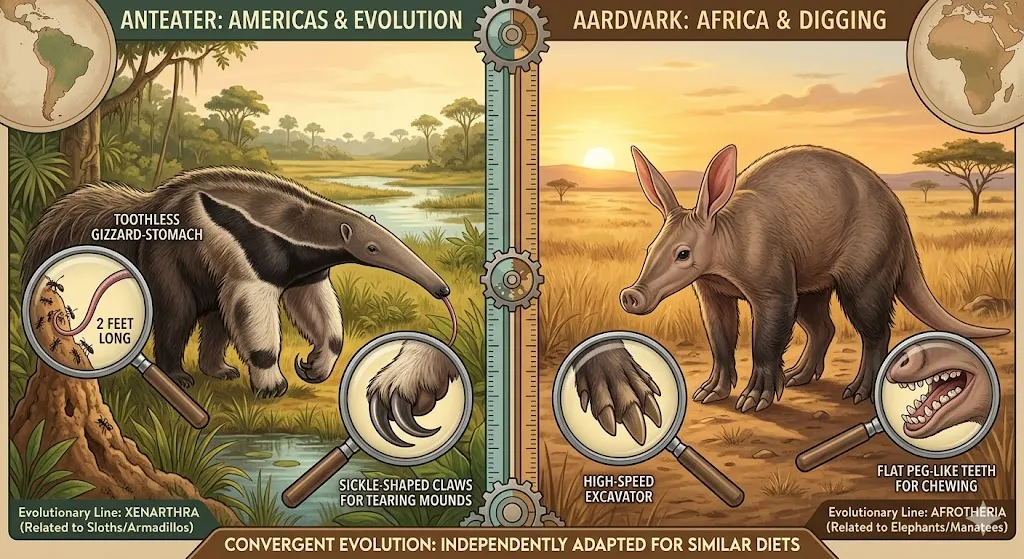
In the natural world, the difference between anteater and aardvark often confuses many wildlife learners and even casual animal lovers. Imagine visiting a safari park where you see two unusual creatures digging into anthills one from South America and the other from Africa. A guide explains that one is an anteater and the other is an aardvark, yet both seem to behave almost the same. This is where the confusion begins and the importance of understanding the difference between anteater and aardvark becomes clear. The difference between anteater and aardvark helps us study evolution, ecosystems, and animal adaptation more accurately. The difference between anteater and aardvark is also widely discussed in zoology and education because of their similar feeding habits but completely different biological origins.
Pronunciation
- Anteater: US /ˈæn.tiː.tər/ | UK /ˈæn.tiː.tə/
- Aardvark: US /ˈɑːrd.vɑːrk/ | UK /ˈɑːd.vɑːk/
Before diving deeper, let’s explore how these two animals differ in origin, structure, and behavior in detail.
Key Difference Between Anteater and Aardvark
The major difference is that anteaters belong to the Myrmecophagidae family (native to Central and South America), while aardvarks belong to the Orycteropodidae family (native to Africa). Anteaters are more closely related to sloths, while aardvarks are closer to elephants in evolutionary terms.
Why Knowing the Difference Matters
Understanding the difference between anteater and aardvark is important for students, researchers, and wildlife experts because it helps avoid biological misclassification. In education, this knowledge supports accurate learning of evolution and habitats. In conservation, it helps protect species based on their ecological needs. For society, knowing the difference between anteater and aardvark builds awareness about biodiversity and the importance of preserving unique animal species across continents.
H2: Difference Between Anteater and Aardvark
1. Geographic Location
- Anteaters live in Central and South America.
- Example 1: Giant anteater in Brazil’s rainforests.
- Example 2: Tamandua anteater in Panama forests.
- Aardvarks live in Africa.
- Example 1: Aardvark in South African savannas.
- Example 2: Aardvark in Kenyan grasslands.
2. Family Classification
- Anteater belongs to Myrmecophagidae.
- Example 1: Giant anteater species.
- Example 2: Silky anteater species.
- Aardvark belongs to Orycteropodidae.
- Example 1: Common aardvark species.
- Example 2: African burrowing aardvark.
3. Physical Appearance
- Anteater has long bushy tail and curved snout.
- Example 1: Giant anteater’s fluffy tail.
- Example 2: Tamandua’s clawed forelimbs.
- Aardvark has pig-like body and rabbit-like ears.
- Example 1: Thick-skinned aardvark body.
- Example 2: Long ears of African aardvark.
4. Habitat Type
- Anteaters prefer forests and grasslands.
- Example 1: Amazon rainforest anteaters.
- Example 2: Savanna anteaters in Bolivia.
- Aardvarks prefer dry savannas and burrows.
- Example 1: Underground aardvark burrows.
- Example 2: Open grassland habitats in Namibia.
5. Diet Pattern
- Anteaters eat ants and termites using sticky tongue.
- Example 1: Giant anteater feeding on ant hills.
- Example 2: Tamandua breaking termite nests.
- Aardvarks eat termites mainly.
- Example 1: Nighttime termite feeding.
- Example 2: Digging termite mounds.
6. Activity Time
- Anteaters can be diurnal or nocturnal.
- Example 1: Day-active giant anteater.
- Example 2: Night-feeding tamandua.
- Aardvarks are strictly nocturnal.
- Example 1: Night burrow emergence.
- Example 2: Midnight termite hunting.
7. Movement Style
- Anteaters walk slowly with curved claws.
- Example 1: Slow forest walking.
- Example 2: Defensive standing posture.
- Aardvarks dig and run quickly when threatened.
- Example 1: Fast digging escape.
- Example 2: Sudden burrow retreat.
8. Defense Mechanism
- Anteaters use claws for defense.
- Example 1: Giant anteater standing on hind legs.
- Example 2: Sharp claw strike.
- Aardvarks escape by digging.
- Example 1: Quick underground hiding.
- Example 2: Blocking burrow entrance.
9. Evolutionary Link
- Anteaters are related to sloths.
- Example 1: Shared arboreal ancestors.
- Example 2: Similar claw structure.
- Aardvarks are related to elephants.
- Example 1: Genetic similarity studies.
- Example 2: Unique African lineage.
10. Body Strength
- Anteaters rely on claws, not strength.
- Example 1: Climbing defense posture.
- Example 2: Ant nest breaking.
- Aardvarks have strong digging limbs.
- Example 1: Deep burrow creation.
- Example 2: Hard soil excavation.
Nature and Behaviour
Anteaters are generally calm, slow-moving, and defensive animals that avoid confrontation. They focus mainly on feeding and survival. Aardvarks are shy, nocturnal diggers that spend most of their time underground and emerge at night to feed. Both animals are solitary and avoid group living, but aardvarks are more secretive due to their burrowing lifestyle.
Why People Get Confused
People confuse anteaters and aardvarks because both eat ants, have long snouts, and live solitary lives. Their similar body shape and feeding habits create visual misunderstanding, especially for those unfamiliar with wildlife diversity.
Table: Difference and Similarity
| Feature | Anteater | Aardvark |
| Habitat | Americas | Africa |
| Family | Myrmecophagidae | Orycteropodidae |
| Diet | Ants & termites | Mostly termites |
| Activity | Day/Night | Nocturnal |
| Similarity | Both eat ants/termites | Both dig with claws |
Which is Better in What Situation?
Anteaters are better adapted for forest ecosystems where ants and termites are widely spread above ground. Their long tongues and claws help them feed efficiently in varied environments. Aardvarks, however, are better suited for dry African savannas where termites live deep underground. Their strong digging ability gives them an advantage in hard soil conditions. Neither is “better” overall; each is perfectly designed for its own habitat. Anteaters excel in flexible feeding environments, while aardvarks excel in deep burrow survival systems.
Metaphors and Similes
- Anteater: “like a living vacuum cleaner of the forest”
- Aardvark: “like a night-time digging machine under the earth”
Connotative Meanings
- Anteater: Neutral to positive (symbol of patience and slow precision)
- Example: “He works like an anteater, carefully and steadily.”
- Aardvark: Neutral (symbol of mystery and hidden strength)
- Example: “She stays like an aardvark, quiet but powerful underground.”
Idioms or Proverbs (Creative Usage)
- “Busy as an anteater in an ant hill” – meaning extremely focused worker
- Example: He was busy as an anteater during exam preparation.
- “Silent as an aardvark at night” – meaning very quiet and unnoticed
- Example: She moved silent as an aardvark during the surprise party setup.
Literature and Media Mentions
- The Ant and the Aardvark (Animated Series, DePatie-Freleng, 1969, USA)
- Arthur (Children’s TV Series featuring aardvark character, Marc Brown, 1996–present, USA)
- BBC Planet Earth II (Documentary, 2016, UK – features anteater behavior)
- National Geographic Wildlife Documentaries (Various years, Global – both animals featured)
Movie and Cultural References
- The Ant and the Aardvark (1969, USA – animated shorts)
- Wildlife documentaries by BBC (UK, 2016)
- National Geographic films featuring anteaters and aardvarks (USA, various years)
Frequently Asked Questions
1. Are anteaters and aardvarks related?
No, they belong to completely different animal families.
2. Do both eat the same food?
Yes, both mainly eat ants and termites.
3. Where do they live?
Anteaters live in America; aardvarks live in Africa.
4. Are they dangerous?
No, both are harmless to humans.
5. Why do they look similar?
Because of convergent evolution due to similar diets.
How They Are Useful for Surroundings
Anteaters and aardvarks play a major role in controlling insect populations. By eating ants and termites, they help maintain ecological balance. They also improve soil health through digging and burrowing, which supports plant growth and nutrient circulation.
Final Words
Both anteaters and aardvarks are essential parts of their ecosystems. Though they live in different continents, their role in nature is surprisingly similar. Understanding them helps us appreciate how evolution creates different solutions for similar survival challenges.
Conclusion
The difference between anteater and aardvark is not just about appearance but about evolution, geography, and behavior. Anteaters from the Americas are adapted for forest life with long tongues and curved claws, while aardvarks from Africa are powerful diggers built for underground survival. Despite their similarities in diet, they are completely unrelated species that evolved independently. Learning the difference between anteater and aardvark helps us understand biodiversity more deeply and appreciate nature’s creativity. Both animals play an important ecological role and deserve protection. Recognizing their uniqueness enhances our knowledge of wildlife and strengthens conservation awareness for future generations.
Despite their overlapping diets, these two animals belong to completely separate mammalian branches. Their similarities exist simply because they both evolved to solve the same problem: how to efficiently eat millions of ants and termites.
                  [ MAMMALIA ]
                       |
         +-------------+-------------+
         |                           |
   [ XENARTHRA ]               [ AFROTHERIA ]
         |                           |
    (Anteater)                  (Aardvark)
         |                           |
  Origin: South America        Origin: Africa
  Related to: Sloths/Armadillos Related to: Elephants/Manatees
- The Anteater: Belongs to the superorder Xenarthra. Their closest living relatives are sloths and armadillos. They evolved entirely in the isolation of South and Central America.
- The Aardvark: Belongs to the superorder Afrotheria. Their closest living relatives are actually elephants, manatees, and hyraxes. Their name translates to “earth pig” in Afrikaans, reflecting their unique African roots.
1. Structural and Physical Distinctions
When you look past the elongated snouts, their anatomical designs are tailored for entirely different styles of survival.
Teeth vs. No Teeth
- Anteaters are completely toothless (edentate). They rely entirely on their sticky, whip-like tongues—which can extend up to two feet and a muscular gizzard-like stomach that grinds down insects with the help of swallowed sand and pebbles.
- Aardvarks have teeth. They lack incisors and canines, but they possess flat, peg-like molars at the back of their jaws that grow continuously. They use these teeth to chew up tougher insects before swallowing.
Claws and Locomotion
- Anteaters have massive, sickle-shaped claws on their front paws. Because these claws are so long, giant anteaters actually have to walk on their knuckles to keep them from dulling or puncturing their own paws.
- Aardvarks have shovel-like claws modified into flat, nail-like hooves. They walk normally on the flats of their feet (digitigrade/plantigrade hybrid) and use their limbs as high-speed excavators to dig underground burrows.
Their habitats and daily behaviors dictate how they interact with their respective ecosystems.
Summary: Nature’s Parallel Problem Solvers
The split between the anteater and the aardvark showcases the brilliance of biodiversity. The anteater is a specialized surface hunter, using its tail for balance or warmth and roaming the Americas like an ancient nomad. The aardvark is an engineering marvel of the African plains, acting as an ecological anchor whose abandoned burrows provide vital shelter for dozens of other African wildlife species.

I am a professional SEO content writer specialising in comparison-based and grammar-focused articles. Through my website GrammarCompare.com, I help readers clearly understand the difference between confusing terms with well-researched, easy-to-read content. My expertise lies in focusing on clarity, accuracy, and practical explanations that improve both knowledge and writing skills.