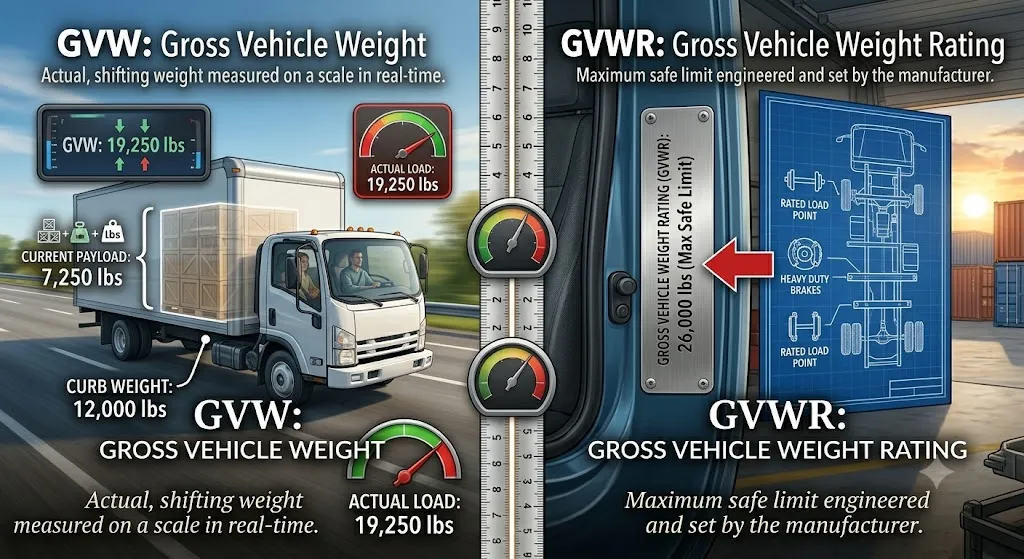
On a busy highway, a delivery driver notices his truck struggling on a steep incline. Later at a checkpoint, the inspector points out a serious issue: the truck is overloaded beyond its safe limit. The driver had confused GVW (Gross Vehicle Weight) with GVWR (Gross Vehicle Weight Rating) a mistake that many drivers make. Understanding the difference between GVW and GVWR is essential for safe driving and legal compliance. The difference between GVW and GVWR determines how much weight a vehicle actually carries versus how much it is designed to carry. The difference between GVW and GVWR can prevent accidents, fines, and mechanical failure. Many transport issues arise simply because people ignore the difference between GVW and GVWR.
Key Difference Between GVW and GVWR
- GVW = Actual current weight of the vehicle (with passengers, fuel, cargo)
- GVWR = Maximum safe weight limit set by manufacturer
Why Knowing This Difference Matters
Knowing the difference between GVW and GVWR is crucial for drivers, engineers, logistics companies, and policymakers. It ensures road safety, protects infrastructure, and prevents vehicle breakdowns. In modern society, where transport systems run global trade, misunderstanding these terms can lead to costly accidents and legal penalties.
Pronunciation
- GVW
- US: jee-vee-double-u
- UK: jee-vee-double-u
- GVWR
- US: jee-vee-double-u-are
- UK: jee-vee-double-u-are
Linking Hook
Now that we understand the basics, let’s dive deeper into the difference between GVW and GVWR and explore how they vary in definition, usage, and real-world application.
H2: Difference Between GVW and GVWR
1. Definition
- GVW: Actual weight of a vehicle at a given moment
- Example 1: A truck weighing 6,000 kg after loading goods
- Example 2: A car with passengers weighing 1,500 kg total
- GVWR: Maximum safe weight allowed
- Example 1: A truck rated for 7,500 kg GVWR
- Example 2: A van with GVWR of 2,000 kg
2. Nature
- GVW: Dynamic, changes every time load changes
- Example 1: Fuel addition increases GVW
- Example 2: Unloading cargo reduces GVW
- GVWR: Fixed by manufacturer
- Example 1: Truck specification plate shows GVWR
- Example 2: Car manual lists GVWR
3. Control
- GVW: Controlled by user behavior
- Example 1: Driver adds extra luggage
- Example 2: Loading passengers increases GVW
- GVWR: Controlled by engineering design
- Example 1: Frame strength limits GVWR
- Example 2: Axle capacity sets GVWR
4. Purpose
- GVW: Shows current load condition
- Example 1: Weighbridge measurement
- Example 2: Road inspection check
- GVWR: Ensures safety limit
- Example 1: Prevents overloading
- Example 2: Used for legal compliance
5. Legal Importance
- GVW: Checked during transport
- Example 1: Highway weigh stations
- Example 2: Cargo inspections
- GVWR: Used in regulations
- Example 1: Vehicle registration rules
- Example 2: Insurance classification
6. Safety Role
- GVW: Indicates real-time safety status
- Example 1: Overloaded truck risk
- Example 2: Balanced loading check
- GVWR: Defines safety ceiling
- Example 1: Maximum load threshold
- Example 2: Structural safety design
7. Measurement
- GVW: Measured using scales
- Example 1: Weighbridge station reading
- Example 2: Portable axle scales
- GVWR: Written on label/manual
- Example 1: Door sticker on car
- Example 2: Manufacturer specification sheet
8. Changeability
- GVW: Changes frequently
- Example 1: Adding cargo mid-trip
- Example 2: Fuel consumption reduces weight
- GVWR: Never changes
- Example 1: Factory-set limit
- Example 2: Fixed chassis design
9. Dependency
- GVW: Depends on current usage
- Example 1: Delivery load variations
- Example 2: Passenger count differences
- GVWR: Depends on design and materials
- Example 1: Steel frame strength
- Example 2: Suspension system rating
10. Practical Use
- GVW: Used in daily transport decisions
- Example 1: Loading decisions for trucks
- Example 2: Travel safety checks
- GVWR: Used in manufacturing and regulation
- Example 1: Vehicle design stage
- Example 2: Legal compliance approval
Nature and Behaviour
GVW
GVW behaves like a flexible number. It increases or decreases depending on passengers, fuel, and cargo. It reflects real-time conditions of a vehicle and is always changing.
GVWR
GVWR is stable and fixed. It behaves like a strict boundary set by engineers. It does not change unless the vehicle is redesigned or modified legally.
Why People Get Confused
People confuse GVW and GVWR because both involve vehicle weight and are often written together on documents. The similarity in naming and lack of awareness leads to misunderstanding. Many assume both represent the same value, which causes overloading mistakes.
Table: Difference and Similarity Between GVW and GVWR
| Feature | GVW | GVWR |
| Meaning | Actual weight | Maximum allowed weight |
| Nature | Variable | Fixed |
| Purpose | Current load check | Safety limit |
| Control | Driver/user | Manufacturer |
| Measurement | Weighing scales | Vehicle specs |
| Change | Changes often | Never changes |
Similarity: Both relate to vehicle weight and are essential for safe transportation and regulation.
Which Is Better in What Situation?
GVW is more useful when you need real-time information. For example, during transportation, drivers use GVW to check if the vehicle is overloaded. It helps in daily operations and immediate decision-making. Without GVW, it would be impossible to know the current safety status of a loaded vehicle.
GVWR is better for design, planning, and legal purposes. Manufacturers and authorities rely on GVWR to set safety standards. It ensures vehicles are not used beyond safe structural limits. GVWR is essential during registration, inspection, and engineering design processes. Both are important but serve different roles in safety and performance.
Metaphors and Similes
- GVW is like a “shopping bag you keep filling.”
- GVWR is like the “maximum capacity of the bag before it tears.”
- GVW behaves like “current body weight.”
- GVWR is like “your genetic physical limit.”
Connotative Meaning
- GVW: Neutral (represents condition at a moment)
- Example: “The GVW of the truck is high today.”
- GVWR: Positive (represents safety limit and protection)
- Example: “Never exceed the GVWR for safe driving.”
Idioms or Proverbs (Creative Usage)
- “Don’t exceed your limit” (used with GVWR)
- Example: The truck exceeded GVWR, just like “don’t exceed your limit.”
- “Weigh your options” (used with GVW context)
- Example: Drivers must weigh their GVW before traveling.
Works in Literature
- No direct literary works focus on GVW or GVWR, but they are commonly referenced in:
- Engineering textbooks (Transportation Engineering, SAE Standards – modern academic field, 20th–21st century)
- Automotive safety manuals (Engineering genre, various authors, ongoing publications)
Movies Related to Concept (Indirect Themes)
- Maximum Overdrive (1986, USA) – features heavy vehicle mechanics themes
- Convoy (1978, USA) – truck transport and road weight dynamics
- Mad Max: Fury Road (2015, Australia/USA) – vehicle load and engineering stress concepts
Frequently Asked Questions
1. What is GVW?
GVW is the total current weight of a vehicle including cargo and passengers.
2. What is GVWR?
GVWR is the maximum safe weight a vehicle can carry.
3. Can GVW exceed GVWR?
No, exceeding GVWR is unsafe and illegal.
4. Who sets GVWR?
Vehicle manufacturers set GVWR based on design limits.
5. Why is GVW important?
It helps ensure real-time safety and proper loading.
How Both Are Useful for Surroundings
GVW and GVWR help maintain road safety, reduce accidents, and protect infrastructure like bridges and highways. They ensure vehicles do not damage roads or endanger lives. These measurements also help transportation industries operate efficiently and legally.
Final Words for Both
GVW and GVWR work together like a system of balance. One shows reality, and the other sets the boundary. Understanding both ensures safety, efficiency, and responsibility in transportation.
Conclusion
The difference between GVW and GVWR is essential for anyone involved in driving, logistics, or vehicle design. GVW represents the actual weight of a vehicle at any moment, while GVWR defines the maximum safe limit set by manufacturers. Confusing these terms can lead to serious safety risks, fines, and mechanical failures. When drivers understand both concepts, they can load vehicles correctly and operate within safe limits. Engineers and policymakers rely on these terms to design safer transport systems. Ultimately, mastering the difference between GVW and GVWR improves road safety and ensures smoother transportation systems worldwide.
GVWR (Gross Vehicle Weight Rating)
- What it is: The absolute maximum legal and safe weight a vehicle can weigh when fully loaded.
- Who determines it: The vehicle’s manufacturer. It is a permanent, static engineering limit that never changes.
- Where to find it: It is printed on the vehicle’s safety compliance certification label, typically located on the driver’s side door jamb or inside the glove box.
- How it’s decided: It is determined by the weakest link in the vehicle’s structural chain taking into account the load capacity of the frame, suspension, axles, brakes, and tires.
GVW (Gross Vehicle Weight)
- What it is: The actual, real-time weight of the vehicle at any given moment.
- Who determines it: The current contents of the vehicle. It fluctuates every single time someone steps inside, cargo is loaded, or fuel is consumed.
- Where to find it: You can only find the exact GVW by driving the vehicle onto a physical certified scale (such as a CAT scale at a truck stop).
1. The Golden Equation of Logistics: Payload Capacity
To see how GVW and GVWR work together, you have to introduce a third metric: Curb Weight (the weight of the empty vehicle with a full tank of fuel but no passengers or cargo).
The relationship between these three terms determines your Payload Capacity—the maximum amount of weight you can actually add to the vehicle.
$$GVWR – Curb Weight = Maximum Payload Capacity$$
When loading a vehicle, your real-time weight (GVW) must never exceed the manufacturer’s limit (GVWR):
$$\text{GVW} \le \text{GVWR}$$
If your GVW is greater than your GVWR, your vehicle is overloaded, illegal
3. Why Confusing the Two Causes Catastrophes
Mechanical Failure
If your GVW exceeds your GVWR, you are forcing the vehicle to do work it wasn’t engineered to handle.
- Brake Fade: Brakes convert kinetic energy into heat. An overloaded vehicle generates more heat than the brakes can dissipate, leading to complete brake failure down steep hills.
- Suspension and Tire Blowouts: Excessive weight places extreme pressure on sidewalls and leaf springs, drastically increasing the risk of high-speed blowouts or structural snaps.
Legal and Financial Liability
Insurance Voiding: If an individual or commercial driver gets into an accident and accident reconstruction proves the vehicle’s GVW was operating above its GVWR, insurance companies frequently deny coverage, leaving the driver or company open to massive civil lawsuits.
DOT Fines: State troopers and Department of Transportation (DOT) officers routinely force commercial vehicles onto roadside scales. If your GVW ticks past your GVWR, severe fines are levied per pound of excess weight.

I am a professional SEO content writer specialising in comparison-based and grammar-focused articles. Through my website GrammarCompare.com, I help readers clearly understand the difference between confusing terms with well-researched, easy-to-read content. My expertise lies in focusing on clarity, accuracy, and practical explanations that improve both knowledge and writing skills.