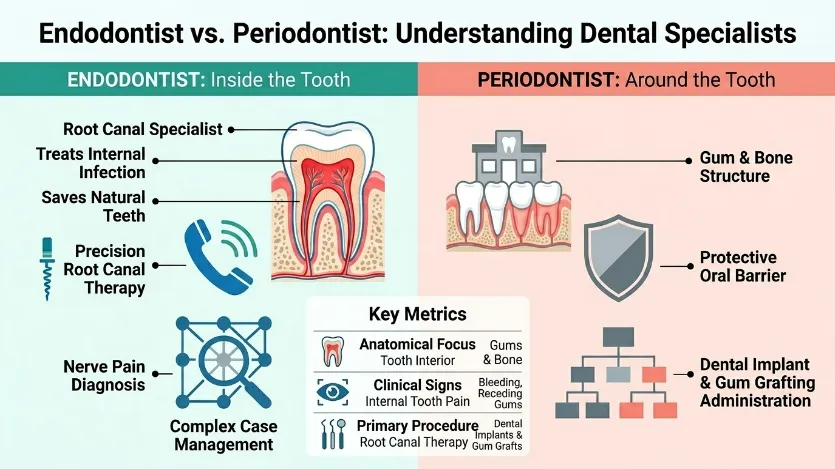
A visit to the dentist often feels simple until pain becomes complex. Imagine a patient named Ahmed who arrives at a clinic with a severe toothache. The general dentist checks him and says, “You need a specialist.” One doctor focuses deep inside the tooth, while another treats the gums that hold the tooth in place. This is where the real difference between endodontist and periodontist becomes important. Many patients confuse the difference between endodontist and periodontist, assuming both treat the same problem, but their roles are very different. Understanding the difference between endodontist and periodontist helps patients choose the right care quickly and avoid worsening dental issues. In short, knowing the difference between endodontist and periodontist can protect both your teeth and gums from long-term damage.
- Key difference (brief): One treats the inside of the tooth, the other treats supporting gums and bone.
- Importance: It improves diagnosis accuracy, treatment speed, and patient awareness in dental healthcare.
Pronunciation:
- Endodontist: US /ˌen.dəˈdɑːn.tɪst/ | UK /ˌen.dəˈdɒn.tɪst/
- Periodontist: US /ˌper.i.oʊˈdɑːn.tɪst/ | UK /ˌper.i.əˈdɒn.tɪst/
Now, let’s move deeper into the difference between endodontist and periodontist and understand how each plays a unique role in oral health.
Difference Between Endodontist and Periodontist
1. Area of Treatment
- Endodontist: Treats inside the tooth (pulp, root canals).
- Example 1: Root canal treatment for infected pulp.
- Example 2: Removing damaged nerve tissue.
- Periodontist: Treats gums and supporting bone.
- Example 1: Treating gum disease.
- Example 2: Bone grafting for tooth support.
2. Focus of Care
- Endodontist: Tooth preservation from inside.
- Example 1: Saving a cracked tooth.
- Example 2: Treating deep decay.
- Periodontist: Tooth stability and support.
- Example 1: Strengthening loose teeth.
- Example 2: Gum tissue repair.
3. Type of Disease Treated
- Endodontist: Tooth pulp infections.
- Example 1: Pulpitis.
- Example 2: Root abscess.
- Periodontist: Gum and bone diseases.
- Example 1: Gingivitis.
- Example 2: Periodontitis.
4. Main Procedures
- Endodontist: Root canal therapy.
- Example 1: Cleaning canals.
- Example 2: Filling root space.
- Periodontist: Gum surgery.
- Example 1: Scaling and root planing.
- Example 2: Gum grafting.
5. Tools Used
- Endodontist: Microscopes and fine files.
- Example 1: Rotary files.
- Example 2: Dental microscopes.
- Periodontist: Surgical tools for gums.
- Example 1: Scalpel for gum surgery.
- Example 2: Ultrasonic scalers.
6. Treatment Goal
- Endodontist: Save the natural tooth.
- Example 1: Avoid extraction.
- Example 2: Restore tooth function.
- Periodontist: Support long-term oral structure.
- Example 1: Prevent tooth loss.
- Example 2: Improve gum health.
7. Pain Management
- Endodontist: Treats tooth pain source.
- Example 1: Severe nerve pain relief.
- Example 2: Abscess drainage.
- Periodontist: Treats gum discomfort.
- Example 1: Bleeding gums treatment.
- Example 2: Swollen gum care.
8. Patient Referral
- Endodontist: Referred for tooth infection.
- Example 1: After deep cavity.
- Example 2: Failed filling.
- Periodontist: Referred for gum disease.
- Example 1: Loose teeth.
- Example 2: Gum recession.
9. Training Background
- Endodontist: Specialized in root canal science.
- Example 1: Advanced endodontic training.
- Example 2: Tooth pulp biology.
- Periodontist: Specialized in gum and bone health.
- Example 1: Gum surgery training.
- Example 2: Implant support training.
10. Outcome of Treatment
- Endodontist: Functional tooth remains.
- Example 1: Pain-free tooth.
- Example 2: Restored chewing ability.
- Periodontist: Stable gums and teeth.
- Example 1: Firm tooth support.
- Example 2: Healthy gum line.
Nature and Behaviour
- Endodontist: Precision-focused, working deep inside microscopic tooth structures. Their work is technical and highly detail-oriented.
- Periodontist: Tissue-focused, dealing with gums, bone, and external support structures. Their work is both surgical and restorative.
Why People Get Confused
Many people think both specialists “fix teeth,” but the confusion arises because tooth pain often overlaps with gum issues. Also, both work in the same dental environment and sometimes treat related symptoms.
Table: Difference and Similarity
| Feature | Endodontist | Periodontist | Similarity |
| Focus | Tooth interior | Gums & bone | Both treat oral health |
| Main treatment | Root canal | Gum therapy | Dental specialists |
| Goal | Save tooth | Support tooth | Prevent tooth loss |
| Tools | Microscopes | Surgical tools | Clinical instruments |
Which is Better in What Situation?
An endodontist is better when the problem is inside the tooth, such as nerve infection or deep decay. In such cases, root canal treatment can save the tooth and avoid extraction. Patients experiencing sharp, deep tooth pain should prefer an endodontist for quick relief and internal healing.
A periodontist is better when the problem involves gums or bone structure. If teeth feel loose, gums bleed, or recede, periodontal treatment is necessary. In such cases, strengthening support tissues is more important than treating the tooth itself. Both specialists are essential depending on the nature of the disease.
Metaphors and Similes
- Endodontist is like a “mechanic inside a machine,” fixing hidden internal damage.
- Periodontist is like a “gardener tending roots and soil,” maintaining support structure.
Connotative Meaning
- Endodontist: Positive (healer of hidden pain)
- Example: “The endodontist saved my painful tooth.”
- Periodontist: Positive (protector of foundation)
- Example: “The periodontist strengthened my gums and smile.”
Idioms / Proverbs (Adapted Use)
- “Prevention is better than cure”
- Example: Visiting a periodontist early prevents gum disease.
- “A strong foundation lasts longer”
- Example: Healthy gums from a periodontist support lifelong teeth.
Works in Literature
(No major literary works directly focused on these specialties, but related academic fields exist.)
- Principles of Endodontics Academic textbook, dental science, 2019
- Clinical Periodontology Academic textbook, dentistry, 2020
Movies / Documentaries
(No mainstream films specifically based on these specialties.)
- Dental Health: The Hidden Science Documentary, USA, 2018
- Inside Modern Dentistry Educational film, UK, 2021
Frequently Asked Questions
1. Is an endodontist better than a periodontist?
Neither is better; they treat different problems.
2. Do both treat tooth pain?
Yes, but causes differ internal vs gum-related.
3. Can I visit both at the same time?
Yes, for complex dental cases.
4. Does root canal need a periodontist?
No, it is an endodontist’s job.
5. Do periodontists perform surgery?
Yes, they treat gums and supporting bone surgically.
How Both Are Useful for Surroundings
Both specialists contribute to public oral health. Endodontists help people keep natural teeth, reducing extraction rates. Periodontists improve gum health, preventing tooth loss and improving overall hygiene in communities.
Final Words
Endodontists and periodontists are both essential pillars of modern dentistry. One works inside the tooth like a hidden repair expert, while the other strengthens the foundation like a structural engineer of oral health. Together, they ensure a complete dental care system that protects both teeth and gums.
Conclusion (100–150 words)
Understanding the difference between endodontist and periodontist is essential for making informed dental decisions. While both are dental specialists, their roles are completely different. An endodontist focuses on treating infections and damage inside the tooth, often performing root canal treatments to save natural teeth. In contrast, a periodontist works on gums and supporting bone structures, ensuring that teeth remain firmly anchored and healthy. Knowing the difference between endodontist and periodontist helps patients seek the right treatment quickly, reducing complications and improving recovery. This awareness also supports better communication between patients and dental professionals. Ultimately, both specialists work together to preserve oral health, prevent tooth loss, and improve quality of life through specialized care.
The Structural and Anatomical Breakdown
To visualize where these specialists operate, it helps to think of a tooth like a house. The endodontist is the master plumber and electrician working inside the walls, while the periodontist is the structural engineer managing the foundation and the soil.
1. Endodontist (Inside the Tooth)
- The Specialty: The word comes from endo- (inside) and -odont (tooth). Endodontists are specialists in treating the dental pulp the living tissue, nerves, and blood vessels inside the root canal system.
- Core Mandate: Saving the natural tooth from the inside out when it has been compromised by deep decay, fractures, or trauma.
- Primary Procedures: Complex root canal therapies, endodontic retreatments, and apical surgeries (apicoectomies) to clear internal infections.
2. Periodontist (Around the Tooth)
- The Specialty: Derived from perio- (around) and -odont (tooth). Periodontists specialize strictly in the periodontium the supporting apparatus surrounding the teeth, which includes the gums, alveolar bone, and periodontal ligament.
- Core Mandate: Halting chronic inflammatory diseases that destroy the tissues anchoring the teeth, and reconstructing lost foundation.
- Primary Procedures: Scaling and root planing (deep cleaning), gum graft surgeries, treatment of severe periodontitis (gum disease), bone grafting, and the surgical placement of dental implants.
How They Collaborate: The Endo-Perio Lesion
In complex cases, the boundaries between these two fields blur. A severe infection inside a tooth can escape through the bottom of the root and destroy the surrounding bone (an endodontic issue causing a periodontal problem). Conversely, severe gum disease can travel down the outside of a tooth and enter the internal pulp chamber through accessory canals (a periodontal issue infecting the interior).
When this happens, it is known as an endo-perio lesion. To save the tooth, both specialists must coordinate a sequenced treatment plan the endodontist neutralizes the interior infection, while the periodontist rebuilds and stabilizes the surrounding bone and gum tissue.

I am a professional SEO content writer specialising in comparison-based and grammar-focused articles. Through my website GrammarCompare.com, I help readers clearly understand the difference between confusing terms with well-researched, easy-to-read content. My expertise lies in focusing on clarity, accuracy, and practical explanations that improve both knowledge and writing skills.