In a small classroom, a teacher asked students why poetry sounds musical even without instruments. One student noticed repeated starting sounds like “Peter Piper picked a peck of pickled peppers,” while another pointed out repeating consonant sounds like “pitter-patter” inside words. This simple observation leads us to understand the difference between alliteration and consonance. The difference between alliteration and consonance often confuses learners because both involve repetition of sounds, yet they function differently. The difference between alliteration and consonance becomes clearer when we explore how poets and writers use them to create rhythm and mood. Understanding the difference between alliteration and consonance helps readers appreciate language more deeply in poetry, advertising, and storytelling.
Key Difference Between the Both
Alliteration focuses on repeating initial consonant sounds, while consonance focuses on repeating consonant sounds anywhere in a word.
Why Knowing the Difference Matters
Understanding the difference between alliteration and consonance is important for students, writers, poets, and even advertisers. It improves communication skills, enhances creativity, and helps in analyzing literature more effectively in society.
Pronunciation
- Alliteration:
US: /əˌlɪt̬.əˈreɪ.ʃən/
UK: /əˌlɪt.əˈreɪ.ʃən/ - Consonance:
US: /ˈkɑːn.sə.nəns/
UK: /ˈkɒn.sə.nəns/
Linking Hook
Now that we understand the basics, let’s dive deeper into the difference between alliteration and consonance and see how they work in real language use.
H2: Difference Between Alliteration and Consonance
1. Position of Sound Repetition
- Alliteration: Repetition at the beginning of words.
Examples: “Sweet smell of success”, “Big blue balloons” - Consonance: Repetition anywhere in words.
Examples: “Mike likes his bike”, “Pitter patter rain”
2. Type of Sound Focus
- Alliteration: Focuses on initial consonant sounds only.
Examples: “Lazy lions laugh”, “Cold coffee cup” - Consonance: Focuses on internal or ending consonant sounds.
Examples: “Blank and think”, “Stroke of luck”
3. Usage in Poetry
- Alliteration: Creates rhythm at the start of lines.
Examples: “Wild winds whisper”, “Fierce fire flies” - Consonance: Adds subtle harmony within lines.
Examples: “Dark bark in park”, “Silk feels still”
4. Emotional Impact
- Alliteration: Strong and catchy effect.
Examples: “Magic makes moments”, “Happy hearts hurry” - Consonance: Soft and musical effect.
Examples: “Lost coast posts”, “Red road ahead”
5. Structure in Sentences
- Alliteration: Pattern is predictable at start.
Examples: “Bright birds build”, “Slow sea sways” - Consonance: Flexible placement of sound.
Examples: “Ticket struck luck”, “He lost his last chance”
6. Role in Advertising
- Alliteration: Makes slogans memorable.
Examples: “Best Buy”, “Coca-Cola classic campaign” - Consonance: Makes phrases catchy subtly.
Examples: “Fill it, feel it”, “Master blaster”
7. Complexity Level
- Alliteration: Easy to identify.
Examples: “Funny frogs fly”, “Smart students study” - Consonance: Slightly harder to detect.
Examples: “Blank and blink”, “Glass class”
8. Literary Purpose
- Alliteration: Used for emphasis.
Examples: “Dark days dawn”, “Silent sea sounds” - Consonance: Used for musical texture.
Examples: “Wheel of steel feel”, “Hard card yard”
9. Sound Placement Flexibility
- Alliteration: Fixed at start of words.
Examples: “Fast flying falcons”, “Golden glowing grass” - Consonance: Flexible placement.
Examples: “East beast feast”, “Lost coast ghost”
10. Reader Perception
- Alliteration: More obvious and rhythmic.
Examples: “Bright burning blaze”, “Cool calm clouds” - Consonance: More subtle and smooth.
Examples: “Black rock clock”, “Still hill thrill”
Nature and Behaviour
Alliteration behaves like a loud rhythmic drum in language, grabbing attention immediately. It is direct, bold, and often used in titles or slogans.
Consonance behaves like background music, smoother and more hidden. It blends into sentences and enhances flow without being too obvious.
Why People Get Confused
People confuse both because they involve repetition of consonant sounds. Both create rhythm and musicality, and sometimes overlap in sentences. Without careful analysis, learners assume they are the same poetic device.
Table: Difference and Similarity
| Feature | Alliteration | Consonance |
| Sound Position | Beginning of words | Anywhere in words |
| Visibility | Easy to notice | Subtle |
| Purpose | Emphasis, rhythm | Musical flow |
| Similarity | Both use consonant repetition | Both use consonant repetition |
| Usage | Poetry, slogans | Poetry, prose |
Which is Better in What Situation?
Alliteration is better when the goal is to attract attention quickly. It works best in branding, headlines, and slogans where memorability matters. For example, advertisements and tongue twisters rely heavily on it. Its bold sound repetition creates instant impact and emotional energy.
Consonance is better when smoothness and subtle musical quality are needed. It is ideal for poetry, novels, and reflective writing. It does not shout for attention but enhances readability and rhythm. Writers use it when they want depth rather than loud emphasis. Both are valuable depending on the creative purpose and tone of writing.
Use in Metaphors and Similes
- Alliteration: “Her voice was as soft as silky sounds.”
- Consonance: “His words echoed like broken stone tones.”
Connotative Meaning
- Alliteration: Positive, energetic, attention-grabbing
Example: “Bright blazing business ideas” - Consonance: Neutral to positive, calm and smooth
Example: “Silent gentle wind moves”
Idioms or Proverbs
- “Actions speak louder than words.” (Alliteration style rhythm in speak louder)
Example: Actions speak louder than words in leadership. - “Practice makes perfect.” (Consonant repetition feel)
Example: Practice makes perfect in writing skills.
Works in Literature
- The Raven – Edgar Allan Poe (Poetry, 1845)
- Beowulf (Epic Poetry, Anonymous, c. 1000)
- Paradise Lost – John Milton (Epic, 1667)
Movies with Sound-Based Titles
- Sound of Music (1965, USA)
- Birdman (2014, USA)
- Black Swan (2010, USA)
Frequently Asked Questions
1. What is the main difference between alliteration and consonance?
Alliteration repeats initial sounds, consonance repeats internal consonant sounds.
2. Can both appear in the same sentence?
Yes, many sentences use both for rhythm and style.
3. Which is easier to identify?
Alliteration is easier because it appears at word beginnings.
4. Where is consonance mostly used?
In poetry and prose for subtle sound effects.
5. Are they only used in poetry?
No, they are used in advertising, speeches, and storytelling.
How Both Are Useful for Surroundings
Both enrich communication in daily life. Alliteration makes slogans and names more memorable, while consonance improves storytelling and emotional expression. Together, they enhance language beauty in media, education, and entertainment.
Final Words
Understanding both techniques allows writers to control sound and emotion in language. They are not just literary devices but tools that shape how messages are heard and remembered.
Conclusion
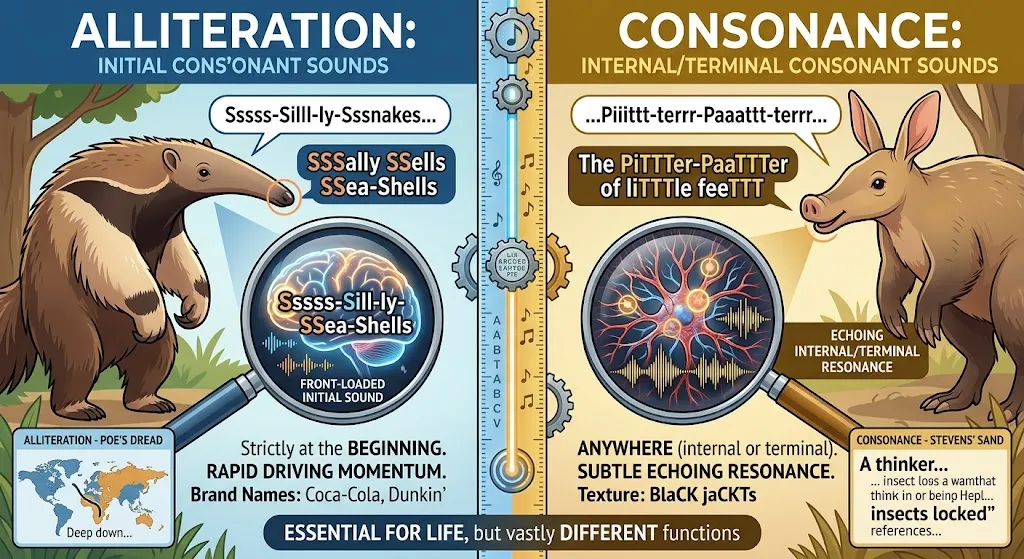
The difference between alliteration and consonance is essential for understanding how language creates rhythm and beauty. Alliteration focuses on repeating initial consonant sounds, while consonance emphasizes repeated consonant sounds within or at the end of words. Both techniques are widely used in poetry, advertising, and everyday speech. Recognizing the difference between alliteration and consonance helps learners improve writing skills and literary analysis. These sound devices not only enhance creativity but also make communication more engaging and memorable. By mastering the difference between alliteration and consonance, readers can better appreciate the musical quality of English language in literature and media.The easiest way to tell them apart is to look at where the sound waves physically collide in a sequence of words.
[ ALLITERATION ]
👉 Focuses ONLY on the front-loaded initial sound.

   "Peter Piper picked a peck..."
    ▲     ▲     ▲        ▲

-------------------------------------------------------

[ CONSONANCE ]
👉 Focuses on sounds tucked deep inside or capping off the words.

   "The pitter-patter of little feet..."
          ▲  ▲   ▲  ▲        ▲  ▲
Alliteration (Initial Repetition)
- What it is: The repetition of the same consonant sound at the beginning of adjacent or closely connected words.
- The Rule: It relies strictly on the sound, not the letter. For example, “Chilly cats” isn’t alliterative, but “Capable cats” is.
- Primary Effect: It creates a rapid, driving forward momentum. It is highly punchy, which is why it dominates marketing brand names (e.g., Best Buy, Coca-Cola, Dunkin’ Donuts).
Consonance (Internal or Terminal Repetition)
- What it is: The repetition of identical consonant sounds across words, most distinctively when found in the middle (internal) or at the end (terminal) of those words.
- The Rule: The vowel sounds surrounding the consonants must change; otherwise, you are just dealing with pure rhyme.
- Primary Effect: It creates a subtle, echoing internal resonance. It feels more textured and less obvious than alliteration, making it a favorite for poets who want to craft a specific mood without sounding like a nursery rhyme.
Literary Examples side-by-side
To see how they alter the texture of a line, look at how masters of the English language deploy them:
Classic Alliteration
“Deep down in that darkness dwelling, dreading…”
— Edgar Allan Poe, The Raven
The heavy, repetitive front-loaded “D” sound acts like a rhythmic drumbeat, physically dragging the reader forward into the line and mimicking the heavy feeling of dread.
Classic Consonance
“A thinker… who blinks the tense insects locked in the sand.”
Wallace Stevens, The Comedian as the Letter El
Notice how your tongue has to dance across the sharp “nk”, “ns”, and “ck” sounds inside the words. It creates a dry, scratchy, micro-textured auditory sensation that perfectly mirrors the image of insects trapped in desert sand.
Summary: Writing Application
When building a piece of content, a speech, or an ad layout:
Use consonance when you want to weave a subtle, rich undercurrent of sound that evokes a specific sensory feeling without calling too much overt attention to itself.
Use alliteration when you want immediate structural impact, quick memory recall, or high-energy pacing.

I am a professional SEO content writer specialising in comparison-based and grammar-focused articles. Through my website GrammarCompare.com, I help readers clearly understand the difference between confusing terms with well-researched, easy-to-read content. My expertise lies in focusing on clarity, accuracy, and practical explanations that improve both knowledge and writing skills.