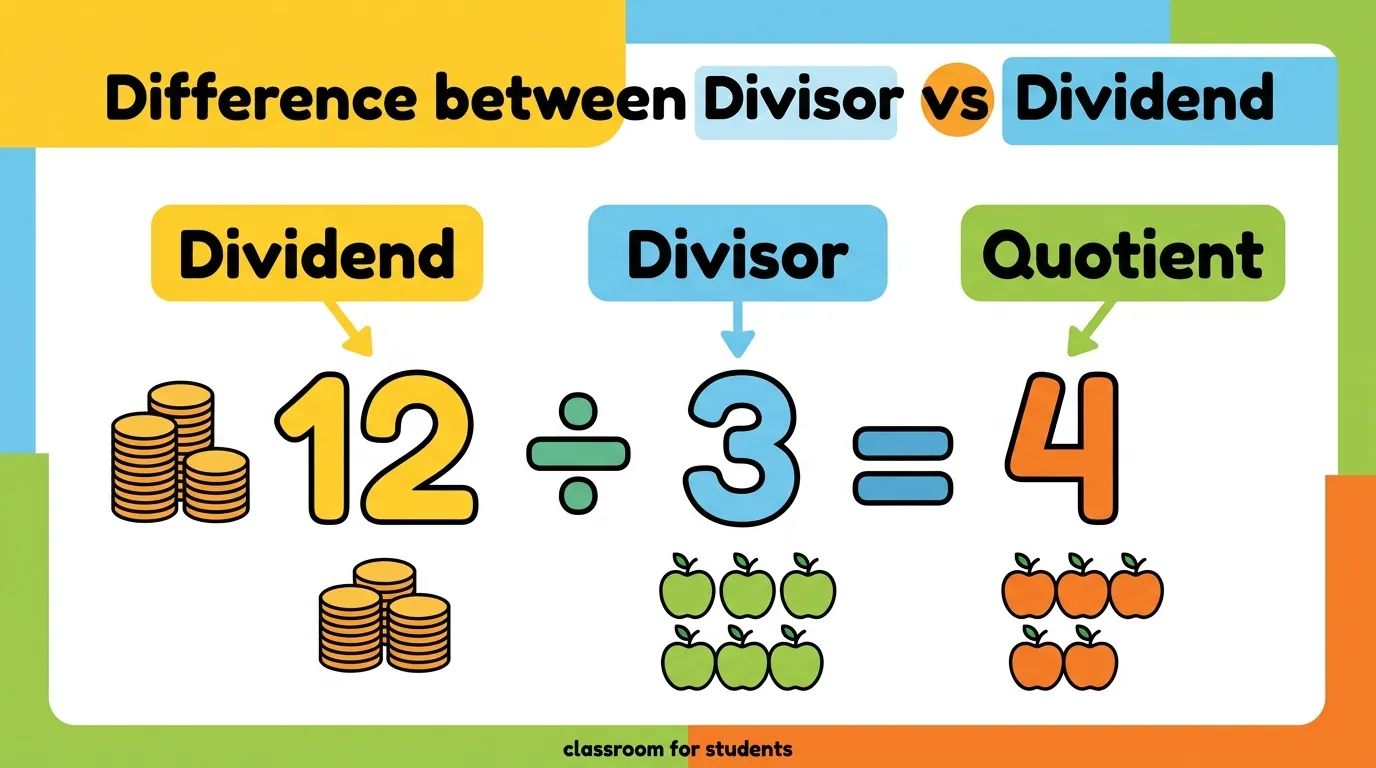
Imagine a teacher dividing a box of 24 chocolates among 6 students in a classroom. The total chocolates (24) are being split into equal parts, and each student receives some share. In this real-life situation, the number being divided is called the dividend, while the number we divide by is the divisor. This simple story reflects the difference between divisor and dividend in everyday life.
Understanding the difference between divisor and dividend is essential not only in mathematics but also in solving real-world problems like sharing resources or budgeting. Many learners struggle with the difference between divisor and dividend, especially in early education, but mastering it builds a strong mathematical foundation. In fact, recognizing the difference between divisor and dividend helps both students and professionals perform calculations accurately and confidently.
Key Difference Between the Both
The dividend is the number that is being divided, while the divisor is the number by which we divide the dividend.
Why Is Their Difference Necessary to Know?
Knowing the difference between divisor and dividend is crucial for students, teachers, and professionals because division is a fundamental mathematical operation. It helps in fair distribution, financial planning, engineering calculations, and data analysis. Without understanding these roles, errors can occur in simple and complex calculations, affecting real-life decisions.
Pronunciation
- Dividend:
- US: /ˈdɪvɪˌdɛnd/
- UK: /ˈdɪvɪdɛnd/
- Divisor:
- US: /dɪˈvaɪzər/
- UK: /dɪˈvaɪzə/
Now that you understand the basics, let’s explore the detailed difference between divisor and dividend.
Difference Between Divisor and Dividend
1. Definition
- Dividend: The number being divided.
- Example 1: In 20 ÷ 5, 20 is the dividend.
- Example 2: In 50 ÷ 10, 50 is the dividend.
- Divisor: The number that divides.
- Example 1: In 20 ÷ 5, 5 is the divisor.
- Example 2: In 50 ÷ 10, 10 is the divisor.
2. Position in Division
- Dividend comes first.
- Example 1: 30 ÷ 6
- Example 2: 100 ÷ 20
- Divisor comes second.
- Example 1: 30 ÷ 6
- Example 2: 100 ÷ 20
3. Role
- Dividend provides the total quantity.
- Example 1: Total apples = 12
- Example 2: Total money = 100
- Divisor determines how many parts.
- Example 1: Divide among 3 people
- Example 2: Divide into 5 groups
4. Mathematical Function
- Dividend is the input.
- Example 1: 40 ÷ 8
- Example 2: 60 ÷ 6
- Divisor is the operator.
- Example 1: 40 ÷ 8
- Example 2: 60 ÷ 6
5. Size Comparison
- Dividend is usually larger.
- Example 1: 25 ÷ 5
- Example 2: 80 ÷ 10
- Divisor is usually smaller.
- Example 1: 25 ÷ 5
- Example 2: 80 ÷ 10
6. Relation to Quotient
- Dividend equals divisor × quotient.
- Example 1: 20 = 5 × 4
- Example 2: 30 = 6 × 5
- Divisor helps find quotient.
- Example 1: 20 ÷ 5 = 4
- Example 2: 30 ÷ 6 = 5
7. Real-life Meaning
- Dividend represents total items.
- Example 1: 10 candies
- Example 2: 50 books
- Divisor represents number of groups.
- Example 1: 2 children
- Example 2: 5 shelves
8. Dependency
- Dividend depends on context.
- Example 1: Total marks
- Example 2: Total distance
- Divisor depends on division method.
- Example 1: Number of students
- Example 2: Number of days
9. Symbol Representation
- Dividend is before ÷ sign.
- Example 1: 18 ÷ 3
- Example 2: 45 ÷ 9
- Divisor is after ÷ sign.
- Example 1: 18 ÷ 3
- Example 2: 45 ÷ 9
10. Error Impact
- Wrong dividend gives wrong total.
- Example 1: Using 15 instead of 12
- Example 2: Using 90 instead of 100
- Wrong divisor gives wrong grouping.
- Example 1: Dividing by 4 instead of 3
- Example 2: Dividing by 6 instead of 5
Nature and Behaviour
- Dividend: Passive; it gets divided. It represents the whole quantity.
- Divisor: Active; it performs division. It controls how division happens.
Why People Are Confused
People often confuse these terms because both appear in the same equation and are closely related. Also, their names sound similar, which adds to the confusion, especially for beginners.
Table: Difference and Similarities
| Feature | Dividend | Divisor | Similarity |
| Definition | Number being divided | Number dividing | Both used in division |
| Position | First | Second | Same equation |
| Role | Total value | Divider | Produce quotient |
| Function | Input | Operator | Mathematical relationship |
Which Is Better in What Situation?
The dividend is more important when you want to know the total quantity or value involved. For example, in budgeting or inventory, the dividend represents the whole amount you are dealing with. Without the correct dividend, the calculation loses its meaning entirely.
The divisor becomes more important when deciding how to distribute or divide something. For instance, in sharing resources or planning schedules, the divisor determines fairness and structure. Choosing the right divisor ensures equal and logical distribution.
Metaphors and Similes
- Dividend is like a “cake waiting to be sliced.”
- Divisor is like a “knife that decides the slices.”
Connotative Meaning
- Dividend: Neutral (represents quantity)
- Example: “The dividend of effort brings success.”
- Divisor: Neutral/Positive (represents organization)
- Example: “Discipline is the divisor of chaos.”
Idioms or Proverbs
(No direct idioms exist, but related expressions can be adapted)
- “Divide and conquer”
- Example: The divisor helps divide problems to solve them easily.
Works in Literature
- Mathematics for the Million (Non-fiction, Lancelot Hogben, 1936)
- The Joy of x (Non-fiction, Steven Strogatz, 2012)
Movies Related to Mathematics
- A Beautiful Mind (2001, USA)
- The Man Who Knew Infinity (2015, UK/USA)
FAQs
1. What is the main difference between divisor and dividend?
The dividend is divided, while the divisor divides it.
2. Can a divisor be bigger than a dividend?
Yes, but it results in a fraction.
3. What comes first in division?
The dividend comes first.
4. Why are they important?
They help perform accurate mathematical operations.
5. Are they used in real life?
Yes, in budgeting, sharing, and planning.
How Both Are Useful for Surroundings
Both dividend and divisor help in everyday tasks like sharing food, dividing money, organizing work, and managing time efficiently.
Final Words for Both
The dividend represents the whole, while the divisor brings structure. Together, they create balance in calculations.
Conclusion
Understanding the difference between divisor and dividend is essential for mastering basic mathematics and applying it in real life. While the dividend represents the total quantity, the divisor determines how that quantity is divided. Both play equally important roles in achieving accurate results. From classrooms to real-world problem-solving, their proper use ensures clarity and efficiency. By learning their differences and functions, learners can build a strong foundation in mathematics and improve their analytical thinking skills.
1. The Gateway to Fraction and Ratio Optimization
Once a learner fully grasps the roles of the dividend and the divisor, the transition to fractions, percentages, and ratios becomes intuitive rather than intimidating.
- The Numerator and Denominator: In higher math, the dividend becomes the numerator, and the divisor becomes the denominator ($\frac{\text{Dividend}}{\text{Divisor}}$). A solid understanding of the introductory concept prevents the common mistake of confusing which number alters the scale of a fraction.
- Proportional Reasoning: It trains the brain to understand how changes to one side of an equation affect the outcome. For instance, if you want a fraction to result in a larger number, you can either increase the dividend (top) or decrease the divisor (bottom). This is the exact logic used in financial forecasting and scientific scaling.
2. Developing an Algorithmic Mindset
In the modern digital world, understanding the divisor and dividend is essential for computer science and programming. The logic of division forms the basis for two critical computational operations:
- Integer Division: Telling a computer to divide a dividend by a divisor and throw away the remainder (focusing strictly on how many whole times the divisor fits).
- The Modulo Operation ($X \pmod Y$): An essential programming tool that ignores the quotient and only looks at the remainder left over after the dividend is split by the divisor. This is used everywhere from cryptography to creating alternating row colors on a website or determining if a number is even or odd.
Without a firm grip on which number holds the structural power (the divisor), writing or understanding these foundational algorithms is impossible.
3. Real-World Decision Architecture: Fixed vs. Variable Limits
In professional problem-solving, understanding these two roles helps analytical thinkers recognize what kind of constraint they are dealing with:
- When the Dividend is Fixed: You have a hard ceiling on resources. For example, a non-profit has a fixed grant of $\$50,000$ (Dividend). Their analytical challenge is adjusting the divisor (the number of projects or duration of time) to maximize the impact of that fixed amount.
- When the Divisor is Fixed: You have a structural constraint. For example, a logistics company has exactly 10 delivery trucks (Divisor). Their challenge is maximizing the dividend (the volume of packages processed) to ensure those 10 structural units are running at peak efficiency

I am a professional SEO content writer specialising in comparison-based and grammar-focused articles. Through my website GrammarCompare.com, I help readers clearly understand the difference between confusing terms with well-researched, easy-to-read content. My expertise lies in focusing on clarity, accuracy, and practical explanations that improve both knowledge and writing skills.