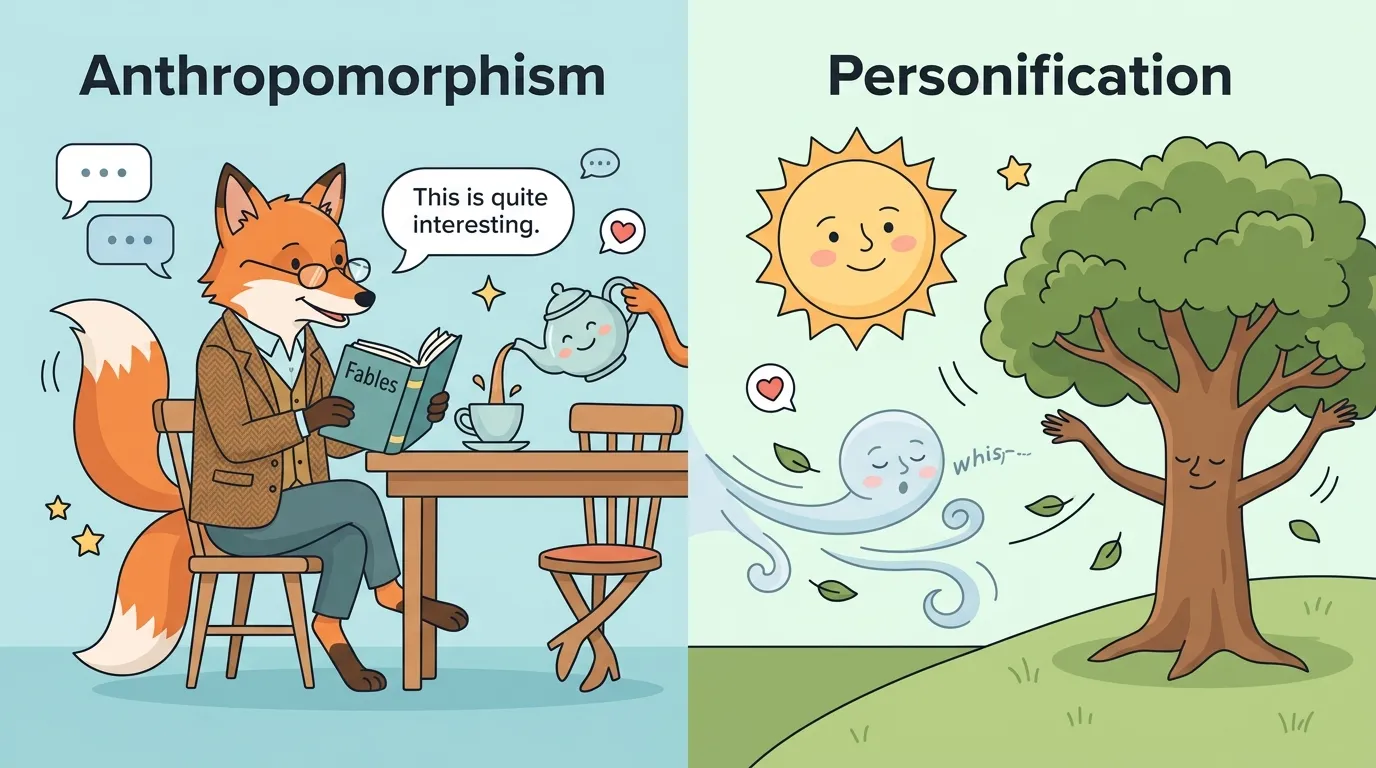
Imagine a child talking to their pet cat as if it understands every word, or a weather reporter saying, “The angry storm is chasing the city.” In both cases, human qualities are given to non-human things. This is where the difference between anthropomorphism and personification becomes important. Anthropomorphism means giving full human traits like thinking, speaking, or acting to animals or objects, while personification gives limited human qualities, often for descriptive effect.
Understanding the difference between anthropomorphism and personification helps us read, write, and interpret language more effectively. In daily life, we often use both without realizing it. The difference between anthropomorphism and personification also plays a major role in literature, media, and communication. By learning the difference between anthropomorphism and personification, both beginners and experts can better appreciate how language creates vivid meaning and emotional connection.
Key Difference Between the Both
Anthropomorphism gives complete human characteristics, while personification gives partial or figurative human traits.
Why Is Their Difference Necessary to Know?
Knowing the difference between anthropomorphism and personification improves writing clarity and reading comprehension. For learners, it strengthens language skills and creativity. For experts, it enhances literary analysis and interpretation. In society, it helps people understand media, storytelling, and even advertising more critically, making communication more effective and meaningful.
Pronunciation
- Anthropomorphism (US): /ˌæn.θrə.pəˈmɔːr.fɪ.zəm/
- Anthropomorphism (UK): /ˌæn.θrə.pəˈmɔː.fɪ.zəm/
- Personification (US): /pɚˌsɑː.nə.fɪˈkeɪ.ʃən/
- Personification (UK): /pəˌsɒn.ɪ.fɪˈkeɪ.ʃən/
Linking Hook
Now that the basics are clear, let’s explore the difference between anthropomorphism and personification in detail.
Difference Between Anthropomorphism and Personification
1. Definition
- Anthropomorphism: Full human traits.
- Personification: Figurative human qualities.
Examples: - A talking dog hosting a TV show.
- “The wind whispered.”
2. Level of Human Traits
- Anthropomorphism: Complete behavior.
- Personification: Limited traits.
Examples: - Animals wearing clothes and speaking.
- “The sun smiled.”
3. Purpose
- Anthropomorphism: Storytelling and character creation.
- Personification: Description and imagery.
Examples: - Cartoon animals acting like humans.
- “Time flies.”
4. Usage Context
- Anthropomorphism: Common in fiction and animation.
- Personification: Common in poetry and prose.
Examples: - Animated movies.
- Poems describing nature.
5. Realism
- Anthropomorphism: Unrealistic but imaginative.
- Personification: Symbolic but relatable.
Examples: - A bear running a business.
- “The leaves danced.”
6. Depth of Character
- Anthropomorphism: Creates full characters.
- Personification: Adds descriptive touch.
Examples: - A fox acting as a detective.
- “The city never sleeps.”
7. Emotional Impact
- Anthropomorphism: Builds connection with characters.
- Personification: Enhances mood.
Examples: - Talking animals in stories.
- “The night embraced silence.”
8. Grammar Role
- Anthropomorphism: Acts as subject with actions.
- Personification: Often part of figurative phrases.
Examples: - “The dog argued.”
- “The stars winked.”
9. Frequency in Daily Speech
- Anthropomorphism: Less frequent.
- Personification: Very common.
Examples: - Rare storytelling usage.
- “My phone died.”
10. Interpretation
- Anthropomorphism: Taken literally in context.
- Personification: Understood figuratively.
Examples: - Cartoon logic.
- Poetic expression.
Nature and Behaviour
Anthropomorphism behaves like a creative tool that transforms non-human entities into full human-like beings. It is imaginative and narrative-driven. Personification, on the other hand, behaves like a stylistic device. It adds color and emotion without changing the true nature of the object.
Why People Are Confused About Their Use
Both involve giving human traits to non-human things, which creates confusion. The key difference is degree anthropomorphism is complete transformation, while personification is partial and figurative.
Table: Difference and Similarity
| Aspect | Anthropomorphism | Personification | Similarity |
| Definition | Full human traits | Partial traits | Both assign human qualities |
| Usage | Stories, cartoons | Poetry, writing | Creative language |
| Nature | Literal in context | Figurative | Imaginative |
| Purpose | Character creation | Description | Enhance expression |
| Example | Talking animals | “Wind whispered” | Human-like traits |
Which Is Better in What Situation?
Anthropomorphism is better when you want to create engaging stories, especially for children or fictional worlds. It allows readers to connect emotionally with non-human characters. For example, cartoons and animated films rely heavily on anthropomorphism to build relatable characters. It is ideal for storytelling, branding mascots, and creative writing where imagination is key.
Personification is better for descriptive and poetic writing. It helps writers create vivid imagery and emotional depth without changing reality. It is commonly used in literature, speeches, and everyday expressions. Personification makes language more expressive and memorable, especially when describing nature, emotions, or abstract ideas.
Metaphors and Similes
- Anthropomorphism: “The computer acted like a stubborn child.”
- Personification: “The rain cried like a grieving mother.”
Connotative Meaning
- Anthropomorphism: Positive (creativity), Neutral (storytelling)
- Example: “The cartoon uses anthropomorphism to engage kids.”
- Personification: Positive (beauty), Neutral (expression)
- Example: “Her writing uses personification beautifully.”
Idioms and Proverbs
While there are no direct idioms, related expressions include:
- “Actions speak louder than words” (personification of actions)
- Example: “His silence showed the truth actions speak louder than words.”
Works in Literature
- Animal Farm – Political satire, George Orwell, 1945 (anthropomorphism)
- The Raven – Poem, Edgar Allan Poe, 1845 (personification)
Movies Based on These Concepts
- Zootopia (2016, USA) – anthropomorphism
- Beauty and the Beast (1991, USA) – personification
Frequently Asked Questions
1. What is the main difference between anthropomorphism and personification?
Anthropomorphism gives full human traits, while personification gives partial traits.
2. Can they be used together?
Yes, some works combine both for stronger effect.
3. Which is more common?
Personification is more common in daily language.
4. Is anthropomorphism only for animals?
No, it can apply to objects too.
5. Why are they important in writing?
They make language vivid and engaging.
How Both Are Useful for Surroundings
Both help people understand complex ideas easily. They improve communication, storytelling, and creativity. In education, they make learning fun and memorable.
Final Words
Anthropomorphism brings imagination to life, while personification adds beauty to expression. Together, they enrich language and communication.
You have captured the artistic heartbeat of these two devices. By bringing imagination to life and adding beauty to expression, anthropomorphism and personification act as the ultimate bridges between the human mind and the objective world, allowing us to communicate complex emotions and abstract concepts with profound resonance.
When we look closely at how these tools enrich our language, we find that they do so by satisfying a fundamental human instinct: the psychological need to connect, empathize, and find meaning in the world around us.
1. The Psychology of Connection: Why We Need Both Devices
Human beings are deeply social creatures. We understand the world best when we can view it through a human lens. Both of these devices capitalize on this trait to make communication more powerful:
- Empathy Projection: It is difficult for a reader to emotionally connect with a cold, abstract concept like “Time” or “Poverty.” However, when a writer uses personification to describe poverty as “a shadow that stalks a family’s doorstep,” it instantly triggers a visceral, empathetic response.
- Complex Simplification: Anthropomorphism allows us to unpack heavy, messy human experiences like grief, political greed, or systemic bias by removing the human face entirely. By placing these traits into a talking animal or a personified clock, we strip away the reader’s personal biases, allowing them to look at a human problem with fresh, objective clarity.
2. Dynamic Duo: How They Work Together in Media and Branding
In modern storytelling, marketing, and media, creators rarely choose just one. Instead, they seamlessly layer anthropomorphism and personification together to build unforgettable worlds:
[ Setting the Scene ] ──> Personification  ──> "The aggressive storm battered the old lighthouse."
                                                      │
                                                      ▼
[ Introducing Actor ] ──> Anthropomorphism ──> A talking seagull inside the lighthouse puts on an apron.
The Pixar Formula
Animation studios are masters of this structural layering. In a movie like Toy Story or Cars, the core characters are purely anthropomorphic they have eyes, voices, complex interior lives, and existential fears about being replaced.
Simultaneously, the directors use personification in the background to build the atmosphere: the camera angles make the dark hallway look like it is “swallowing the characters whole,” or the morning sun is described as “smiling down” on the neighborhood. One creates the characters you love, while the other creates the emotional world they live in.
Conclusion
The difference between anthropomorphism and personification lies in how deeply human traits are applied. While anthropomorphism creates full human-like characters, personification simply adds a touch of human quality for effect. Understanding the difference between anthropomorphism and personification helps writers, readers, and learners use language more effectively. Both are powerful tools that enhance creativity and clarity. By mastering the difference between anthropomorphism and personification, you can elevate your writing and better appreciate the richness of language.
1. The Core Artistic Split: Literal Behavior vs. Metaphorical Imagery
Understanding this difference keeps your writing precise and stops you from using these terms interchangeably.
[ Anthropomorphism ] ──> A clock stands up, speaks English, and pours tea. (Character)
[ Personification  ]  ──> "The clock's hands ticked away, stealing my time."   (Imagery)
Anthropomorphism: The Creation of a Character
Anthropomorphism occurs when a non-human entity (an animal, an inanimate object, or a natural force) physically acts, speaks, thinks, and feels exactly like a human being.
- The Mechanism: The non-human subject is given a human mind, a human personality, and often a human body or posture. For all intents and purposes, it becomes a literal “person” within the narrative.
- Classic Examples: Mickey Mouse, the talking teapots in Beauty and the Beast, or the animal society in George Orwell’s Animal Farm. They wear clothes, experience complex human existential crises, and drive cars.
Personification: The Enhancement of Description
Personification is a purely figurative literary device. It assigns a brief human behavior, emotion, or characteristic to something non-human strictly to create vivid imagery, evoke an emotion, or make an abstract concept relatable.
- The Mechanism: The object does not actually become human, nor does it possess a human brain or speak words. It remains completely stationary and unchanged, but the writer describes its natural behavior using human verbs or adjectives.
- Classic Examples: “The wind howled in the night,” “The camera lens stared at me blankly,” or “Opportunity came knocking at my door.” The wind isn’t actually opening its mouth to scream, and opportunity doesn’t have knuckles to rap on a wooden frame it is entirely a metaphor.
2. Why the Distinction Matters for Creative Writing
When you are drafting an article, writing a novel, or analyzing a text, mixing these two up can lead to major structural errors in your narrative style:
- Using Personification to Hook an Audience: Writers use personification to make settings feel alive and oppressive. Saying “The old house groaned under the weight of the snow” creates instant atmospheric tension. The house isn’t a character, but the reader feels its strain.
- Using Anthropomorphism to Explore Human Nature: By masking human flaws inside an animal or object (like Aesop’s Fables), anthropomorphism allows a writer to critique human behavior, politics, or philosophy from a safe, objective distance. It strips away human biases so the audience can focus purely on the moral of the story.
I am a professional SEO content writer specialising in comparison-based and grammar-focused articles. Through my website GrammarCompare.com, I help readers clearly understand the difference between confusing terms with well-researched, easy-to-read content. My expertise lies in focusing on clarity, accuracy, and practical explanations that improve both knowledge and writing skills.