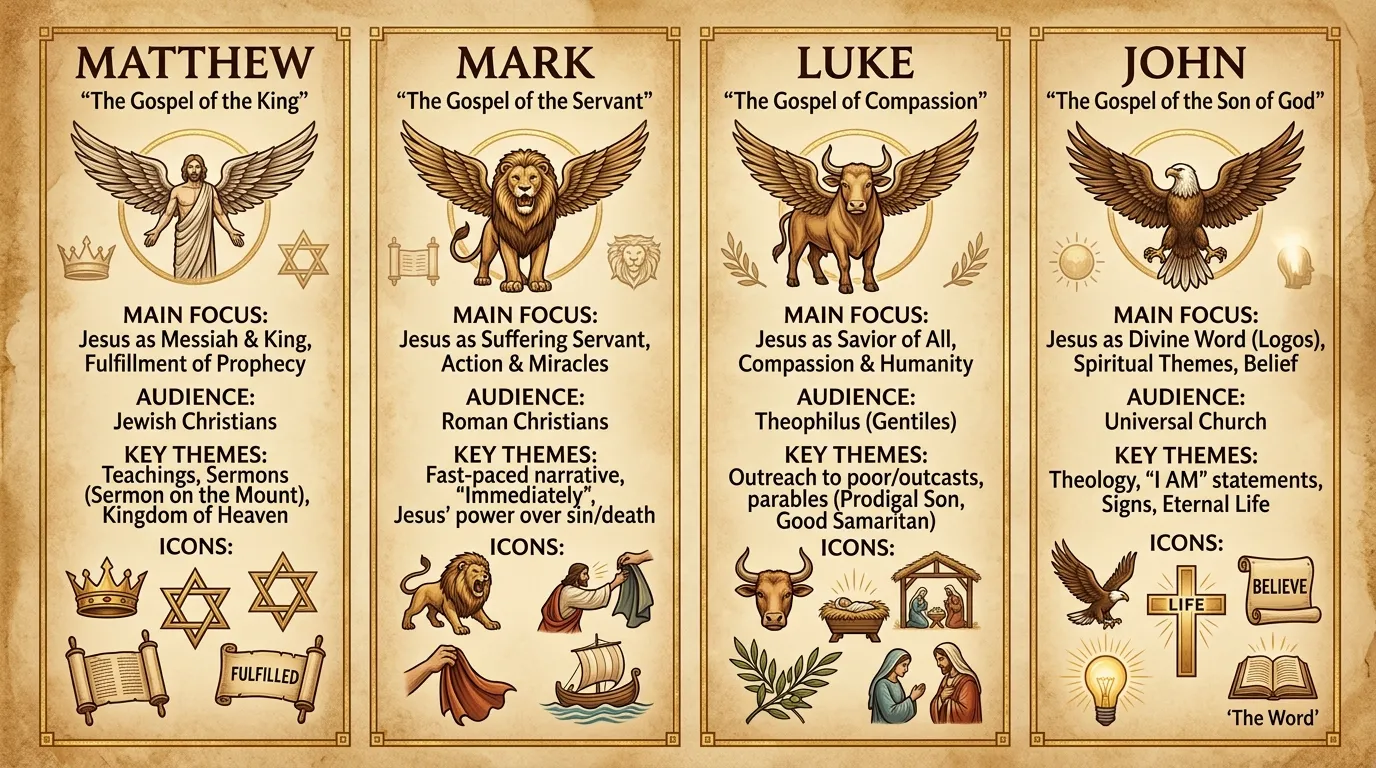
Imagine four journalists covering the same major event. Each one observes the same story but highlights different details, speaks to different audiences, and uses a unique tone. This is the best way to understand the difference between the gospels. The term “gospels” refers to the first four books of the New Testament Matthew, Mark, Luke, and John which tell the story of Jesus Christ’s life and teachings.
When exploring the difference between the gospels, we are not looking at contradictions but perspectives. The difference between the gospels helps us see a richer, fuller picture of the same message. In fact, understanding the difference between the gospels allows both learners and experts to appreciate how context, audience, and purpose shape storytelling. This diversity is what makes the study of these texts deeply meaningful and intellectually rewarding.
Key Difference Between the Gospels
The key difference lies in their audience, style, and theological emphasis. While the core message remains the same, each gospel presents Jesus in a unique way.
Why Is Their Difference Necessary to Know?
Understanding the difference between the gospels is essential because it enhances interpretation and avoids confusion. For learners, it builds critical thinking and reading skills. For experts, it opens doors to deeper theological and historical analysis. In society, this knowledge promotes respectful dialogue, cultural literacy, and a better understanding of religious diversity.
Pronunciation
- Gospel (US): /ˈɡɑː.spəl/
- Gospel (UK): /ˈɡɒs.pəl/
Linking Hook
Now that we understand why the difference between the gospels matters, let’s explore their distinctions in detail.
Difference Between the Gospels
1. Audience Focus
- Matthew: Written for Jewish readers.
- Luke: Written for Gentiles (non-Jews).
Examples: - Matthew connects Jesus to Jewish prophecy.
- Luke explains Jewish customs for outsiders.
2. Writing Style
- Mark: Fast-paced and action-oriented.
- John: Reflective and philosophical.
Examples: - Mark uses words like “immediately.”
- John includes long spiritual discourses.
3. Portrayal of Jesus
- Matthew: Jesus as King.
- Mark: Jesus as Servant.
Examples: - Matthew emphasizes authority.
- Mark highlights service and sacrifice.
4. Genealogy
- Matthew: Traces lineage to Abraham.
- Luke: Traces lineage to Adam.
Examples: - Matthew shows Jewish heritage.
- Luke shows universal humanity.
5. Birth Narrative
- Matthew: Focuses on Joseph.
- Luke: Focuses on Mary.
Examples: - Matthew includes the Magi.
- Luke includes shepherds.
6. Miracles
- Mark: Emphasizes many miracles.
- John: Selects fewer but symbolic miracles.
Examples: - Mark shows healing crowds.
- John highlights turning water into wine.
7. Teachings
- Matthew: Structured sermons.
- Luke: Parables and stories.
Examples: - Matthew includes the Sermon on the Mount.
- Luke includes the Good Samaritan.
8. Timeline
- Mark: Shorter timeline.
- John: Extended timeline.
Examples: - Mark covers events quickly.
- John includes multiple visits to Jerusalem.
9. Language Tone
- Luke: Polished and educated Greek.
- Mark: Simple and direct language.
Examples: - Luke appeals to educated readers.
- Mark is easy for general audiences.
10. Theological Focus
- John: Divinity of Jesus.
- Matthew, Mark, Luke: Humanity and teachings.
Examples: - John calls Jesus “the Word.”
- Synoptic gospels focus on actions.
Nature and Behaviour of the Gospels
The Synoptic Gospels (Matthew, Mark, Luke) are similar in structure and narrative. They focus on events and teachings in a chronological manner. John’s Gospel, however, is more reflective and symbolic, emphasizing spiritual meaning rather than sequence.
Why People Are Confused About Their Use
People often expect identical storytelling. However, the difference between the gospels lies in perspective, not contradiction. Just like eyewitness accounts differ, these variations reflect purpose, audience, and emphasis.
Table: Difference and Similarity Between the Gospels
| Aspect | Matthew | Mark | Luke | John | Similarity |
| Audience | Jews | Romans | Gentiles | Universal | All share Jesus’ message |
| Style | Structured | Fast | Detailed | Reflective | Narrative form |
| Focus | King | Servant | Savior | Divine Son | Same central figure |
| Miracles | Moderate | Many | Balanced | Symbolic | Show power of Jesus |
| Teachings | Sermons | Actions | Parables | Discourses | Moral lessons |
Which Is Better in What Situation?
For beginners, Mark is often the best choice because it is short and easy to follow. It provides a quick overview of Jesus’ life and actions. Matthew is ideal for those interested in Jewish history and prophecy, while Luke suits readers who enjoy detailed storytelling and social themes. John is best for advanced readers who want to explore deeper spiritual and philosophical ideas. Each gospel serves a purpose, so none is “better”it depends on the reader’s goal.
Metaphors and Similes
- “The gospels are like four mirrors reflecting the same light.”
- “Reading them is like hearing one song in four different voices.”
Connotative Meaning
- Gospel (Positive): Truth, hope, guidance
- Example: “His advice felt like gospel truth.”
- Gospel (Neutral): Religious teaching
- Example: “She studies the gospel academically.”
- Gospel (Negative – rare): Blind belief
- Example: “He treats rumors as gospel.”
Idioms and Proverbs
- “Take it as gospel” – believe completely
- Example: “Don’t take everything you hear as gospel.”
Works in Literature
- Gospel According to Matthew – Religious text, 1st century
- The Gospel According to Jesus Christ – Novel by José Saramago, 1991
Movies Based on the Gospels
- The Gospel According to St. Matthew (1964, Italy)
- The Gospel of John (2003, Canada)
Frequently Asked Questions
1. Why are there four gospels instead of one?
Because different authors wrote for different audiences and purposes.
2. Are the gospels contradictory?
No, they are complementary perspectives.
3. Which gospel was written first?
Mark is generally considered the earliest.
4. Why is John different from the others?
It focuses more on theology than narrative.
5. Can beginners read all four?
Yes, but starting with Mark or Luke is easier.
How Both Are Useful for Surroundings
The gospels teach moral values like compassion, forgiveness, and humility. They influence culture, literature, and ethical thinking, helping individuals build better relationships and communities.
Final Words for the Gospels
The beauty of the gospels lies in their diversity. Each one adds depth and meaning to the story of Jesus, making the message more complete and relatable.
Conclusion
Understanding the difference between the gospels is not about choosing one over another but appreciating their unity in diversity. Each gospel offers a unique lens through which we can view the life and teachings of Jesus. Together, they create a fuller narrative that speaks to people across cultures and generations. Whether you are a learner or an expert, exploring these differences enriches your knowledge and deepens your perspective. The difference between the gospels ultimately strengthens our understanding rather than weakening it.
1. The Great Structural Divide: Synoptic vs. Johannine
Before looking at the individual books, the Gospels must be split into two massive literary categories based on their structural architecture:
                  [ The Four Gospels ]
                           │
         ┌─────────────────┴─────────────────┐
         ▼                                   ▼
[ The Synoptics ]                     [ The Johannine ]
Matthew, Mark, Luke                   John
(Shared timeline, parables, miracles) (Unique timeline, long discourses)
The Synoptic Gospels (Matthew, Mark, and Luke)
The word “Synoptic” comes from the Greek synopsis, meaning “seeing together” or “viewing from a shared perspective.” These three books read very similarly. They share roughly the same geographical timeline (Jesus ministries in Galilee, culminating in a single journey to Jerusalem), utilize short, punchy parables, and focus heavily on the physical “Kingdom of God.”
The Johannine Gospel (John)
The Gospel of John is a completely independent literary creation. Over 90% of the material in John is not found in the other three Gospels. John discards the short parables in favor of long, deeply philosophical discourses. Furthermore, Jesus’ ministry timeline is different, tracking multiple trips to Jerusalem for various Jewish festivals, which is how historians deduced that Jesus’ public ministry lasted roughly three years.
2. The Four Portraits: Target Audiences and Distinct Themes
To truly appreciate their diversity, you must look at who each author was trying to persuade and how they chose to present Jesus to that specific demographic:
👑 Matthew: The Promised Jewish Messiah
Matthew was a Jewish tax collector writing primarily to a Jewish-Christian audience struggling to understand how Christianity fit with ancient Hebrew law.
- The Unique Lens: Matthew presents Jesus as the ultimate King and Messiah who fulfills Old Testament prophecy.
- The Structural Tell: He constantly quotes Hebrew scripture, utilizing the phrase “this was done to fulfill what was spoken by the prophet.” He also structures his Gospel around five major blocks of teaching to mirror the five books of the Torah (Moses).
⏳ Mark: The Suffering Servant & Man of Action
Mark (historically associated with Peter) wrote the earliest and shortest Gospel, targeting a Roman audience—a culture that valued power, military efficiency, and action over lengthy philosophical speeches.
- The Unique Lens: Mark portrays Jesus as a tireless, urgent Suffering Servant on a mission.
- The Structural Tell: Mark skips Jesus’ birth entirely and dives straight into his adult ministry. He uses the Greek word euthys (“immediately” or “at once”) over 40 times, giving his narrative a fast-paced, cinematic energy.
🩺 Luke: The Compassionate Savior of the World
Luke was a Greek physician and a companion of the Apostle Paul. He wrote a highly polished, two-volume historical work (Luke-Acts) aimed at a Gentile (non-Jewish), educated Greek audience.
- The Unique Lens: Luke portrays Jesus as the Universal Savior of all humanity, emphasizing social justice, compassion, and inclusion.
- The Structural Tell: Luke’s Gospel goes out of its way to elevate individuals who were marginalized in first-century society focusing heavily on women, the poor, outcasts, and foreigners (like the Good Samaritan).
🕊️ John: The Divine Son of God
Writing much later than the others, John’s audience was the universal, evolving Christian Church, facing early internal debates about Jesus’ true nature.
- The Unique Lens: John filters everything through cosmic, theological truth, presenting Jesus clearly as the Incarnate Word of God made flesh.
- The Structural Tell: John replaces traditional birth narratives with a cosmic prologue (“In the beginning was the Word…”). He anchors his entire book around seven monumental “I Am” statements (e.g., “I am the bread of life,” “I am the light of the world”), explicitly declaring Jesus’ divinity.

I am a professional SEO content writer specialising in comparison-based and grammar-focused articles. Through my website GrammarCompare.com, I help readers clearly understand the difference between confusing terms with well-researched, easy-to-read content. My expertise lies in focusing on clarity, accuracy, and practical explanations that improve both knowledge and writing skills.