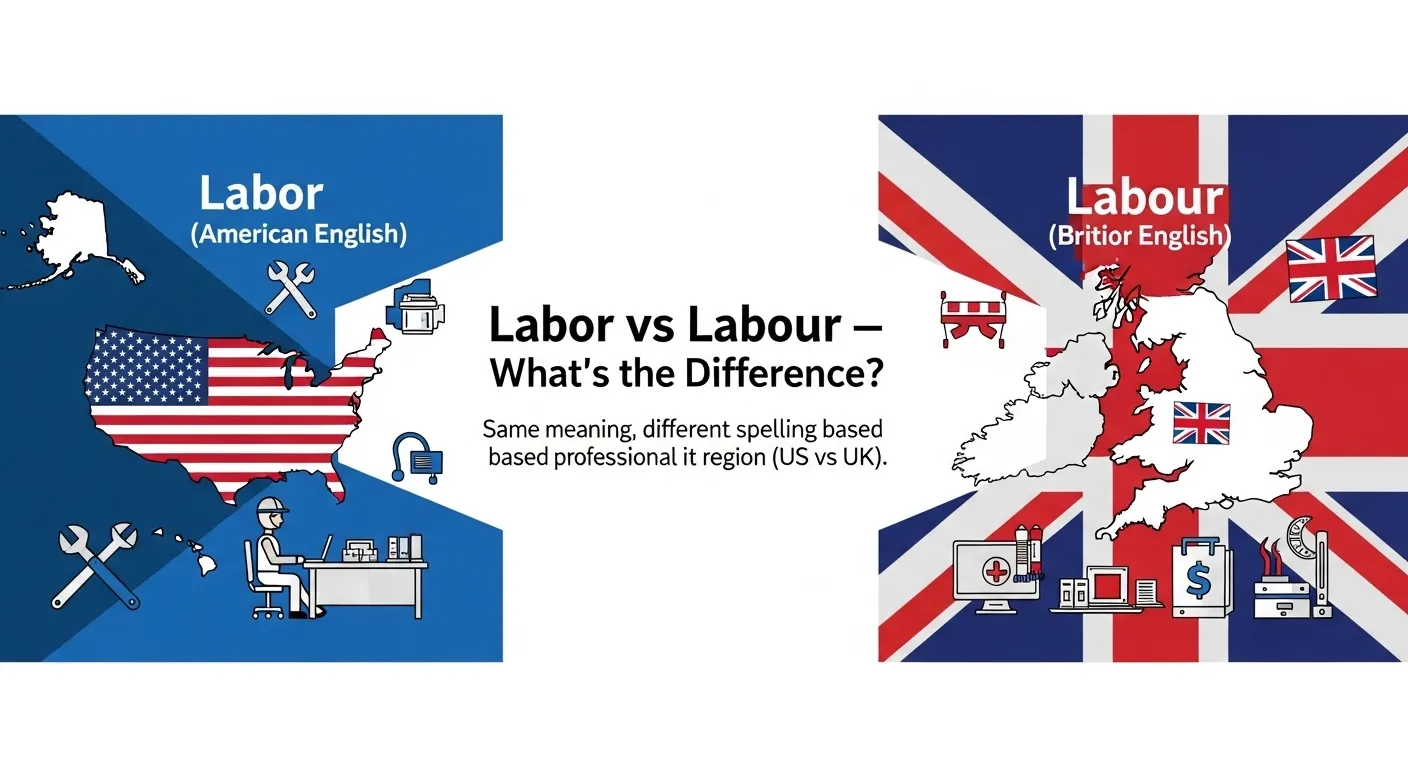
While editing an international report, a writer noticed something interesting—his American colleague used “labor,” while his British counterpart insisted on “labour.” Both were correct, yet different. This simple situation highlights the difference between labor and labour, a common confusion for English learners and even professionals. In essence, both words carry the same meaning: work, effort, or physical and mental exertion. However, the difference between labor and labour lies mainly in spelling and regional usage. Understanding the difference between labor and labour helps avoid errors in writing, especially in academic, professional, and global communication. This blog will clearly explain the difference between labor and labour so you can use each form correctly and confidently.
Key Difference Between the Both
The main difference is that “labor” is American English spelling, while “labour” is British English spelling.
Why Is Their Difference Necessary to Know?
Knowing this difference is essential because English is a global language with regional variations. Students, writers, and professionals must adapt their spelling depending on the audience. For example, academic papers in the United States require “labor,” while those in the United Kingdom prefer “labour.” Understanding this distinction improves writing accuracy, enhances credibility, and ensures effective communication across different regions and cultures.
Pronunciation (US & UK)
- Labor
- US: /ˈleɪ.bər/
- UK: /ˈleɪ.bə/
- Labour
- US: /ˈleɪ.bər/
- UK: /ˈleɪ.bə/
(Pronunciation is the same; only spelling differs.)
Now that the basics are clear, let’s explore their differences in detail.
Difference Between the Keywords
1. Spelling
- Labor: American spelling
- Example 1: “Labor laws in the US”
- Example 2: “Department of Labor”
- Labour: British spelling
- Example 1: “Labour laws in the UK”
- Example 2: “Ministry of Labour”
2. Region of Use
- Labor: Used in the United States
- Example 1: American textbooks
- Example 2: US media
- Labour: Used in the UK and Commonwealth
- Example 1: British publications
- Example 2: Canadian usage
3. Writing Style
- Labor: American English writing
- Example 1: Essays in US schools
- Example 2: US business reports
- Labour: British English writing
- Example 1: UK academic papers
- Example 2: Commonwealth documents
4. Institutional Usage
- Labor: Used in US organizations
- Example 1: US Department of Labor
- Example 2: Labor unions in the US
- Labour: Used in UK institutions
- Example 1: Labour Party
- Example 2: British labour unions
5. Global Preference
- Labor: Dominates in American influence
- Example 1: International companies based in US
- Example 2: American publications
- Labour: Common in global English outside US
- Example 1: UK-based journals
- Example 2: Commonwealth countries
6. Digital Usage
- Labor: Common in US-based websites
- Example 1: American blogs
- Example 2: US news portals
- Labour: Common in UK-based websites
- Example 1: British blogs
- Example 2: UK news sites
7. Academic Standards
- Labor: Used in APA style
- Example 1: US research papers
- Example 2: American universities
- Labour: Used in UK academic styles
- Example 1: British theses
- Example 2: UK journals
8. Historical Development
- Labor: Simplified spelling
- Example 1: Noah Webster reforms
- Example 2: American English evolution
- Labour: Traditional spelling
- Example 1: Old French influence
- Example 2: British linguistic history
9. Consistency Requirement
- Labor: Must be consistent in US writing
- Example 1: Entire document uses “labor”
- Example 2: Avoid mixing styles
- Labour: Must be consistent in UK writing
- Example 1: Entire document uses “labour”
- Example 2: Maintain uniform spelling
10. Meaning
- Labor: Work or effort
- Example 1: Physical labor
- Example 2: Labor during childbirth
- Labour: Same meaning
- Example 1: Manual labour
- Example 2: Labour pains
Nature and Behaviour
Labor:
“Labor” is modern, simplified, and widely used in American English. It reflects efficiency and streamlined spelling.
Labour:
“Labour” is traditional and formal, commonly used in British English. It reflects historical and linguistic heritage.
Why People Are Confused
People are confused because both words sound identical and have the same meaning. The only difference is spelling, which depends on region. Global communication mixes both styles, increasing confusion.
Difference and Similarity Table
| Aspect | Labor | Labour | Similarity |
| Spelling | American | British | Same meaning |
| Pronunciation | Same | Same | Identical sound |
| Usage | US | UK/Commonwealth | Used globally |
| Meaning | Work/effort | Work/effort | Completely same |
| Style | Simplified | Traditional | Context-based use |
Which Is Better in What Situation?
Labor:
“Labor” is better when writing for an American audience or following US academic or professional standards. It ensures consistency and aligns with expectations in the United States. Using “labor” in US-based documents enhances clarity and correctness.
Labour:
“Labour” is better when writing for British or Commonwealth audiences. It maintains linguistic accuracy and cultural relevance. Using “labour” in UK contexts reflects proper usage and professionalism.
Metaphors and Similes
- “Success is built on labor like a strong foundation.”
- “Her effort was as intense as labour in the fields.”
Connotative Meaning
- Labor: Neutral to positive (effort, productivity)
- Example: “Hard labor leads to success.”
- Labour: Neutral to slightly formal
- Example: “Manual labour built the nation.”
Idioms and Proverbs
- “Fruit of one’s labor/labour”
- Example: He enjoyed the fruit of his labor.
- “Labor of love”
- Example: The project was a labor of love.
Works in Literature
- “The Road to Wigan Pier” (Social commentary, George Orwell, 1937)
- “Das Kapital” (Economic theory, Karl Marx, 1867)
Movies Related to Labor Themes
- Modern Times (1936, USA)
- Norma Rae (1979, USA)
FAQs
1. Are labor and labour different in meaning?
No, both have the same meaning.
2. Which spelling is correct?
Both are correct depending on region.
3. Should I use both in one document?
No, stick to one style for consistency.
4. Why does American English use “labor”?
It follows simplified spelling rules.
5. Is labour more formal than labor?
Not necessarily, but it may feel more traditional.
How Both Are Useful for Surroundings
Both terms describe work and effort, which are essential in society. They represent human productivity, economic growth, and development across industries.
Final Words for Both
“Labor” and “labour” are two sides of the same coin—different in spelling but identical in meaning. Choosing the right one depends on context and audience.
Conclusion
Understanding the difference between labor and labour is crucial for clear and effective communication. While the words share the same meaning and pronunciation, their spelling differs based on regional usage. “Labor” is preferred in American English, while “labour” is used in British English and other Commonwealth countries. By recognizing this distinction, writers can ensure consistency, professionalism, and accuracy in their work. Ultimately, mastering such differences enhances language skills and helps bridge communication gaps in a globalized world.