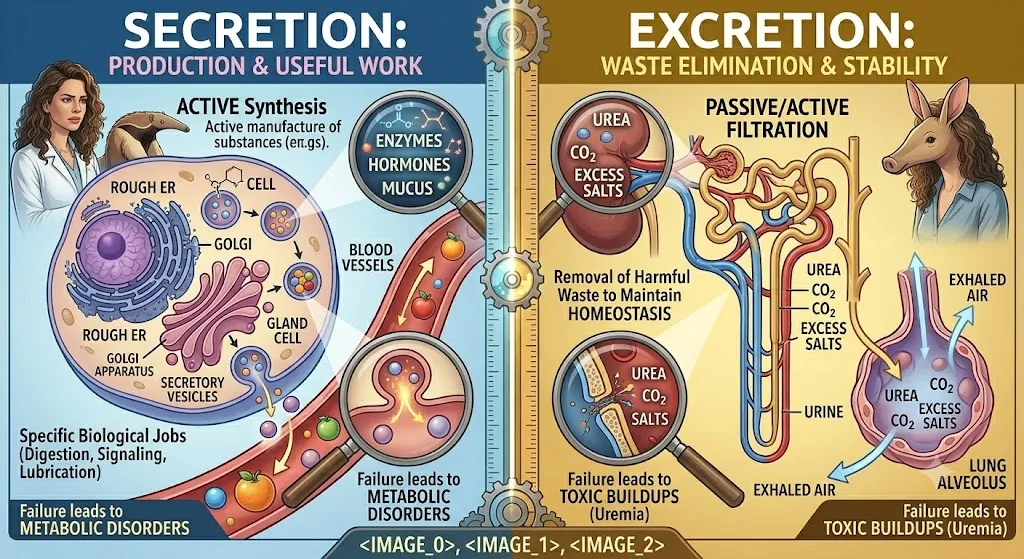
In a busy biology lab, a student once wondered why the human body produces both useful fluids like saliva and waste materials like sweat and urine. The teacher explained that the body performs two different processes: secretion and excretion. Understanding the difference between secretion and excretion becomes easier when we observe how glands release useful substances while organs remove waste. The difference between secretion and excretion is often confused because both involve release of substances from the body. However, the difference between secretion and excretion lies in purpose and function. Learning the difference between secretion and excretion helps students understand how the human body maintains balance and survives in a healthy state.
Key Difference Between the Both
Secretion is the release of useful substances in the body, while excretion is the removal of waste materials from the body.
Why Their Difference Matters in Society
Understanding the difference between secretion and excretion is important for students, doctors, and researchers. It helps in studying body functions, diagnosing diseases, and maintaining overall health in society.
Pronunciation
- Secretion
US: /sɪˈkriː.ʃən/
UK: /sɪˈkriː.ʃən/ - Excretion
US: /ɪkˈskriː.ʃən/
UK: /ɪkˈskriː.ʃən/
Linking Hook
Now that we understand the basic meaning, let’s explore the difference between secretion and excretion in detail with biological examples and functions.
H2: Difference Between Secretion and Excretion
1. Definition
- Secretion: Release of useful substances for body function.
Examples: Saliva secretion, hormone secretion - Excretion: Removal of waste materials from the body.
Examples: Urine excretion, sweat removal
2. Purpose
- Secretion: Helps in digestion, growth, and regulation.
Examples: Enzyme secretion in stomach, hormone secretion in blood - Excretion: Maintains body cleanliness and removes toxins.
Examples: Kidney removing urea, lungs removing CO₂
3. Nature of Substance
- Secretion: Useful substances like enzymes, hormones.
Examples: Insulin release, mucus secretion - Excretion: Harmful wastes like urea, CO₂.
Examples: Urine formation, sweat excretion
4. Organs Involved
- Secretion: Glands like salivary glands, endocrine glands.
Examples: Thyroid gland, pancreas - Excretion: Organs like kidneys, lungs, skin.
Examples: Kidney filtration, sweating
5. Direction of Flow
- Secretion: Moves into blood or body cavity.
Examples: Hormones into bloodstream, enzymes into stomach - Excretion: Moves out of the body.
Examples: Urine out through urethra, sweat through skin
6. Biological Importance
- Secretion: Supports metabolism and body regulation.
Examples: Insulin controlling sugar, saliva aiding digestion - Excretion: Prevents toxicity in body.
Examples: Removing excess salts, eliminating nitrogen waste
7. Control System
- Secretion: Controlled by nervous and endocrine systems.
Examples: Hormone response, digestive enzyme release - Excretion: Controlled mainly by urinary system.
Examples: Kidney filtration, bladder control
8. Type of Process
- Secretion: Internal process.
Examples: Hormone release inside body, enzyme production - Excretion: External elimination process.
Examples: Urination, sweating
9. Energy Use
- Secretion: Requires metabolic activity for production.
Examples: Protein synthesis in glands, hormone formation - Excretion: Requires filtration and transport.
Examples: Kidney filtration, lung gas exchange
10. Result of Process
- Secretion: Improves body function.
Examples: Better digestion, growth regulation - Excretion: Maintains homeostasis.
Examples: Clean internal environment, toxin removal
Nature and Behaviour
Secretion is a constructive process that builds and releases useful chemicals. It behaves like a supportive system that helps the body function smoothly.
Excretion is a cleaning process that removes waste. It behaves like a disposal system that keeps the body free from harmful substances.
Why People Get Confused
People confuse both because they involve release of substances from the body. However, secretion releases useful materials while excretion removes waste. Both are biological output processes, which increases confusion.
Table: Difference and Similarity
| Feature | Secretion | Excretion |
| Purpose | Useful functions | Waste removal |
| Substance | Enzymes, hormones | Urea, CO₂ |
| Direction | Inside body | Outside body |
| Organs | Glands | Kidneys, lungs |
| Similarity | Both are body processes | Both maintain balance |
Which is Better in What Situation?
Secretion is more important when the body needs regulation and function support. For example, digestion depends on enzyme secretion, and growth depends on hormone secretion. Without secretion, the body cannot perform normal activities.
Excretion is more important when the body needs detoxification. For example, kidneys remove urea and lungs remove carbon dioxide. Without excretion, harmful substances would build up and cause diseases. Both processes are essential, but their importance depends on whether the body needs function support or waste removal.
Use in Metaphors and Similes
- Secretion: “Her kindness flowed like secretion of healing light.”
- Excretion: “Tension left his body like excretion of stress from a machine.”
Connotative Meaning
- Secretion: Positive, life-giving process
Example: “Hormonal secretion brings growth and balance.” - Excretion: Neutral to positive (cleaning function)
Example: “Excretion keeps the body free from toxins.”
Idioms or Proverbs
- “Cleanliness is next to godliness.” (linked to excretion)
Example: Proper excretion keeps the body clean. - “Health is wealth.” (linked to secretion and excretion balance)
Example: Balanced secretion and excretion maintain health.
Works in Literature (Science References)
- The Human Body – Isaac Asimov (Science writing, 1963)
- Biology – Neil A. Campbell (Textbook, 1987)
- Essentials of Anatomy – Gray’s Anatomy (Medical reference, 1858)
Movies/Documentaries
- Inner Body: The Secret Life of Humans (2011, UK Documentary)
- Human Body: Pushing the Limits (2008, USA Documentary)
- The Incredible Human Machine (2007, USA Documentary)
Frequently Asked Questions
1. What is secretion?
It is the release of useful substances by glands.
2. What is excretion?
It is the removal of waste products from the body.
3. Are both processes the same?
No, secretion is useful output, excretion is waste removal.
4. Which organs help in excretion?
Kidneys, lungs, and skin.
5. Why are both important?
They maintain body balance and health.
How Both Are Useful for Surroundings
Secretion helps organisms function properly, supporting life systems. Excretion keeps the environment clean by removing harmful waste from living beings. Together, they maintain ecological and biological balance.
Final Words
Both secretion and excretion are vital biological processes. One builds and supports the body, while the other cleans and protects it. Without either, survival would not be possible.
Conclusion
The difference between secretion and excretion is fundamental in biology for understanding how living organisms function. Secretion is the process of releasing useful substances like enzymes and hormones that help the body perform essential activities. Excretion, on the other hand, is the removal of harmful waste products such as urea and carbon dioxide to maintain internal balance. Knowing the difference between secretion and excretion helps students, doctors, and researchers understand health and disease better. Both processes are essential for survival, as secretion supports body functions while excretion ensures cleanliness and stability. Mastering the difference between secretion and excretion provides a strong foundation for learning human physiology.
You have hit on a classic foundational split in metabolic biology. It is incredibly common for students to mix these two terms up because they both describe a biological system releasing a substance out of a cell or tissue.
However, their physiological intents are completely opposite. Secretion is an active manufacturing process that produces useful chemical tools, while excretion is a waste-management process designed to flush out toxic byproducts before they poison the organism.
Here is a detailed breakdown of how these two cellular workflows operate to maintain homeostasis.
1. Functional Intent: Production vs. Waste Management
To understand the difference, look at what happens to the substance after it is released.
                  [ CELLULAR RELEASE ]
                           |
         +-----------------+-----------------+
         |                                   |
   [ SECRETION ]                       [ EXCRETION ]
  (The Factory)                       (The Janitor)
         |                                   |
  Produces Functional                 Flushes Out Toxic
  Chemical Tools                      Metabolic Byproducts
         |                                   |
  Examples: Hormones,                 Examples: Urea, Sweat,
  Enzymes, Mucus, Saliva              CO2, Urine, Feces
- Secretion (The Factory): The substance being released has a specific biological job to do. The cell uses energy to synthesize molecules (like hormones or digestive juices) and moves them to where they can actively assist with digestion, cellular communication, or tissue protection.
- Excretion (The Janitor): The substance being released is a useless, often toxic leftover of metabolism. The body cannot reuse it or break it down further, so it must be completely ejected from the system to prevent chemical imbalances or cell damage.
2. Technical Comparison
Because their evolutionary goals are entirely different, their pathways, locations, and components do not overlap:
| Feature | Secretion | Excretion |
| Primary Goal | To perform a specific function (lubrication, digestion, chemical signaling). | To eliminate metabolic waste and maintain osmotic balance (Homeostasis). |
| Nature of Substance | Highly useful, metabolically active chemical compounds. | Discarded, inactive, or toxic byproducts. |
| Involved Organs/Glands | Pancreas, salivary glands, thyroid, pituitary, and gastric glands. | Kidneys, lungs, skin (sweat glands), and liver. |
| Cellular Transport | Uses active transport through the Golgi apparatus and endoplasmic reticulum. | Uses filtration, passive diffusion, or specialized excretory ducts. |
3. Real-World Biological Examples Side-by-Side
To see how these two processes run parallel in the human body, look at how individual organ systems divide the labor:
The Gastric System
- Secretion: Your stomach lining secretes hydrochloric acid and pepsinogen to chemically dismantle food particles.
- Excretion: The digestive tract packages and eliminates indigestible food matrix waste through defecation.
The Skin System
- Secretion: Sebaceous glands secrete sebum (skin oil) to coat, moisturize, and protect the skin barrier from bacterial invasion.
- Excretion: Sweat glands excrete water, excess salt, and traces of urea to cool the body down and dump waste.
Summary: The Balance of Life
Mastering this split is crucial for diagnosing health issues. When secretion fails (e.g., the pancreas failing to secrete insulin), it results in metabolic disorders like Type 1 Diabetes. When excretion fails (e.g., the kidneys failing to filter out urea), it results in dangerous toxic buildups like Uremia. Ultimately, secretion builds the internal chemical environment your body needs to thrive, while excretion sweeps away the debris left behind.

I am a professional SEO content writer specialising in comparison-based and grammar-focused articles. Through my website GrammarCompare.com, I help readers clearly understand the difference between confusing terms with well-researched, easy-to-read content. My expertise lies in focusing on clarity, accuracy, and practical explanations that improve both knowledge and writing skills.