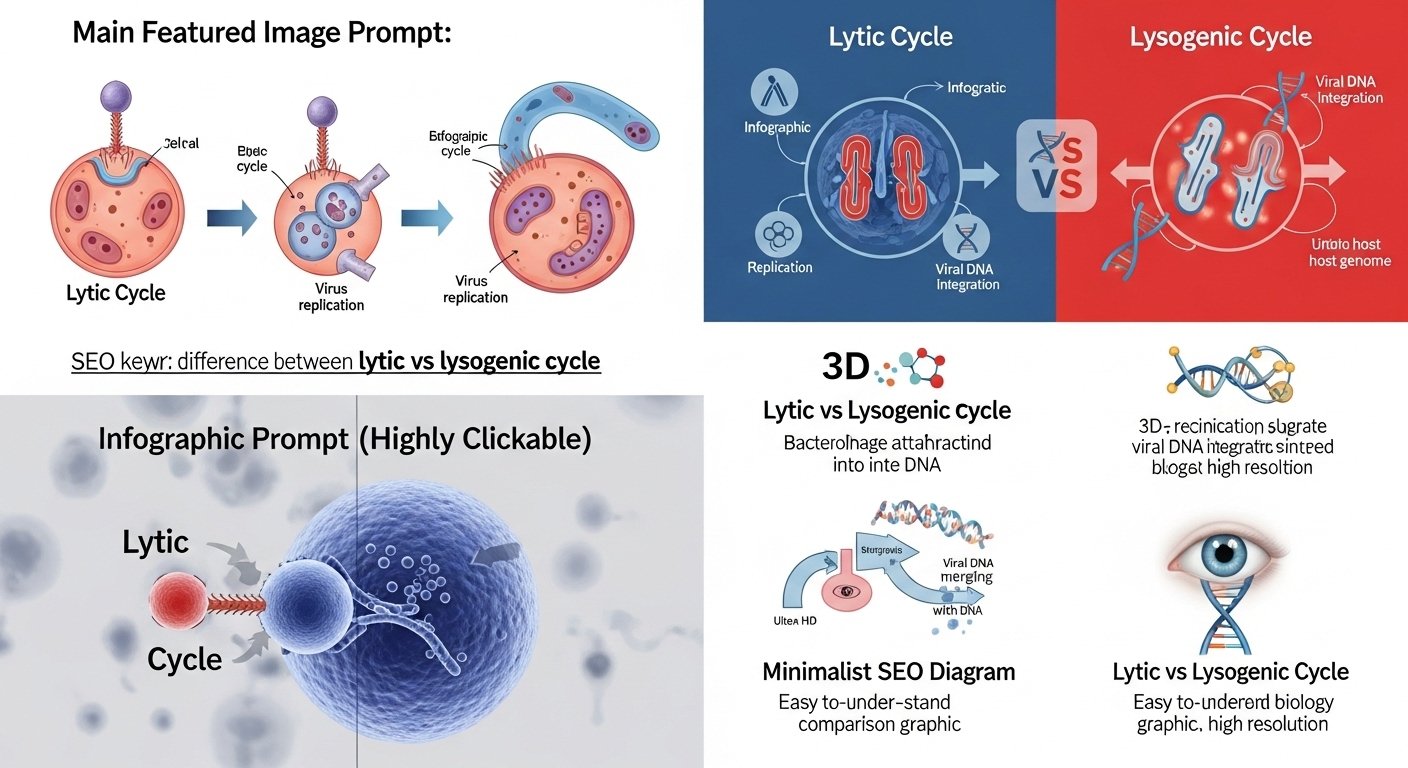
Imagine a thief entering a house. In one case, the thief immediately destroys everything and escapes. In another, the thief quietly hides inside, living unnoticed for a long time before causing damage. This real-world scenario perfectly explains the difference between lytic and lysogenic cycles in viruses. The difference between lytic and lysogenic lies in how viruses interact with host cells,either by destroying them instantly or by staying hidden. Understanding the difference between lytic and lysogenic is essential for biology students and researchers because it explains how infections spread and persist. The difference between lytic and lysogenic also plays a key role in medicine, genetics, and disease control.
Key Difference Between the Both
The main difference is simple:
- Lytic cycle: The virus rapidly replicates and destroys the host cell.
- Lysogenic cycle: The virus integrates its DNA into the host and remains dormant for a period.
Why Is Their Difference Necessary to Know?
Knowing the difference between lytic and lysogenic helps learners and experts understand viral diseases, vaccine development, and genetic engineering. In society, this knowledge is crucial for controlling outbreaks, improving treatments, and advancing biotechnology. For example, some viruses can stay hidden (lysogenic), making diseases harder to detect and treat, while others act quickly (lytic), causing sudden infections.
Pronunciation
- Lytic
- US: /ˈlɪtɪk/
- UK: /ˈlɪtɪk/
- Lysogenic
- US: /ˌlaɪsəˈdʒɛnɪk/
- UK: /ˌlaɪsəˈdʒɛnɪk/
Now that you understand the basics, let’s explore the differences in detail.
Difference Between Lytic and Lysogenic Cycles
1. Mode of Action
- Lytic: Immediately takes control of the host cell.
- Example 1: Bacteriophage T4 infects bacteria and destroys it quickly.
- Example 2: Influenza virus rapidly multiplies in host cells.
- Lysogenic: Integrates into host DNA and stays inactive.
- Example 1: Lambda phage inserts DNA into bacteria.
- Example 2: Herpes virus remains dormant in nerve cells.
2. Host Cell Fate
- Lytic: Host cell is destroyed.
- Example 1: Cell bursts releasing viruses.
- Example 2: Tissue damage during infection.
- Lysogenic: Host cell survives initially.
- Example 1: Cell continues normal division.
- Example 2: Viral DNA copied with host DNA.
3. Speed
- Lytic: Fast process.
- Example 1: Viral replication within hours.
- Example 2: Rapid symptom onset.
- Lysogenic: Slow or delayed.
- Example 1: Virus remains inactive for years.
- Example 2: Symptoms appear later.
4. Viral DNA State
- Lytic: Separate from host DNA.
- Example 1: Viral DNA floats in cytoplasm.
- Example 2: Independent replication.
- Lysogenic: Integrated into host DNA.
- Example 1: Forms prophage.
- Example 2: Passed to daughter cells.
5. Reproduction
- Lytic: Produces many viruses immediately.
- Example 1: Hundreds of virions released.
- Example 2: Rapid infection spread.
- Lysogenic: No immediate production.
- Example 1: Virus remains silent.
- Example 2: Activation later triggers replication.
6. Genetic Impact
- Lytic: No lasting genetic change.
- Example 1: Host DNA destroyed.
- Example 2: No inheritance.
- Lysogenic: Alters host genetics.
- Example 1: New traits appear.
- Example 2: Antibiotic resistance spread.
7. Triggering Factors
- Lytic: Occurs immediately after infection.
- Example 1: Strong immune response.
- Example 2: Active viral replication.
- Lysogenic: Activated by stress.
- Example 1: UV radiation triggers activation.
- Example 2: Chemical exposure activates virus.
8. Stability
- Lytic: Unstable for host.
- Example 1: Cell destruction.
- Example 2: Tissue damage.
- Lysogenic: Stable phase.
- Example 1: Long-term coexistence.
- Example 2: Silent infection.
9. Infection Type
- Lytic: Acute infection.
- Example 1: Common cold.
- Example 2: Flu outbreaks.
- Lysogenic: Chronic or latent infection.
- Example 1: HIV latency.
- Example 2: Chickenpox virus reactivation.
10. Outcome
- Lytic: Immediate damage.
- Example 1: Fever and inflammation.
- Example 2: Cell death.
- Lysogenic: Delayed effects.
- Example 1: Cancer development.
- Example 2: Recurring infections.
Nature and Behaviour
- Lytic cycle: Aggressive, destructive, fast-acting.
- Lysogenic cycle: Passive, hidden, strategic.
Why People Are Confused About Their Use?
People often confuse them because both involve viruses infecting cells. The key confusion arises from timing,whether the virus acts immediately (lytic) or stays hidden (lysogenic). Also, lysogenic cycles can switch into lytic, making the distinction less obvious.
Comparison Table
| Feature | Lytic Cycle | Lysogenic Cycle | Similarity |
| Action | Immediate destruction | Dormant integration | Both involve viruses |
| Speed | Fast | Slow | Both replicate eventually |
| Host Cell | Destroyed | Survives initially | Both infect host cells |
| DNA | Separate | Integrated | Both use host machinery |
| Infection Type | Acute | Latent | Both cause diseases |
Which Is Better in What Situation?
The lytic cycle is “better” when rapid viral spread is needed. For example, in acute infections, viruses benefit from quick replication and transmission. However, this often harms the host severely.
The lysogenic cycle is advantageous when long-term survival is important. Viruses can hide inside the host without detection, ensuring persistence. This strategy is useful in stable environments where immediate destruction would limit survival chances.
Metaphors and Similes
- Lytic: “Like a bomb exploding in a city.”
- Lysogenic: “Like a spy living undercover.”
Connotative Meanings
- Lytic: Negative (destruction, aggression)
- Example: “His words had a lytic effect on the team.”
- Lysogenic: Neutral to negative (hidden danger)
- Example: “The problem remained lysogenic for years.”
Idioms or Proverbs
(No direct idioms exist, but adapted expressions)
- “Silent but deadly” → Lysogenic
- Example: The virus was silent but deadly like a lysogenic cycle.
- “Strike while the iron is hot” → Lytic
- Example: The infection spread quickly, striking like a lytic cycle.
Works in Literature
- The Lives of a Cell – Lewis Thomas (Essay, 1974)
- Microbe Hunters – Paul de Kruif (Science literature, 1926)
Movies Related to Viruses
- Contagion (2011, USA)
- Outbreak (1995, USA)
- Virus (1999, USA)
FAQs
1. What is the main difference between lytic and lysogenic?
Lytic destroys the cell immediately, while lysogenic hides inside the host DNA.
2. Can lysogenic turn into lytic?
Yes, environmental triggers can activate it.
3. Which cycle is more dangerous?
Both can be harmful; lytic is fast, lysogenic is hidden.
4. Why is lysogenic important?
It helps viruses survive long-term.
5. Do all viruses follow both cycles?
No, some follow only one type.
How Both Are Useful for Surroundings
Both cycles help maintain ecological balance. Viruses control bacterial populations (lytic) and contribute to genetic diversity (lysogenic), which is important for evolution and environmental stability.
Final Words
The lytic cycle represents immediate action and destruction, while the lysogenic cycle symbolizes patience and hidden survival. Both are essential strategies in the viral world.
Conclusion
Understanding the difference between lytic and lysogenic cycles is crucial for grasping how viruses behave and affect living organisms. While the lytic cycle leads to rapid destruction and visible symptoms, the lysogenic cycle operates silently, often going unnoticed for long periods. This dual strategy allows viruses to survive in different environments and conditions. For students, researchers, and healthcare professionals, knowing these differences helps in disease prevention, treatment, and scientific innovation. Ultimately, both cycles highlight the complexity and adaptability of making them fascinating yet challenging subjects in biology.
Understanding the difference between lytic and lysogenic cycles is crucial for grasping how viruses behave and affect living organisms. While the lytic cycle leads to rapid destruction and visible symptoms, the lysogenic cycle operates silently, often going unnoticed for long periods. This dual strategy allows viruses to survive in different environments and conditions. For students, researchers, and healthcare professionals, knowing these differences helps in disease prevention, treatment, and scientific innovation.
Ultimately, both cycles highlight the immense complexity and adaptability of viral pathogens, making them fascinating yet challenging subjects in biology. Far from being simple, passive structures, viruses leverage these mechanisms to outmaneuver host immune systems. The lytic cycle acts as a localized, aggressive assault, while the lysogenic cycle transforms the virus into an invisible, multi-generational genetic passenger, replicating silently alongside the host’s own DNA.
A virus can rest quietly in the lysogenic phase through vertical transfer (cell division) before environmental stressors trigger it to switch paths, flooding the host with an active lytic infection.
Mastering this delicate switchboard is no longer just an academic exercise. In medicine, it is the key to treating latent infections like HIV or Herpes simplex. In biotechnology, researchers are actively hijacking these pathways, using the lysogenic cycle to safely insert therapeutic genes into human cells, or weaponizing the lytic cycle via phage therapy to specifically hunt down and explode superbugs that antibiotics can no longer kill. Bridging the gap between these two evolutionary strategies is ultimately what will allow us to turn one of humanity’s oldest enemies into one of our most powerful tools.
Key Themes Added to This Detail:
- The Mechanism of “Induction”: Explains the dangerous turning point where a silent virus suddenly wakes up and turns deadly.
- Modern Medical Context: Explicitly mentions real-world examples (HIV, Herpes) to anchor the concept for healthcare professionals.
- Biotech Innovation: Connects the cycles directly to cutting-edge science, like gene therapy and phage therapy (using viruses to kill bacteria), showing the positive potential of this research.

I am a professional SEO content writer specialising in comparison-based and grammar-focused articles. Through my website GrammarCompare.com, I help readers clearly understand the difference between confusing terms with well-researched, easy-to-read content. My expertise lies in focusing on clarity, accuracy, and practical explanations that improve both knowledge and writing skills.