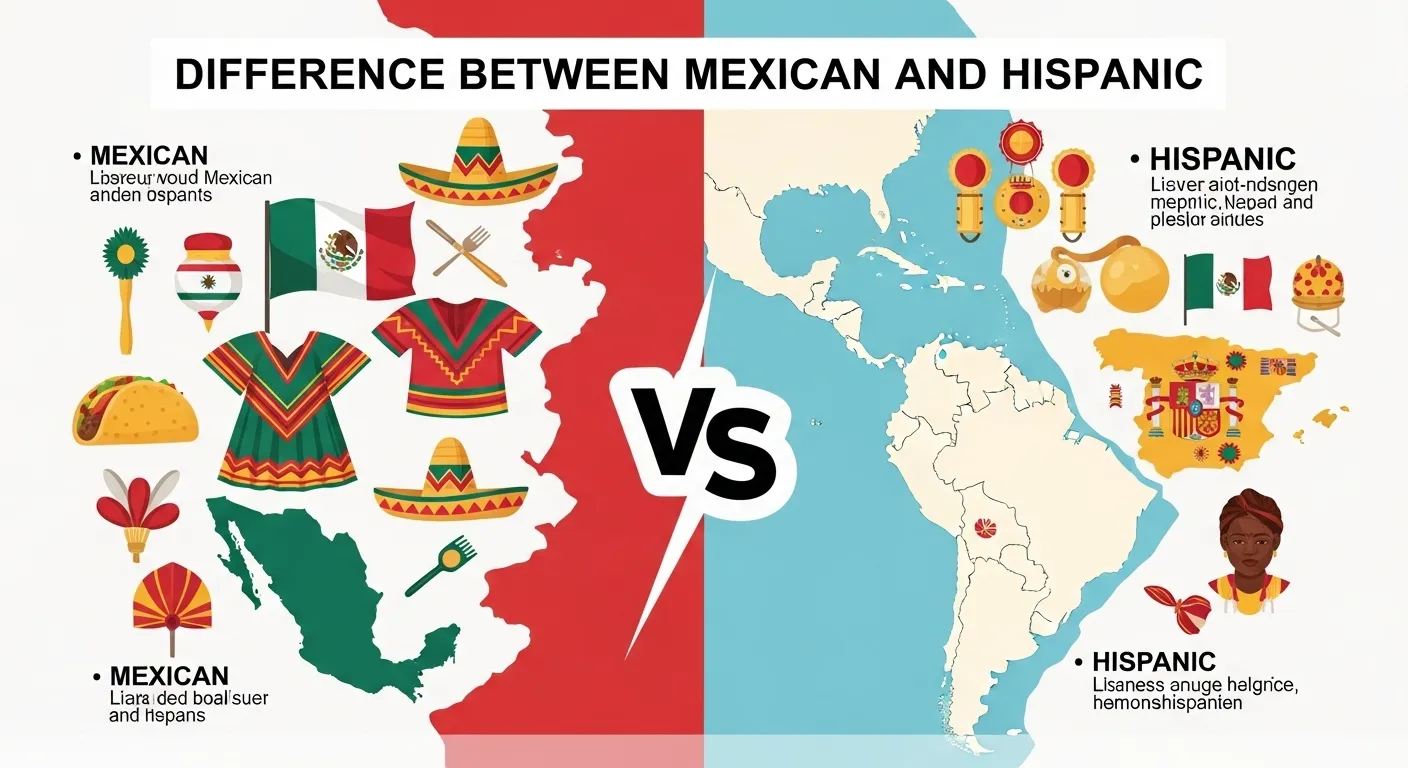
At a cultural festival in United States, a student proudly introduced her friend as “Hispanic,” but the friend gently corrected her, saying, “I’m Mexican.” This simple moment reflects a common confusion in everyday life. The difference between Mexican and Hispanic is often misunderstood, even by well-educated individuals. While both terms relate to culture and identity, they are not interchangeable.
Understanding the difference between Mexican and Hispanic helps avoid stereotypes and promotes respectful communication. In fact, the difference between Mexican and Hispanic lies in nationality versus broader cultural classification. If you truly want clarity, recognizing the difference between Mexican and Hispanic is essential for both social awareness and academic accuracy.
Key Difference Between the Both
- Mexican refers to a person from Mexico (nationality).
- Hispanic refers to people connected to Spanish-speaking cultures (ethnicity/language group).
Why Is Their Difference Necessary to Know?
Understanding this difference is important in today’s global society. For learners, it builds cultural awareness and avoids mislabeling. For experts, it ensures accuracy in research, communication, and policy-making. Socially, using the correct term shows respect for identity and diversity, helping create inclusive communities.
Pronunciation (US & UK Approximation)
- Mexican:
- US: MEK-si-kan
- UK: MEK-si-ken
- Hispanic:
- US: his-PAN-ik
- UK: his-PAN-ik
Now that you understand the basics, let’s explore the detailed differences.
Difference Between Mexican and Hispanic
1. Definition
- Mexican: A nationality.
- Example 1: He is Mexican because he was born in Mexico.
- Example 2: She holds Mexican citizenship.
- Hispanic: A cultural/linguistic group.
- Example 1: A person from Spain is Hispanic.
- Example 2: A Colombian is also Hispanic.
2. Scope
- Mexican: Specific to one country.
- Example 1: Only applies to Mexico.
- Example 2: Cannot include other countries.
- Hispanic: Broad category.
- Example 1: Includes many countries.
- Example 2: Covers Spanish-speaking regions.
3. Language Connection
- Mexican: May or may not speak Spanish.
- Example 1: Some indigenous Mexicans speak native languages.
- Example 2: Spanish is common but not universal.
- Hispanic: Defined by Spanish language.
- Example 1: Spanish-speaking identity.
- Example 2: Language is key factor.
4. Geographic Basis
- Mexican: From Mexico only.
- Example 1: Lives in Mexico.
- Example 2: Born in Mexican territory.
- Hispanic: From Spanish-speaking countries.
- Example 1: Includes Latin America.
- Example 2: Includes Spain.
5. Cultural Identity
- Mexican: Unique traditions and customs.
- Example 1: Mexican cuisine.
- Example 2: National festivals.
- Hispanic: Shared cultural elements.
- Example 1: Language-based traditions.
- Example 2: Similar heritage influences.
6. Ethnicity vs Nationality
- Mexican: National identity.
- Example 1: Passport defines it.
- Example 2: Legal citizenship matters.
- Hispanic: Ethnic/cultural identity.
- Example 1: Based on heritage.
- Example 2: Not tied to one passport.
7. Inclusiveness
- Mexican: Limited group.
- Example 1: Only Mexicans included.
- Example 2: Excludes other nations.
- Hispanic: Inclusive group.
- Example 1: Includes multiple countries.
- Example 2: Covers diverse populations.
8. Usage Context
- Mexican: Used in nationality discussions.
- Example 1: Census data.
- Example 2: Immigration records.
- Hispanic: Used in demographic and cultural contexts.
- Example 1: Surveys.
- Example 2: Cultural studies.
9. Identity Choice
- Mexican: Clear identity.
- Example 1: Defined by origin.
- Example 2: Less flexible.
- Hispanic: Self-identified.
- Example 1: People may choose it.
- Example 2: Identity can vary.
10. Relation Between Them
- Mexican: Can be Hispanic.
- Example 1: A Mexican who speaks Spanish is Hispanic.
- Example 2: Many Mexicans identify as Hispanic.
- Hispanic: Not always Mexican.
- Example 1: A Spaniard is Hispanic but not Mexican.
- Example 2: An Argentine is Hispanic but not Mexican.
Nature and Behaviour
- Mexican identity is concrete and tied to nationality, culture, and geography.
- Hispanic identity is broader and more abstract, focusing on shared language and cultural heritage.
Why People Are Confused
People often confuse these terms because they overlap. Many Mexicans are Hispanic, so the terms seem interchangeable. Media, casual conversations, and lack of awareness also contribute to misunderstanding.
Table: Difference and Similarity
| Aspect | Mexican | Hispanic | Similarity |
| Type | Nationality | Ethnicity/Culture | Identity labels |
| Scope | One country | Many countries | Cultural connection |
| Language | Not required | Spanish-based | Often Spanish influence |
| Usage | Legal/social | Cultural/demographic | Used in society |
| Flexibility | Fixed | Flexible | Identity-related |
Which Is Better in What Situation?
Mexican is better when referring to nationality, legal identity, or country-specific culture. It is precise and should be used when discussing citizenship, origin, or national traditions. For example, in official documents or geographical discussions, “Mexican” is the correct and respectful term.
Hispanic is better in broader cultural or demographic contexts. It is useful when discussing shared language, heritage, or regional identity across multiple countries. In research, surveys, and multicultural discussions, “Hispanic” provides a wider and more inclusive perspective.
Metaphors and Similes
- Mexican: “Rooted like a Mexican tradition.”
- Hispanic: “Connected like a Hispanic family across borders.”
Connotative Meaning
- Mexican: Neutral to positive
- Example: She is proud of her Mexican heritage.
- Hispanic: Neutral
- Example: Hispanic communities celebrate diverse cultures.
Idioms or Proverbs
(Not direct idioms, but adapted usage)
- “Proud as a Mexican.”
- Example: He stood proud as a Mexican at the event.
- “Unity in Hispanic roots.”
- Example: The festival showed unity in Hispanic roots.
Works in Literature
- “The House on Mango Street” – Novel, Sandra Cisneros, 1984
- “One Hundred Years of Solitude” – Novel, Gabriel García Márquez, 1967
Movies Related to the Keywords
- “Coco” (2017, USA)
- “Roma” (2018, Mexico)
Frequently Asked Questions
1. Is every Mexican Hispanic?
Most Mexicans are Hispanic, but identity can vary.
2. Is every Hispanic Mexican?
No, Hispanic includes many countries.
3. Can someone be both?
Yes, a Mexican can also be Hispanic.
4. Why does the confusion exist?
Because of overlapping cultural and linguistic traits.
5. Which term is more respectful?
Both are respectful when used correctly.
How Both Are Useful for Surroundings
Both terms help describe identity, culture, and diversity. They are important in education, policy-making, and social interaction, helping people understand and respect cultural backgrounds.
Final Words
Mexican defines a nation, while Hispanic defines a cultural connection. Both are meaningful and important in their own contexts.
Conclusion
The difference between Mexican and Hispanic is essential for clear and respectful communication. While Mexican refers to nationality, Hispanic describes a broader cultural and linguistic identity. Understanding this distinction prevents confusion and promotes inclusivity. In a diverse world, using the right terms reflects awareness and respect. Whether in academic, professional, or social settings, knowing the difference between Mexican and Hispanic helps build stronger connections and deeper cultural understanding.

I am a professional SEO content writer specialising in comparison-based and grammar-focused articles. Through my website GrammarCompare.com, I help readers clearly understand the difference between confusing terms with well-researched, easy-to-read content. My expertise lies in focusing on clarity, accuracy, and practical explanations that improve both knowledge and writing skills.