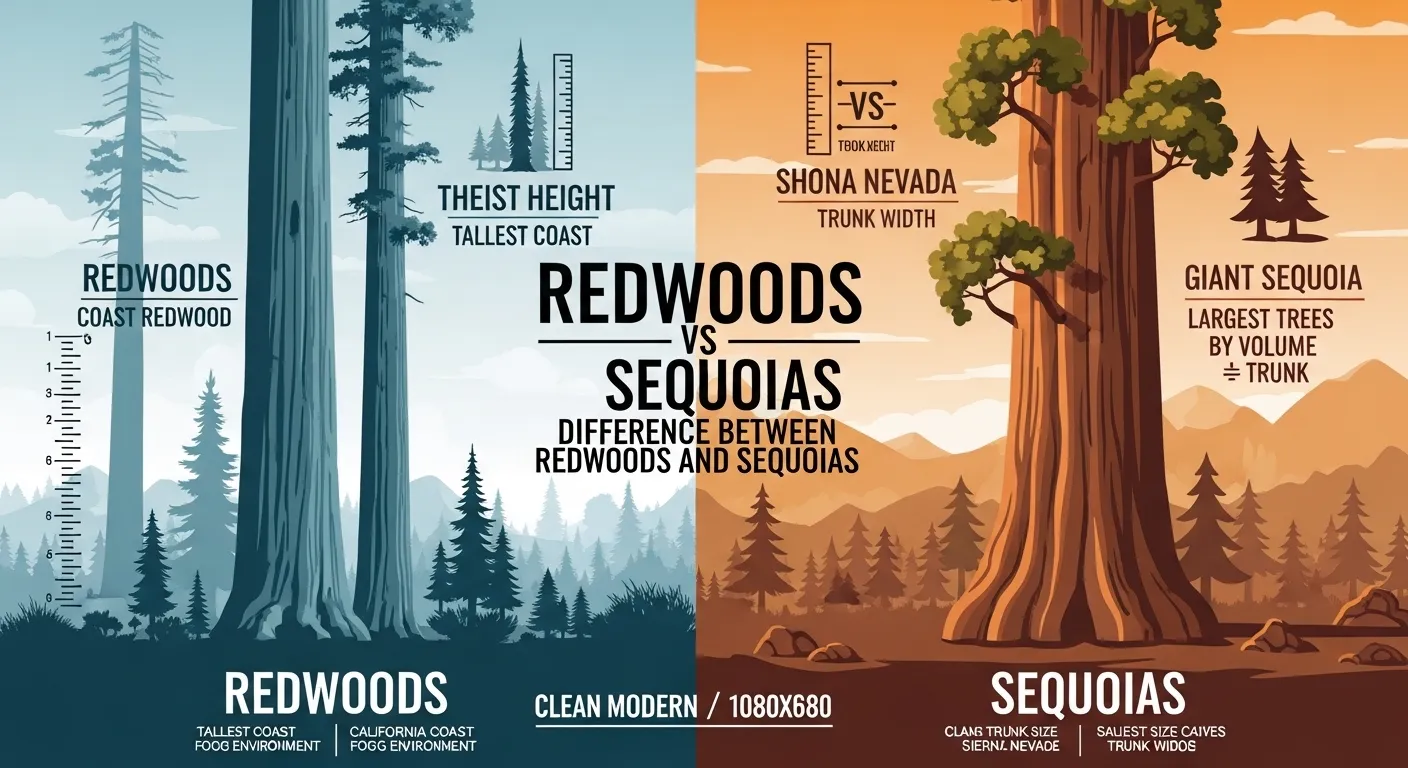
A traveler once stood in a forest in California, staring up at trees so tall they seemed to touch the sky. Locals told him he was surrounded by “redwoods,” but later, at another park, he heard about “sequoias.” Confused, he wondered if they were the same. This real-world curiosity reflects a common question about the difference between redwoods and sequoias. Both are giant trees, both are awe-inspiring, and both belong to the same plant family—yet they are not identical. Understanding the difference between redwoods and sequoias helps nature lovers, students, and experts appreciate their uniqueness. In fact, the difference between redwoods and sequoias lies in their size, habitat, and growth patterns. Exploring the difference between redwoods and sequoias reveals fascinating insights into Earth’s natural wonders.
Key Difference Between the Both
- Redwoods are the tallest trees in the world.
- Sequoias are the largest trees by volume.
Why Is Their Difference Necessary to Know?
Knowing the difference between these trees is important for environmental awareness, scientific study, and tourism. For learners, it builds knowledge of biodiversity. For experts, it supports conservation efforts and ecological research. In society, understanding such distinctions encourages respect for nature and promotes preservation of endangered ecosystems.
Pronunciation (US & UK Approximation)
- Redwoods:
- US: RED-woodz
- UK: RED-woodz
- Sequoias:
- US: si-KWOY-uhz
- UK: si-KWOY-uhz
Now that the basics are clear, let’s explore their differences in detail.
Difference Between Redwoods and Sequoias
1. Height vs Volume
- Redwoods: Tallest trees.
- Example 1: A redwood can grow over 350 feet tall.
- Example 2: It towers above nearby forests.
- Sequoias: Largest by volume.
- Example 1: A sequoia has a massive trunk.
- Example 2: It contains more wood than any other tree.
2. Scientific Names
- Redwoods: Known as Sequoia sempervirens.
- Example 1: Found along coastal regions.
- Example 2: Thrives in foggy climates.
- Sequoias: Known as Sequoiadendron giganteum.
- Example 1: Found in mountainous areas.
- Example 2: Grows in dry, elevated zones.
3. Location
- Redwoods: Coastal regions of California.
- Example 1: Near the Pacific Ocean.
- Example 2: Found in moist forests.
- Sequoias: Sierra Nevada mountains.
- Example 1: Found inland.
- Example 2: Located at higher elevations.
4. Climate Preference
- Redwoods: Prefer cool, foggy weather.
- Example 1: Grow in coastal fog.
- Example 2: Need high humidity.
- Sequoias: Prefer dry summers and snowy winters.
- Example 1: Survive in colder climates.
- Example 2: Adapt to seasonal changes.
5. Bark Characteristics
- Redwoods: Softer and thinner bark.
- Example 1: Easier to mark.
- Example 2: Less bulky appearance.
- Sequoias: Thick and fire-resistant bark.
- Example 1: Protects against wildfires.
- Example 2: Feels spongy and dense.
6. Lifespan
- Redwoods: Live over 2,000 years.
- Example 1: Some trees are ancient.
- Example 2: Survive generations.
- Sequoias: Can live over 3,000 years.
- Example 1: Among the oldest living trees.
- Example 2: Outlive civilizations.
7. Trunk Shape
- Redwoods: Slim and tall trunks.
- Example 1: Straight growth.
- Example 2: Narrow base.
- Sequoias: Wide and massive trunks.
- Example 1: Bulky base.
- Example 2: Thick appearance.
8. Growth Environment
- Redwoods: Grow in dense forests.
- Example 1: Close together.
- Example 2: Compete for sunlight.
- Sequoias: Grow more spaced out.
- Example 1: Need more ground space.
- Example 2: Stand individually.
9. Reproduction
- Redwoods: Can reproduce from sprouts.
- Example 1: Grow from roots.
- Example 2: Regenerate quickly.
- Sequoias: Rely mainly on seeds.
- Example 1: Seeds released from cones.
- Example 2: Fire helps seed release.
10. Appearance
- Redwoods: Dark green and slender.
- Example 1: Tall canopy.
- Example 2: Elegant look.
- Sequoias: Lighter green and bulky.
- Example 1: Massive structure.
- Example 2: Thick branches.
Nature and Behaviour
- Redwoods grow rapidly and adapt to moist environments. They behave like sky-reaching giants competing for sunlight.
- Sequoias grow slower but stronger, focusing on stability and longevity. They behave like grounded giants with immense strength.
Why People Are Confused
People are confused because both trees are enormous, belong to the same family, and are often found in the same state. Their similar names and overlapping features make them seem identical.
Table: Difference and Similarity
| Aspect | Redwoods | Sequoias | Similarity |
| Size | Tallest | Largest by volume | Both are giant trees |
| Location | Coastal | Inland mountains | Found in California |
| Climate | Foggy | Seasonal | Long lifespan |
| Bark | Thin | Thick | Fire resistance (some level) |
| Growth | Fast | Slow | Evergreen species |
Which Is Better in What Situation?
Redwoods are better for ecosystems that require rapid growth and dense forest coverage. They are ideal for coastal regions where moisture is abundant. Their height makes them important for biodiversity, providing shelter for birds and wildlife.
Sequoias are better suited for long-term stability and resilience. Their thick bark and massive size make them ideal for areas prone to fire and harsh climates. They symbolize endurance and strength in nature.
Metaphors and Similes
- Redwoods: “Tall like a redwood reaching the sky.”
- Sequoias: “Strong like a sequoia standing through time.”
Connotative Meaning
- Redwoods: Positive (growth, ambition)
- Example: His dreams grew like redwoods.
- Sequoias: Positive (strength, endurance)
- Example: Her patience was like a sequoia.
Idioms or Proverbs
(Not common, but adapted expressions)
- “Stand tall like a redwood.”
- Example: Face challenges and stand tall like a redwood.
- “Strong as a sequoia.”
- Example: He remained strong as a sequoia during hardship.
Works in Literature
- “The Wild Trees” – Non-fiction, Richard Preston, 2007
- “The Overstory” – Novel, Richard Powers, 2018
Movies Related to the Keywords
- “Redwood Highway” (2013, USA)
- “Giant Sequoia Documentary” (Various, USA)
Frequently Asked Questions
1. Are redwoods and sequoias the same?
No, they are different species with unique traits.
2. Which is taller?
Redwoods are taller.
3. Which is bigger overall?
Sequoias are larger by volume.
4. Where are they found?
Mostly in California, USA.
5. Which lives longer?
Sequoias generally live longer.
How Both Are Useful for Surroundings
Both trees support ecosystems by providing oxygen, shelter, and climate regulation. They also attract tourism and contribute to environmental education and conservation.
Final Words
Redwoods symbolize height and ambition, while sequoias represent strength and endurance. Both are masterpieces of nature.
Conclusion
The difference between redwoods and sequoias highlights the diversity within nature’s giants. While redwoods dominate in height, sequoias excel in volume and strength. Understanding their differences deepens appreciation for ecosystems and encourages conservation. Whether you admire their towering presence or massive structure, both trees remind us of nature’s incredible power and resilience. Learning the difference between redwoods and sequoias is not just about knowledge, it is about valuing the natural world around us.

I am a professional SEO content writer specialising in comparison-based and grammar-focused articles. Through my website GrammarCompare.com, I help readers clearly understand the difference between confusing terms with well-researched, easy-to-read content. My expertise lies in focusing on clarity, accuracy, and practical explanations that improve both knowledge and writing skills.