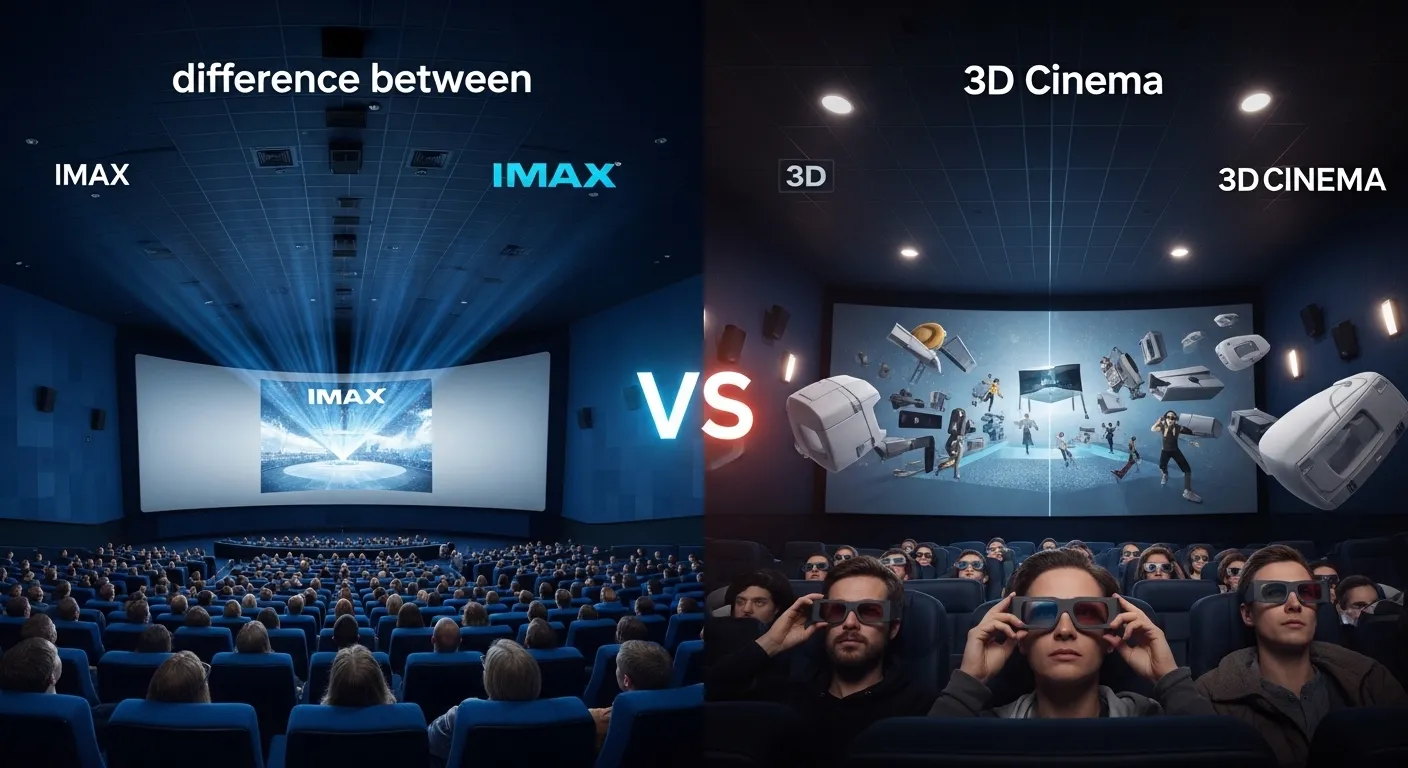
Last weekend, a group of friends went to watch a blockbuster movie. One insisted on booking IMAX tickets for the “bigger and better” experience, while another preferred 3D for its “real-life depth.” Their debate perfectly highlights the difference between IMAX and 3D—a topic many movie lovers often misunderstand.
IMAX refers to a premium film format known for its massive screens, high resolution, and immersive sound. On the other hand, 3D is a viewing technology that creates the illusion of depth using special glasses. Understanding the difference between IMAX and 3D helps viewers choose the right cinematic experience. In fact, the difference between IMAX and 3D is not just technical but also experiential. Whether you’re a casual viewer or a film expert, knowing the difference between IMAX and 3D enhances your appreciation of movies.
Key Difference Between the Both
The main difference lies in purpose: IMAX enhances screen size and quality, while 3D enhances visual depth.
Why Is Their Difference Necessary to Know?
Understanding the difference between IMAX and 3D is important for both learners and experts. For students of media and film, it builds technical knowledge. For audiences, it helps in choosing the best viewing format based on preferences. In society, cinema is a major form of entertainment and storytelling. Knowing these differences improves media literacy and helps people make informed decisions.
Pronunciation
- IMAX
- US: /ˈaɪˌmæks/
- UK: /ˈaɪmæks/
- 3D
- US: /ˌθriː ˈdiː/
- UK: /ˌθriː ˈdiː/
Now that we understand the basics, let’s dive deeper into the difference between IMAX and 3D in detail.
Difference Between IMAX and 3D
1. Definition
IMAX is a film format and projection system.
3D is a visual effect technology.
- Example 1: IMAX uses large screens.
- Example 2: 3D uses special glasses.
2. Viewing Experience
IMAX gives a larger-than-life screen experience.
3D gives a sense of depth.
- Example 1: IMAX fills your vision.
- Example 2: 3D makes objects appear closer.
3. Technology Used
IMAX uses high-resolution cameras and projectors.
3D uses stereoscopic imaging.
- Example 1: IMAX uses laser projection.
- Example 2: 3D uses dual images.
4. Screen Size
IMAX screens are Massive and curved.
3D works on regular screens too.
- Example 1: IMAX screens can be several stories tall.
- Example 2: 3D movies can play in normal cinemas.
5. Glasses Requirement
IMAX may or may not require glasses.
3D always requires glasses.
- Example 1: IMAX 2D needs no glasses.
- Example 2: 3D needs polarized glasses.
6. Image Quality
IMAX offers sharper images.
3D may reduce brightness slightly.
- Example 1: IMAX shows clear details.
- Example 2: 3D sometimes looks darker.
7. Sound System
IMAX has advanced surround sound.
3D focuses less on sound.
- Example 1: IMAX uses precise audio placement.
- Example 2: 3D uses standard sound.
8. Cost
IMAX tickets are usually expensive.
3D tickets are moderately priced.
- Example 1: IMAX premium pricing.
- Example 2: 3D cheaper than IMAX.
9. Availability
IMAX theaters are limited.
3D is widely available.
- Example 1: IMAX in big cities.
- Example 2: 3D in most cinemas.
10. Purpose
IMAX aims for immersion.
3D aims for realism.
- Example 1: IMAX makes you feel inside the movie.
- Example 2: 3D makes visuals pop out.
Nature and Behaviour
IMAX focuses on enhancing the entire cinematic environment, screen, sound, and clarity. It behaves like a complete upgrade of the viewing system.
3D, however, focuses only on visual perception. It behaves like an added effect that can be applied to films regardless of screen type.
Why People Are Confused
People often think IMAX and 3D are the same because both enhance movie experiences. Also, many IMAX movies are shown in 3D, which mixes the concepts. The overlap creates confusion.
Table: Difference and Similarity
| Feature | IMAX | 3D | Similarity |
| Type | Film format | Visual technology | Both enhance movies |
| Screen | Very large | Normal to large | Used in cinemas |
| Glasses | Optional | Required | Improve viewing |
| Focus | Immersion | Depth | Better experience |
| Availability | Limited | Wide | Popular globally |
Which Is Better in What Situation?
IMAX is better when you want a fully immersive cinematic experience. It is ideal for action movies, space films, and documentaries where visuals and sound matter the most. If you want to feel like you are inside the movie, IMAX is the right choice.
3D is better when the movie is designed with depth effects. Animated films and fantasy movies often use 3D to make scenes more engaging. If you enjoy visuals popping out and realistic depth, 3D is a good option.
Metaphors and Similes
- IMAX is like “a window into another world.”
- 3D is like “a painting coming to life.”
Connotative Meaning
IMAX
- Positive: Premium, immersive
- Example: “Watching in IMAX felt luxurious.”
- Neutral: Large-format cinema
- Negative: Expensive
3D
- Positive: Realistic, exciting
- Example: “The 3D effects were thrilling.”
- Neutral: Visual technique
- Negative: Can cause eye strain
Idioms or Proverbs
(No direct idioms exist, but related expressions can be used creatively)
- “Seeing is believing” – 3D enhances this idea.
- “Larger than life” – often used for IMAX.
Example:
- “The IMAX screen made the movie larger than life.”
- “In 3D, seeing is believing.”
Works in Literature
- Understanding Movies (Film Studies, Louis Giannetti, 1972)
- Film Art (Academic, David Bordwell, 1979)
Movies Related to IMAX and 3D
- Avatar (2009, USA)
- Gravity (2013, USA)
- Avengers: Endgame (2019, USA)
FAQs
1. Is IMAX always 3D?
No, IMAX can be 2D or 3D.
2. Do all 3D movies use IMAX?
No, 3D works in standard cinemas too.
3. Which is more expensive?
IMAX is usually more expensive.
4. Which gives better picture quality?
IMAX provides better clarity.
5. Can I watch without glasses in IMAX?
Yes, if it is not 3D.
How Both Are Useful for Surroundings
IMAX enhances educational films and documentaries, making learning immersive. 3D helps in medical, architectural, and scientific visualization by adding depth.
Final Words for Both
IMAX is about scale and immersion. 3D is about depth and realism. Both serve different but valuable purposes in cinema.
Conclusion
The difference between IMAX and 3D lies in their core functions, one enhances the environment, and the other enhances perception. While IMAX offers a grand and immersive viewing experience, 3D adds realism through depth.
Understanding the difference between IMAX and 3D allows viewers to choose what suits their preferences. Both technologies contribute significantly to modern cinema, making films more engaging and memorable. Ultimately, the choice depends on whether you prefer a bigger world or a deeper one. To truly maximize your next trip to the movies, it helps to look at how these two formats manipulate your biology differently:
- The Environmental Approach (IMAX): This format re-engineers the theater architecture itself. By using dual-projectors, a curved screen that sits closer to the audience, and a patented geometric seating layout, it tricks your brain into feeling like you are physically sitting inside the landscape of the movie.
- The Perceptual Approach (3D): This format alters how your eyes receive light. By projecting two slightly offset images simultaneously and using polarized glasses, it mimics binocular vision, causing your brain to perceive a three-dimensional depth plane where characters stretch forward or recede backward.
Balancing the macro-scale of a premium large format with the micro-details of stereoscopic depth is what continues to push the boundaries of how stories are told on the silver screen. As home theaters grow more advanced, the unique spatial dynamics of premium cinema formats remain the ultimate draw for the box office. The true magic of modern exhibition happens when filmmakers don’t make you choose at all—marrying the massive, high-aspect-ratio canvas of IMAX with the layered, stereoscopic depth of 3D to create the definitive “IMAX 3D” experience.
Whether you choose to experience a movie through the colossal framing of a premium giant screen or through the immersive depth planes of 3D glasses, you are stepping away from passive viewing and into active participation. Assessing the genre, the director’s visual style, and your own comfort with 3D eyewear will ensure you select the perfect format to transform a simple story into an unforgettable, larger-than-life event.

I am a professional SEO content writer specialising in comparison-based and grammar-focused articles. Through my website GrammarCompare.com, I help readers clearly understand the difference between confusing terms with well-researched, easy-to-read content. My expertise lies in focusing on clarity, accuracy, and practical explanations that improve both knowledge and writing skills.