A young student once wrote an essay about her village and proudly submitted it to her teacher. But instead of writing “Their house is beautiful,” she wrote “There house is beautiful.” The teacher gently corrected her and explained the difference between there and their. This small mistake is very common, and understanding the difference between there and their is essential for writing correct English. Many learners struggle with the difference between there and their, especially because they sound the same. The difference between there and their may look simple, but it changes the meaning of a sentence completely. Learning the difference between there and their improves grammar, communication, and confidence in writing.
Key Difference Between the Both
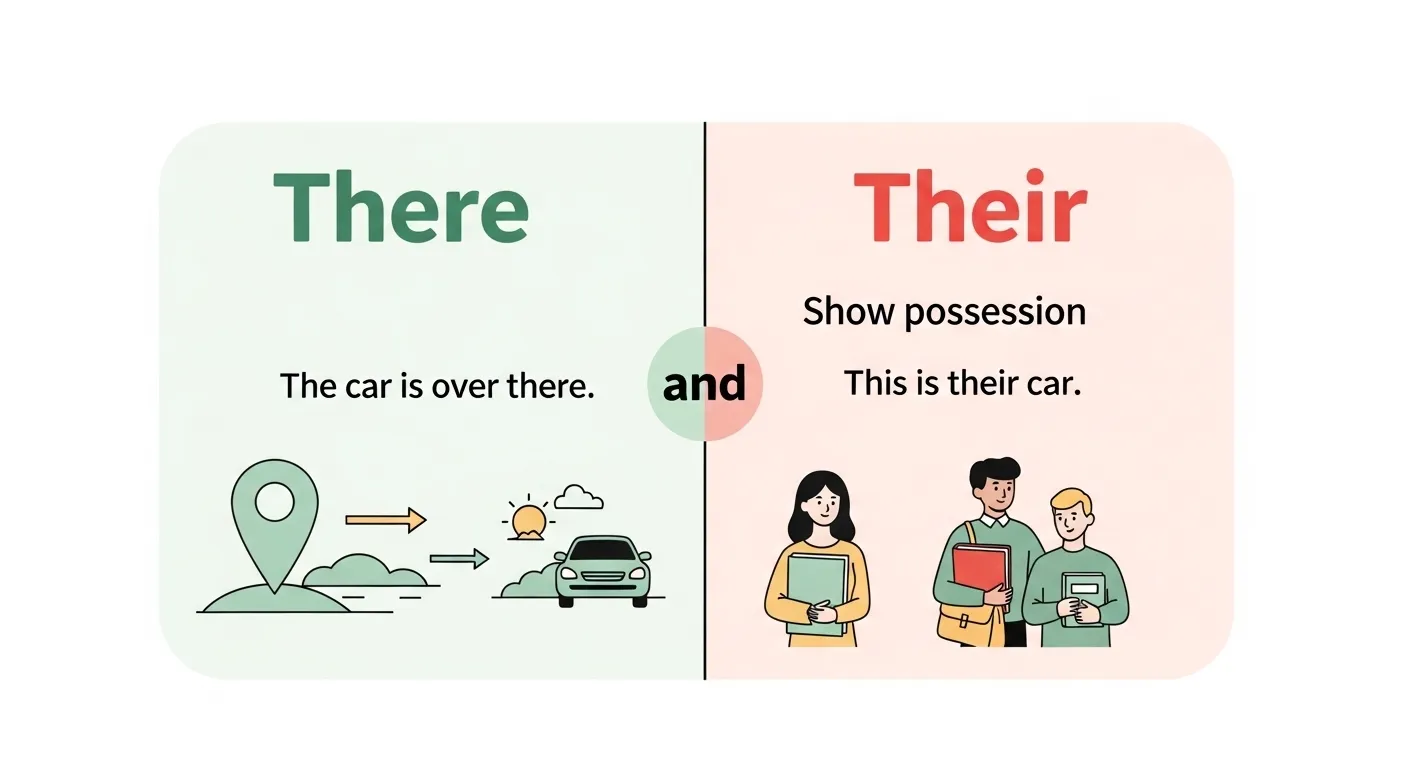
“There” refers to a place or existence, while “their” shows possession or ownership.
Why Their Difference Is Important
Knowing the difference is necessary because incorrect usage can change meaning, cause confusion, and reduce writing quality in education, business, and communication.
Pronunciation
- There: US /ðer/ | UK /ðeə/
- Their: US /ðer/ | UK /ðeə/
Linking Hook
Now let’s explore the difference between there and their in detail to master their correct usage.
Difference Between There and Their
1. Meaning
- There: Refers to a place or existence.
- Example 1: The book is over there.
- Example 2: There is a problem in the system.
- Their: Shows possession.
- Example 1: Their house is big.
- Example 2: Their car is new.
2. Function in Sentence
- There: Used as an adverb or introductory word.
- Example 1: There is a dog outside.
- Example 2: Put it there on the table.
- Their: Used as a possessive adjective.
- Example 1: Their books are on the desk.
- Example 2: I like their idea.
3. Part of Speech
- There: Adverb or dummy subject.
- Example 1: There are many students.
- Example 2: There goes the bus.
- Their: Possessive adjective.
- Example 1: Their teacher is kind.
- Example 2: Their project won.
4. Usage in Writing
- There: Indicates location or existence.
- Example 1: There is water in the bottle.
- Example 2: Stay there quietly.
- Their: Shows ownership.
- Example 1: Their books are missing.
- Example 2: Their plan failed.
5. Grammatical Role
- There: Introduces sentences.
- Example 1: There is hope.
- Example 2: There are solutions.
- Their: Modifies nouns.
- Example 1: Their success is great.
- Example 2: Their efforts matter.
6. Sentence Position
- There: Often at the beginning.
- Example 1: There is a car outside.
- Example 2: There was noise.
- Their: Before a noun.
- Example 1: Their house is clean.
- Example 2: Their friends arrived.
7. Common Usage
- There: Used for general statements.
- Example 1: There is a meeting.
- Example 2: There are rules.
- Their: Used in ownership context.
- Example 1: Their team won.
- Example 2: Their dog barked.
8. Confusion Source
- There: Confused due to sound similarity.
- Example 1: “There” used instead of “their.”
- Example 2: Spelling mistakes in essays.
- Their: Also confused in writing.
- Example 1: “Their” used incorrectly for place.
- Example 2: Common grammar error.
9. Writing Importance
- There: Important for sentence structure.
- Example 1: There is clarity.
- Example 2: There are rules.
- Their: Important for ownership clarity.
- Example 1: Their identity.
- Example 2: Their belongings.
10. Communication Impact
- There: Helps describe situations.
- Example 1: There is progress.
- Example 2: There was confusion.
- Their: Helps express belonging.
- Example 1: Their success matters.
- Example 2: Their voice is strong.
Nature and Behaviour
There Nature
“There” behaves like a location marker or sentence starter. It introduces ideas and shows existence or place.
Their Nature
“Their” behaves like an ownership indicator. It connects nouns with people or groups showing possession.
Why People Get Confused
People confuse “there” and “their” because they sound identical in speech. Also, fast typing, lack of grammar practice, and similar spelling patterns increase mistakes in writing.
Table: Difference and Similarity
| Feature | There | Their | Similarity |
| Meaning | Place/existence | Ownership | Homophones |
| Usage | Sentence starter | Before noun | Common English words |
| Function | Adverb | Possessive adjective | Used in daily writing |
| Confusion | High | High | Same pronunciation |
Which is Better in What Situation?
There (100 words)
“There” is better when describing locations, existence, or introducing new information in a sentence. It is commonly used in daily communication, academic writing, and storytelling. For example, when explaining where something is placed or stating a fact, “there” makes sentences clear and structured. It helps readers understand context quickly, especially in instructions or descriptions. Without “there,” sentences would feel incomplete or unclear. It is essential for expressing situations, events, and positions. Overall, “there” is best used when focusing on place, presence, or introducing ideas in a grammatically correct and meaningful way.
Their (100 words)
“Their” is better when showing ownership or belonging. It is widely used in communication to express relationships between people and objects. For example, when referring to a group’s belongings, ideas, or identity, “their” makes sentences precise and meaningful. It is essential in both formal and informal writing to avoid confusion about possession. Without “their,” sentences would lose clarity about who owns what. It also plays a key role in teamwork, storytelling, and academic writing. Overall, “their” is best used when indicating possession, responsibility, or association in a clear and grammatically correct manner.
Metaphors and Similes
- “There” is like a signboard pointing to a place.
- “Their” is like a label showing ownership.
- “There” behaves like a map marker in language.
- “Their” acts like a name tag on belongings.
Connotative Meaning
- There (Neutral): Direction, existence, place
- Example: “There is hope in the situation.”
- Their (Neutral/Positive): Belonging, connection
- Example: “Their teamwork was strong.”
Idioms or Proverbs
- “There and back again” (journey meaning)
- Example: He went there and back again safely.
- “Their loss is their lesson”
- Example: If they fail, it is their loss and learning.
Works in Literature
There are no literary works specifically focused on “there” or “their,” but they are widely used in English literature:
- Pride and Prejudice (Novel, Jane Austen, 1813) – frequent use of possessive “their”
- The Adventures of Tom Sawyer (Novel, Mark Twain, 1876) – use of “there” in narration
Movies Related
No movies are made about these grammar words, but they are essential in subtitles and scripts:
- The King’s Speech (2010, UK) – language and grammar focus
- Finding Nemo (2003, USA) – dialogue uses both forms
- Harry Potter Series (2001–2011, UK/USA) – extensive English usage
Frequently Asked Questions
1. What is the main difference between there and their?
“There” shows place, while “their” shows possession.
2. Why do people confuse there and their?
Because they sound the same but have different meanings.
3. Can there and their be used in one sentence?
Yes, e.g., There is their house.
4. Is their always about ownership?
Yes, it shows belonging or possession.
5. Is there only used for place?
No, it also introduces sentences (e.g., There is a problem).
How They Are Useful for Surroundings
Both words help in clear communication. “There” improves sentence clarity in instructions and descriptions, while “their” helps express ownership in social, academic, and professional communication.
Final Words
“There” and “their” may look simple, but they play an important role in English grammar. Mastering their use improves writing accuracy and communication skills. Understanding them helps avoid common mistakes and builds confidence in English language use.
Conclusion (100–150 words)
The difference between there and their is one of the most common grammar challenges in English. “There” refers to place, existence, or introducing information, while “their” shows possession or belonging. Understanding the difference between there and their is essential for clear and effective communication in writing and speaking. Many learners confuse the two due to identical pronunciation, but proper practice helps eliminate errors. The difference between there and their improves sentence structure, clarity, and professionalism in language use. Whether in academic writing, business communication, or daily conversations, mastering the difference between there and their ensures accuracy and confidence. In short, knowing the difference between there and their is a small step that makes a big impact on English fluency.

I am a professional SEO content writer specialising in comparison-based and grammar-focused articles. Through my website GrammarCompare.com, I help readers clearly understand the difference between confusing terms with well-researched, easy-to-read content. My expertise lies in focusing on clarity, accuracy, and practical explanations that improve both knowledge and writing skills.