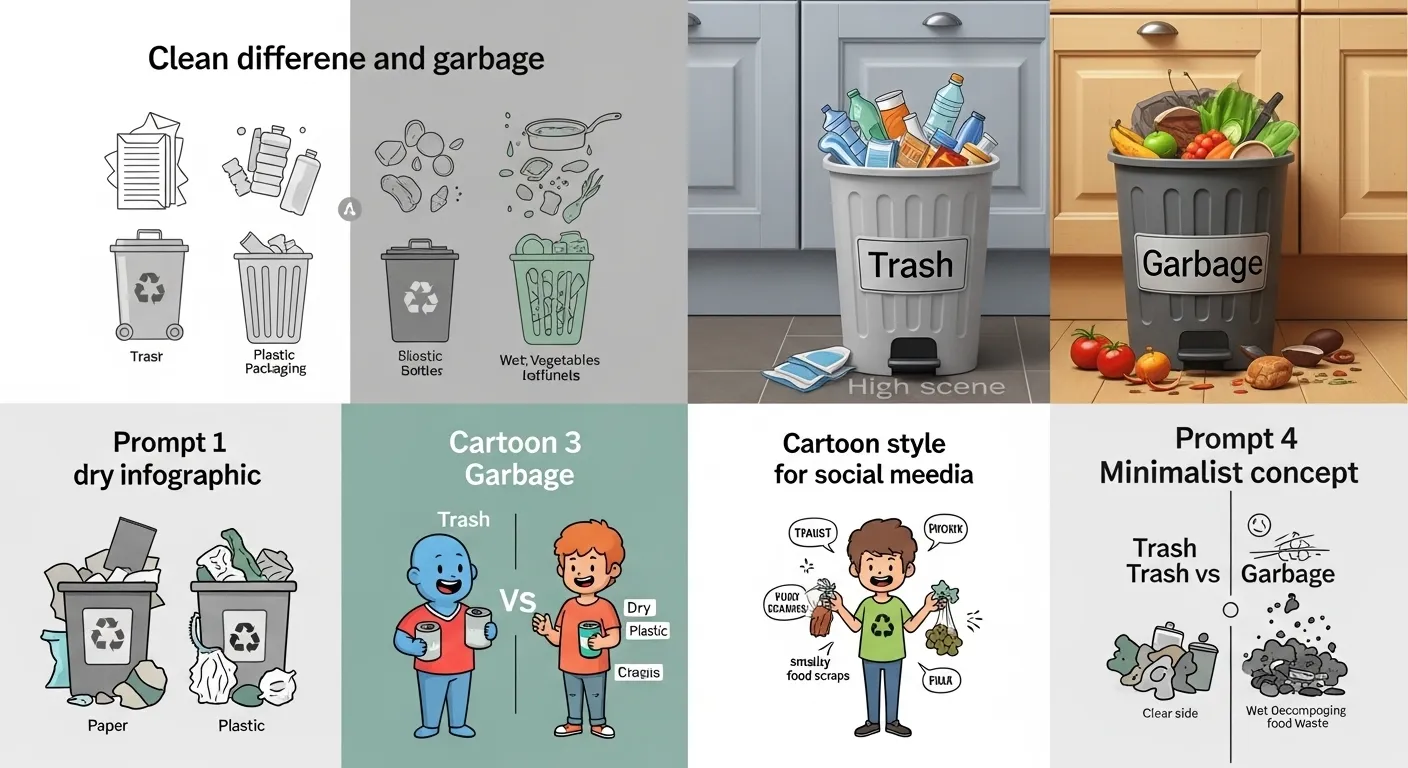
One evening, after a family dinner, a child was asked to “take out the trash.” Confused, he picked up leftover food instead of paper waste. His mother smiled and explained that food scraps are often called “garbage,” while dry waste like wrappers and paper is “trash.” This simple moment highlights the difference between trash and garbage in daily life.
The difference between trash and garbage is not just about words, it reflects how we manage waste. Understanding the difference between trash and garbage helps households, cities, and environmental experts organise disposal systems. In fact, the difference between trash and garbage plays a big role in recycling, cleanliness, and sustainability.
Key Difference Between the Both
- Trash: Dry waste such as paper, plastic, and packaging.
- Garbage: Wet or organic waste like food scraps and kitchen waste.
Why Is Their Difference Necessary to Know?
Knowing the difference between trash and garbage is important for learners and experts because it improves waste management. In society, separating trash and garbage helps recycling systems work efficiently and reduces pollution. Proper understanding leads to cleaner environments, better hygiene, and sustainable living practices.
Pronunciation
- Trash
- US: /træʃ/
- UK: /træʃ/
- Garbage
- US: /ˈɡɑːrbɪdʒ/
- UK: /ˈɡɑːbɪdʒ/
Now that we’ve clarified the basics, let’s dive deeper into the detailed difference between trash and garbage.
Difference Between Trash and Garbage
1. Type of Waste
- Trash: Dry waste.
- Example 1: Old newspapers.
- Example 2: Plastic bottles.
- Garbage: Wet waste.
- Example 1: Leftover food.
- Example 2: Vegetable peels.
2. Source
- Trash: Comes from households and offices.
- Example 1: Packaging materials.
- Example 2: Broken items.
- Garbage: Comes mainly from kitchens.
- Example 1: Food scraps.
- Example 2: Expired groceries.
3. Decomposition
- Trash: Decomposes slowly.
- Example 1: Plastic takes years.
- Example 2: Glass lasts long.
- Garbage: Decomposes quickly.
- Example 1: Fruits rot fast.
- Example 2: Bread molds quickly.
4. Smell
- Trash: Usually odorless.
- Example 1: Paper waste.
- Example 2: Cardboard boxes.
- Garbage: Often smells bad.
- Example 1: Rotten food.
- Example 2: Meat waste.
5. Recycling Potential
- Trash: Highly recyclable.
- Example 1: Paper recycling.
- Example 2: Plastic reuse.
- Garbage: Less recyclable but compostable.
- Example 1: Compost fertilizer.
- Example 2: Biogas production.
6. Storage
- Trash: Stored for longer time.
- Example 1: Office bins.
- Example 2: Recycling containers.
- Garbage: Needs quick disposal.
- Example 1: Daily kitchen waste removal.
- Example 2: Food bins emptied regularly.
7. Environmental Impact
- Trash: Causes pollution if unmanaged.
- Example 1: Plastic pollution.
- Example 2: Landfill overflow.
- Garbage: Produces methane gas.
- Example 1: Decomposing food.
- Example 2: Organic waste in landfills.
8. Handling Method
- Trash: Sorted for recycling.
- Example 1: Paper collection.
- Example 2: Metal sorting.
- Garbage: Used for composting.
- Example 1: Garden compost.
- Example 2: Organic waste bins.
9. Weight
- Trash: Usually lighter.
- Example 1: Empty cans.
- Example 2: Wrappers.
- Garbage: Usually heavier.
- Example 1: Food waste.
- Example 2: Wet leftovers.
10. Usage in Language
- Trash: Often used for general waste or insult.
- Example 1: “Throw it in the trash.”
- Example 2: “That idea is trash.”
- Garbage: Used for waste or nonsense.
- Example 1: “Take out the garbage.”
- Example 2: “That’s garbage talk.”
Nature and Behaviour
- Trash: Dry, stable, non-decomposing quickly.
- Garbage: Wet, biodegradable, quickly decomposing.
Why People Are Confused About Their Use?
People often use “trash” and “garbage” interchangeably in everyday language. Media, regional differences, and casual speech blur the distinction. In some countries, both words simply mean waste, which increases confusion.
Comparison Table
| Feature | Trash | Garbage | Similarity |
| Type | Dry waste | Wet waste | Both are waste materials |
| Source | Homes, offices | Kitchens | Both come from daily life |
| Decomposition | Slow | Fast | Both affect environment |
| Recycling | Recyclable | Compostable | Both can be reused |
| Smell | Usually none | Often strong | Both need disposal |
Which Is Better in What Situation?
Trash is better suited for recycling systems. Dry materials like paper, plastic, and metal can be reused to create new products. This helps reduce environmental pollution and saves resources. In situations where sustainability is important, managing trash properly is highly beneficial.
Garbage is better for composting and organic waste management. It can be turned into natural fertilizer or energy through biogas. In agricultural or eco-friendly settings, garbage becomes valuable instead of waste when handled correctly.
Metaphors and Similes
- Trash: “Like forgotten memories piling up.”
- Garbage: “Like spoiled opportunities that smell over time.”
Connotative Meanings
- Trash: Negative (worthless, low quality)
- Example: “He called the movie trash.”
- Garbage: Negative (nonsense, useless)
- Example: “That explanation is garbage.”
Idioms or Proverbs
- “One man’s trash is another man’s treasure”
- Example: Old furniture may look useless, but one man’s trash is another man’s treasure.
- “Garbage in, garbage out”
- Example: Poor data leads to poor results—garbage in, garbage out.
Works in Literature
- Junkyard – Mike Austin (Children’s literature, 2010)
- Silent Spring – Rachel Carson (Environmental science, 1962)
Movies Related to Waste Themes
- WALL-E (2008, USA)
- Trash (2014, UK/Brazil)
- Garbage Dreams (2009, USA/Egypt)
FAQs
1. What is the main difference between trash and garbage?
Trash is dry waste, while garbage is wet or organic waste.
2. Can garbage be recycled?
Not usually, but it can be composted.
3. Why does garbage smell more than trash?
Because it decomposes quickly and produces gases.
4. Are trash and garbage the same everywhere?
No, meanings vary by region.
5. Which is more harmful to the environment?
Both can be harmful if not managed properly.
How Both Are Useful for Surroundings
Trash and garbage both play roles in environmental systems. Trash supports recycling industries, while garbage contributes to composting and energy production. Proper management of both improves cleanliness and sustainability. The Circular Material Economy (Trash): When clean, dry trash is kept separate, it feeds local and global recycling supply chains. A clean aluminum can or a dry cardboard box can be broken down and manufactured into a new product with a fraction of the energy required to harvest raw, virgin materials from the Earth.
The Biological Nutrient Loop (Garbage): Organic garbage doesn’t belong in a factory; it belongs back in the earth. When diverted to industrial composting or anaerobic digesters, it does two things: it creates nutrient-dense fertilizer that restores depleted agricultural soil, and it can be captured to generate clean biogas (energy) to power local grids.
By framing waste management this way, you show that proper sorting isn’t just about “cleanliness” it is about ensuring that materials go to the right processing stream so they can be reused instead of wasted.
Final Words
Trash and garbage may seem similar, but their differences matter in daily life, language, and environmental care.
Conclusion
Understanding the difference between trash and garbage helps individuals make better decisions about waste disposal and environmental responsibility. While trash includes dry, recyclable materials, garbage consists of organic waste that decomposes quickly. Both require different handling methods to reduce pollution and improve sustainability.
By learning these differences, people can contribute to cleaner communities and more efficient waste management systems. Ultimately, recognizing the role of each type of waste is a small but powerful step toward protecting our environment and promoting a healthier future. Understanding the difference between trash and garbage helps individuals make better decisions about waste disposal and environmental responsibility. While trash includes dry, recyclable materials, garbage consists of organic waste that decomposes quickly. Both require different handling methods to reduce pollution and improve sustainability. By learning these differences, people can contribute to cleaner communities and more efficient waste management systems. Ultimately, recognizing the role of each type of waste is a small but powerful step toward protecting our environment and promoting a healthier future.
Failing to separate these two categories compromises both systems. When organic garbage (like food scraps) is mixed with dry trash (like cardboard or plastics), it contaminates potentially recyclable materials, sending tons of salvageable resources straight to the landfill.
Furthermore, the environmental stakes of combining them are atmospheric. When organic garbage is buried deep in a landfill, it is deprived of oxygen. This creates an anaerobic (oxygen-free) environment, causing the waste to produce methane, a greenhouse gas roughly 28 times more potent than carbon dioxide at trapping heat in our atmosphere.
| Material Type | Primary Threat in Landfills | Modern Sustainable Alternative |
| Trash (Plastics, Metals, Paper) | Infinite lifespan, microplastic pollution, resource depletion | Circular Economy: Mechanical recycling and upcycling |
| Garbage (Food waste, Organics) | Anaerobic decomposition producing potent methane emissions | Regenerative Agriculture: Industrial composting and biogas capture |
Key Themes Added to This Detail:
The Circular Economy: Frames the distinction between the two streams as an opportunity to create closed-loop systems (recycling for trash, composting for garbage)
The Contamination Factor: Explains the physical consequence of mixing them—how wet food scraps ruin perfectly good, recyclable paper and cardboard.
The Methane Problem: Adds critical environmental science by highlighting why burying organic “garbage” in landfills actively harms the climate compared to composting it.

I am a professional SEO content writer specialising in comparison-based and grammar-focused articles. Through my website GrammarCompare.com, I help readers clearly understand the difference between confusing terms with well-researched, easy-to-read content. My expertise lies in focusing on clarity, accuracy, and practical explanations that improve both knowledge and writing skills.