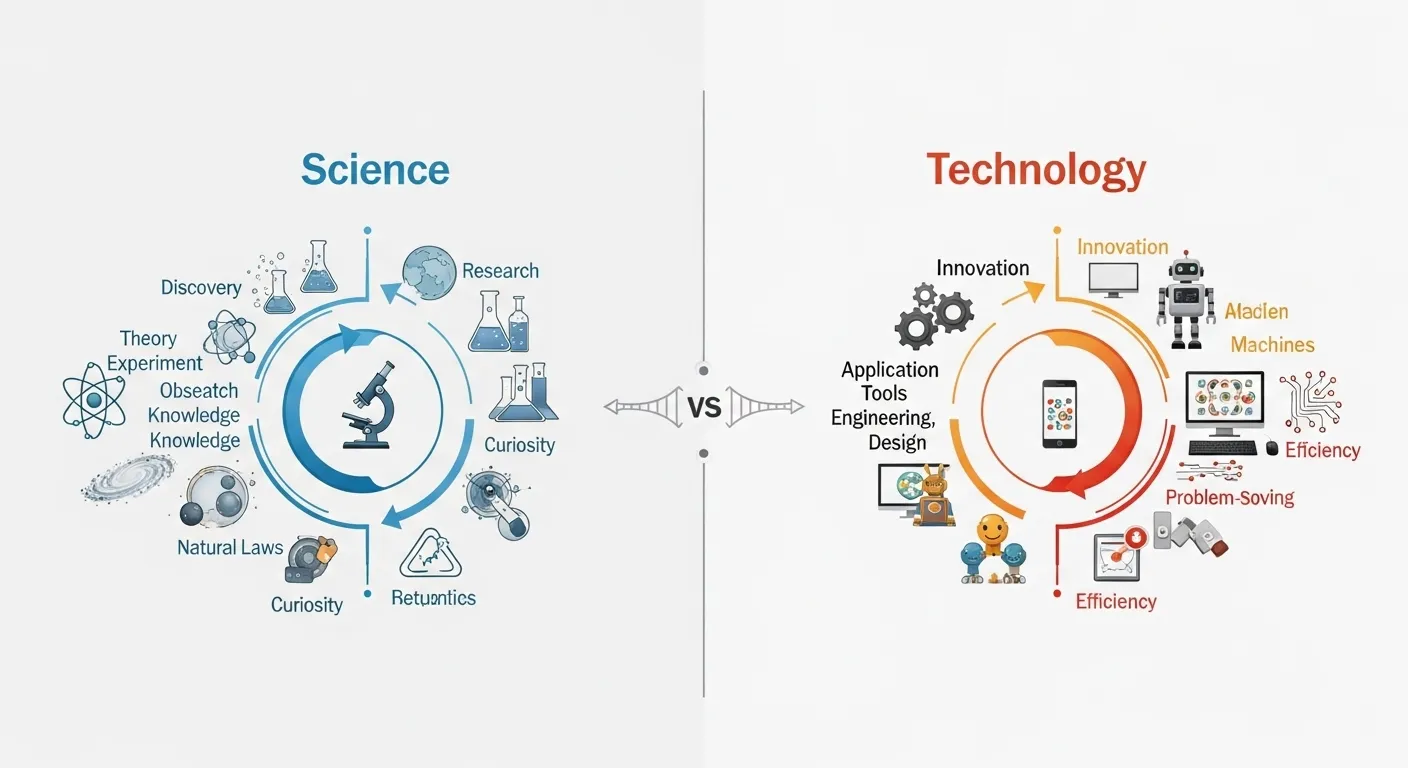
A young student once watched rain falling and asked, “Why does it rain?” Her teacher explained the scientific concept of the water cycle. Later that day, she used a weather app on her phone to check tomorrow’s forecast. That simple moment perfectly shows the difference between science and technology. Science helped her understand the natural phenomenon, while technology helped her use that knowledge in daily life.
The difference between science and technology lies in purpose and application. Science focuses on discovering truths about the natural world, while technology applies those discoveries to solve problems. Understanding the difference between science and technology helps us see how ideas turn into real-world solutions. In fact, the difference between science and technology is essential in shaping modern society, from education to innovation.
Key Difference Between the Both
Science is about knowledge and discovery, whereas technology is about application and invention.
Why Is Their Difference Necessary to Know?
Understanding the difference between science and technology is important for learners, researchers, and professionals. It helps students build clear concepts and encourages innovation. Experts use this distinction to develop new tools and systems. In society, science drives understanding, while technology improves living standards. Knowing their difference helps people appreciate how progress happens, from theory to practice.
Pronunciation
- Science
- US: /ˈsaɪəns/
- UK: /ˈsaɪəns/
- Technology
- US: /tɛkˈnɑːlədʒi/
- UK: /tɛkˈnɒlədʒi/
Now that the basics are clear, let’s explore the difference between science and technology in depth.
Difference Between Science and Technology
1. Definition
Science is the study of natural laws.
Technology is the use of scientific knowledge.
- Example 1: Studying gravity is science.
- Example 2: Building rockets is technology.
2. Purpose
Science aims to understand.
Technology aims to solve problems.
- Example 1: Researching diseases is science.
- Example 2: Creating vaccines is technology.
3. Nature
Science is theoretical.
Technology is practical.
- Example 1: Physics theories are science.
- Example 2: Machines are technology.
4. Process
Science follows experiments and observation.
Technology follows design and development.
- Example 1: Lab experiments are science.
- Example 2: Product design is technology.
5. Output
Science produces knowledge.
Technology produces tools.
- Example 1: Scientific papers are science.
- Example 2: Smartphones are technology.
6. Dependency
Science can exist independently.
Technology depends on science.
- Example 1: Discovering atoms is science.
- Example 2: Electronics depend on atomic theory.
7. Focus Area
Science focuses on natural phenomena.
Technology focuses on human needs.
- Example 1: Studying climate is science.
- Example 2: Air conditioners are technology.
8. Evolution
Science evolves through discoveries.
Technology evolves through innovation.
- Example 1: New theories in biology.
- Example 2: Upgraded gadgets.
9. Measurement of Success
Science is judged by accuracy.
Technology is judged by usefulness.
- Example 1: Correct results in research.
- Example 2: Efficient machines.
10. Examples
Science includes biology, chemistry, physics.
Technology includes computers, AI, robotics.
- Example 1: Chemistry research.
- Example 2: Medical equipment.
Nature and Behaviour
Science is curious and exploratory. It seeks to answer “why” and “how” questions about the universe. It behaves like a continuous journey of discovery.
Technology is innovative and solution-driven. It focuses on “how to use” knowledge to improve life. It behaves like a bridge between ideas and real-world applications.
Why People Are Confused
People often confuse science and technology because they are closely connected. Many technological products are based on scientific discoveries, making them appear the same. Their interdependence causes misunderstanding.
Table: Difference and Similarity
| Feature | Science | Technology | Similarity |
| Purpose | Understanding | Application | Both drive progress |
| Nature | Theoretical | Practical | Interconnected |
| Output | Knowledge | Tools | Benefit society |
| Process | Research | Development | Use logical thinking |
| Dependency | Independent | Depends on science | Work together |
Which Is Better in What Situation?
Science is better when the goal is to understand the world. For example, in education, research, and exploration, science provides the foundation of knowledge. It helps answer fundamental questions and builds theories that shape human understanding.
Technology is better when the goal is to solve real-life problems. In healthcare, communication, and transportation, technology offers practical solutions. It improves efficiency and makes life easier. In daily life, technology plays a more visible role.
Metaphors and Similes
- Science is like “a lamp that reveals truth.”
- Technology is like “a tool that builds the future.”
Connotative Meaning
Science
- Positive: Knowledge, discovery
- Example: “Science brings clarity to confusion.”
- Neutral: Academic field
- Negative: Can seem complex
Technology
- Positive: Innovation, convenience
- Example: “Technology makes life easier.”
- Neutral: Tools and systems
- Negative: Can lead to dependency
Idioms or Proverbs
- “Knowledge is power” (related to science)
- “Necessity is the mother of invention” (related to technology)
Examples:
- “Through science, knowledge is power.”
- “Technology proves that necessity is the mother of invention.”
Works in Literature
- A Brief History of Time (Science, Stephen Hawking, 1988)
- The Structure of Scientific Revolutions (Philosophy of Science, Thomas Kuhn, 1962)
Movies Related to Science and Technology
- Interstellar (2014, USA)
- The Martian (2015, USA)
- Ex Machina (2014, UK)
FAQs
1. Are science and technology the same?
No, science is knowledge, while technology is its application.
2. Can technology exist without science?
No, it depends on scientific principles.
3. Which came first?
Science came first as discovery.
4. Why are they important?
They drive progress and innovation.
5. Can one improve without the other?
They grow best when combined.
How Both Are Useful for Surroundings
Science helps us understand environmental issues like climate change. Technology provides solutions such as renewable energy and waste management systems. Together, they improve living conditions.
Final Words for the Both
Science explains the world. Technology changes the world. Both are essential for human progress.
Conclusion
The difference between science and technology lies in their roles, one seeks knowledge, and the other applies it. While science helps us understand the universe, technology transforms that understanding into practical solutions. Recognising the difference between science and technology allows us to appreciate their unique contributions. Together, they form the backbone of modern civilisation, driving innovation, improving lives, and shaping the future. Ultimately, both are not competitors but partners in progress. Moving beyond basic definitions reveals that the relationship between scientific discovery and technological innovation is fundamentally cyclical rather than linear. Science acts as the intellectual engine, uncovering raw natural laws, mapping biological systems, and answering the fundamental “why” behind the mechanics of our reality. However, these theoretical breakthroughs would remain confined to textbooks without the engineering marvels of technology to translate them into tangible tools.
Crucially, this partnership feeds into itself: new scientific theories allow us to build more advanced technologies, which in turn provide scientists with the highly precise instruments—like supercomputers, particle accelerators, and deep-space telescopes—needed to push the boundaries of human knowledge even further. Recognizing this mutual dependence helps society move past viewing them as separate subjects, framing them instead as an unbroken chain of human ingenuity that continuously redefines the limits of what is possible. Final Thoughts: Balancing Pure Exploration with Practical Application
To truly understand how these two forces shape modern society, it is helpful to look at how they approach problems from entirely different angles:
- The Pursuit of Truth (Science): Driven by curiosity, the scientific method values empirical evidence and systematic experimentation. Its primary objective is to expand the global pool of human knowledge, regardless of immediate commercial or practical utility.
- The Pursuit of Utility (Technology): Driven by necessity and efficiency, technological development focuses on design, optimization, and scalability. Its goal is to take existing scientific principles and package them into products, infrastructure, and software that solve human problems.
As we navigate complex global challenges—from climate change to resource scarcity—the synthesis of these two disciplines becomes critical. Pure science provides the diagnostic data and understanding, while adaptive technology builds the scalable solutions required to safeguard our collective future.

I am a professional SEO content writer specialising in comparison-based and grammar-focused articles. Through my website GrammarCompare.com, I help readers clearly understand the difference between confusing terms with well-researched, easy-to-read content. My expertise lies in focusing on clarity, accuracy, and practical explanations that improve both knowledge and writing skills.