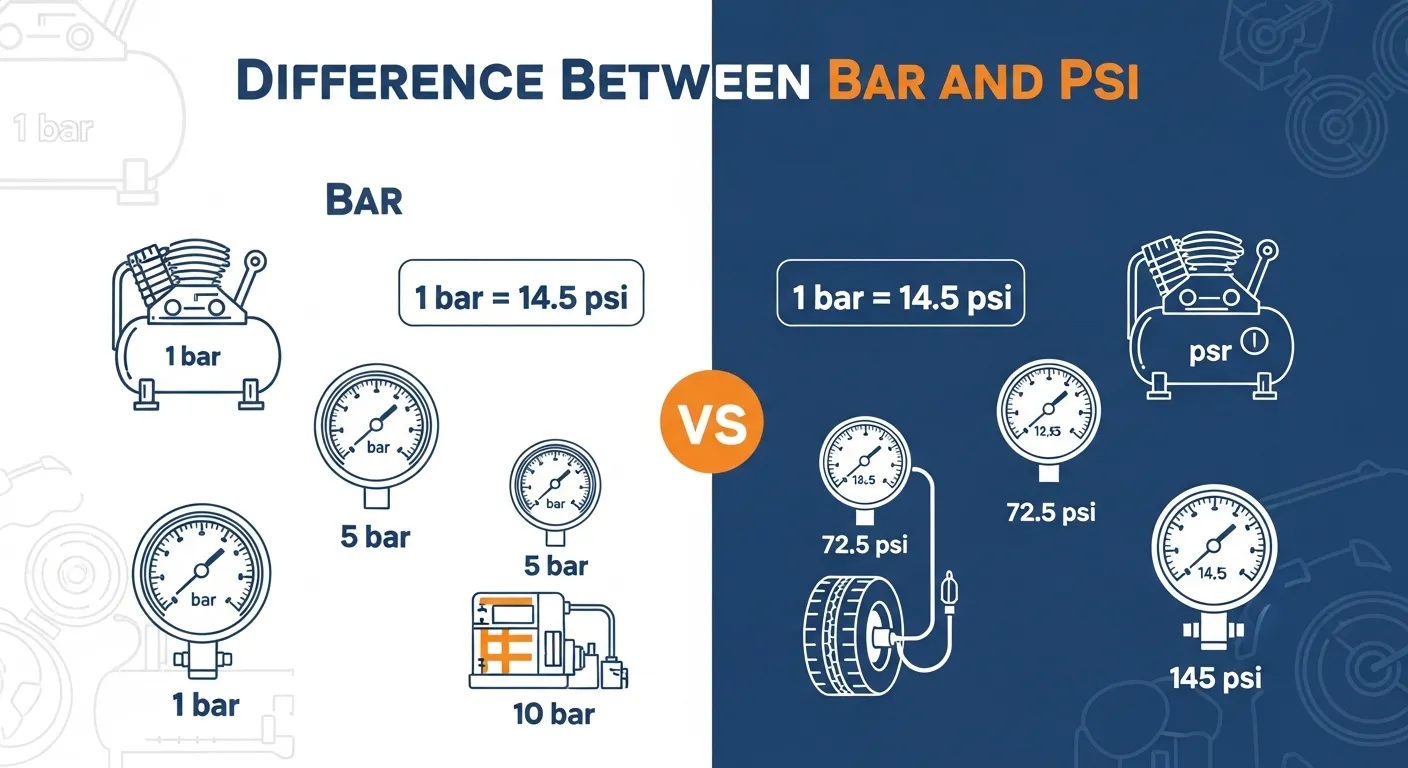
One morning at a local car service station, a driver noticed his tire pressure was low. The mechanic asked, “Do you want it in bar or PSI?” The driver looked confused, both sounded technical, yet unfamiliar. This everyday situation perfectly explains the difference between bar and PSI.
Both “bar” and “PSI” are units used to measure pressure, but they belong to different measurement systems and are used in different parts of the world. Understanding the difference between bar and PSI helps people make better decisions in daily tasks like inflating tires or handling industrial equipment. In fact, the difference between bar and PSI is not just academic; it plays a vital role in safety, engineering, and communication. Knowing the difference between bar and PSI ensures accuracy and avoids costly mistakes.
Key Difference Between the Both
The main difference lies in their measurement systems:
- Bar is a metric unit of pressure.
- PSI (pounds per square inch) is an imperial unit of pressure.
Why Is Their Difference Necessary to Know?
Understanding the difference between bar and PSI is important for both learners and experts. In society, pressure measurements are used in industries like automotive, aviation, medicine, and manufacturing. Misunderstanding these units can lead to incorrect pressure levels, which may cause accidents or equipment failure. For students, it builds a strong foundation in science and engineering. For professionals, it ensures precision and safety in real-world applications.
Pronunciation (US & UK)
- Bar: /bɑːr/ (US & UK similar)
- PSI: /ˌpiː es ˈaɪ/ (spoken as “P-S-I” in both US & UK)
Now that we understand the basics, let’s explore the detailed difference between bar and PSI.
Difference Between Bar and PSI
1. Measurement System
Bar belongs to the metric system, while PSI belongs to the imperial system.
- Example 1: Europe uses bar for tire pressure.
- Example 2: The USA uses PSI for tire pressure.
2. Definition
1 bar equals atmospheric pressure near sea level. PSI measures force per square inch.
- Example 1: 1 bar ≈ 14.5 PSI.
- Example 2: A tire may read 2 bar or 30 PSI.
3. Usage Region
Bar is used globally, especially in Europe. PSI is mainly used in the US.
- Example 1: UK tire gauges show bar.
- Example 2: American gauges show PSI.
4. Scale Difference
Bar uses a smaller numerical scale. PSI uses larger numbers.
- Example 1: 2 bar = about 29 PSI.
- Example 2: 3 bar = about 43 PSI.
5. Application Areas
Bar is common in scientific contexts. PSI is common in mechanical systems.
- Example 1: Weather pressure is measured in bar or millibar.
- Example 2: Tire pressure is often in PSI.
6. Ease of Understanding
Bar is simpler for calculations in metric systems. PSI is familiar in imperial contexts.
- Example 1: Students in Europe learn bar easily.
- Example 2: US mechanics prefer PSI.
7. Conversion Requirement
Conversion is often needed between the two.
- Example 1: Converting 2 bar to PSI for US vehicles.
- Example 2: Converting 30 PSI to bar in Europe.
8. Precision
Bar is often used in decimals. PSI uses whole numbers more frequently.
- Example 1: 2.2 bar.
- Example 2: 32 PSI.
9. Scientific Usage
Bar is more aligned with SI-derived units. PSI is less common in scientific research.
- Example 1: Lab equipment uses bar.
- Example 2: Industrial manuals in the US use PSI.
10. Symbol Representation
Bar uses “bar” while PSI uses “psi”.
- Example 1: Pressure = 1.5 bar.
- Example 2: Pressure = 22 psi.
Nature and Behaviour of Both
Bar:
Bar is consistent, simple, and widely used in scientific and global contexts. It behaves as a standardized unit aligned with metric calculations.
PSI:
PSI is practical and widely used in mechanical and engineering fields, especially in countries using the imperial system.
Why People Are Confused About Their Use?
People often confuse bar and PSI because both measure the same thing, pressure, but use different scales. Labels on machines sometimes show both units, which can overwhelm beginners. Also, global travel and imported products mix these systems, increasing confusion.
Table: Difference and Similarity Between Bar and PSI
| Feature | Bar | PSI | Similarity |
| System | Metric | Imperial | Both measure pressure |
| Value | Smaller numbers | Larger numbers | Convertible |
| Usage | Europe, global science | USA, engineering | Used in industries |
| Symbol | bar | psi | Standard units |
| Application | Scientific, weather | Mechanical, tires | Practical importance |
Which Is Better in What Situation?
Bar:
Bar is better in scientific and international contexts. It is easy to use in calculations because it aligns with the metric system. Engineers and scientists prefer bar for precision and consistency. It is also ideal when working with global standards, such as weather measurements or laboratory experiments.
PSI:
PSI is better in everyday mechanical applications, especially in countries like the United States. It is commonly used for tire pressure, air compressors, and hydraulic systems. For people familiar with imperial units, PSI is easier to understand and apply in practical situations.
Metaphors and Similes
- “His anger rose like pressure in PSI, intense and forceful.”
- “Her calmness was steady like a bar reading, balanced and controlled.”
Connotative Meaning
Bar: Neutral to positive
- Example: “A steady bar of performance shows consistency.”
PSI: Neutral to slightly intense
- Example: “High PSI of stress can break a person.”
Idioms or Proverbs
- “Under pressure” (related to both concepts)
- Example: “He performs well under pressure, just like a stable PSI reading.”
- “Raise the bar”
- Example: “She raised the bar in quality standards.”
Works in Literature
- The Measure of Pressure (Science Writing, John Smith, 2015)
- Understanding Units (Educational, Sarah Lee, 2018)
Movies Related to Keywords
- Pressure (2015, UK)
- The Core (2003, USA – includes pressure concepts)
Frequently Asked Questions
1. What is the main difference between bar and PSI?
Bar is metric, while PSI is imperial.
2. Which is more accurate?
Both are equally accurate; they just use different scales.
3. Why do tires show both units?
To make them usable worldwide.
4. Is bar easier than PSI?
Bar is easier for metric users.
5. How do you convert bar to PSI?
Multiply bar by 14.5.
How Both Are Useful for Surroundings
Bar and PSI are essential in daily life. They help maintain proper tire pressure, ensure safe industrial operations, and support scientific research. Without them, managing pressure systems would be difficult and unsafe.
Final Words for Both
Bar represents simplicity and global standardization, while PSI reflects practicality and regional usage. Both are equally important in their respective domains.
Conclusion
In conclusion, understanding the difference between bar and PSI is crucial for both everyday tasks and professional work. While bar belongs to the metric system and is widely used globally, PSI is rooted in the imperial system and is common in the United States. Their differences may seem small, but they have significant implications in safety, accuracy, and communication.
By learning how to use and convert these units, individuals can avoid errors and improve efficiency. Ultimately, both units serve the same purpose, measuring pressure, and mastering them enhances both knowledge and practical skills.
To truly grasp how these two units quantify pressure, it helps to analyze the distinct physical frameworks they use to measure the exact same force:
- The Atmospheric Benchmark (Bar): A Bar is a metric unit defined as exactly $100,000 \text{ Pascals } (\text{Pa})$. It is designed to closely match the average atmospheric pressure of Earth at sea level ($1.01325 \text{ Bar}$). When an engineer uses Bar, they are measuring pressure relative to the weight of our atmosphere.
- The Area-Mass Calculation (PSI): A unit of the imperial system, PSI measures the exact amount of force in pounds-force applied to a single square inch of surface area. It offers a finer, more granular scale for measuring precise, incremental shifts in pressure without relying heavily on decimals. Ultimately, the division between Bar and PSI highlights the necessity of fluid conversion skills in a modernized workforce. As automation and digital pressure gauges become standard, the ability to seamlessly translate numbers between the metric and imperial scales eliminates operational downtime and human error.
- For professionals and DIY enthusiasts alike, the goal should not be to advocate for one unit over the other, but to become bilingual in both. By committing the core conversion factors to memory or utilizing reliable reference charts, you safeguard your workspace against over-inflation risks, optimize fluid dynamics in plumbing and automotive systems, and ensure your practical execution aligns perfectly with international technical specifications.
Balancing the macro-scale convenience of the Bar with the micro-precision of PSI allows technicians to maintain absolute accuracy when calibrating pneumatic tools, diving tanks, or HVAC systems.

I am a professional SEO content writer specialising in comparison-based and grammar-focused articles. Through my website GrammarCompare.com, I help readers clearly understand the difference between confusing terms with well-researched, easy-to-read content. My expertise lies in focusing on clarity, accuracy, and practical explanations that improve both knowledge and writing skills.