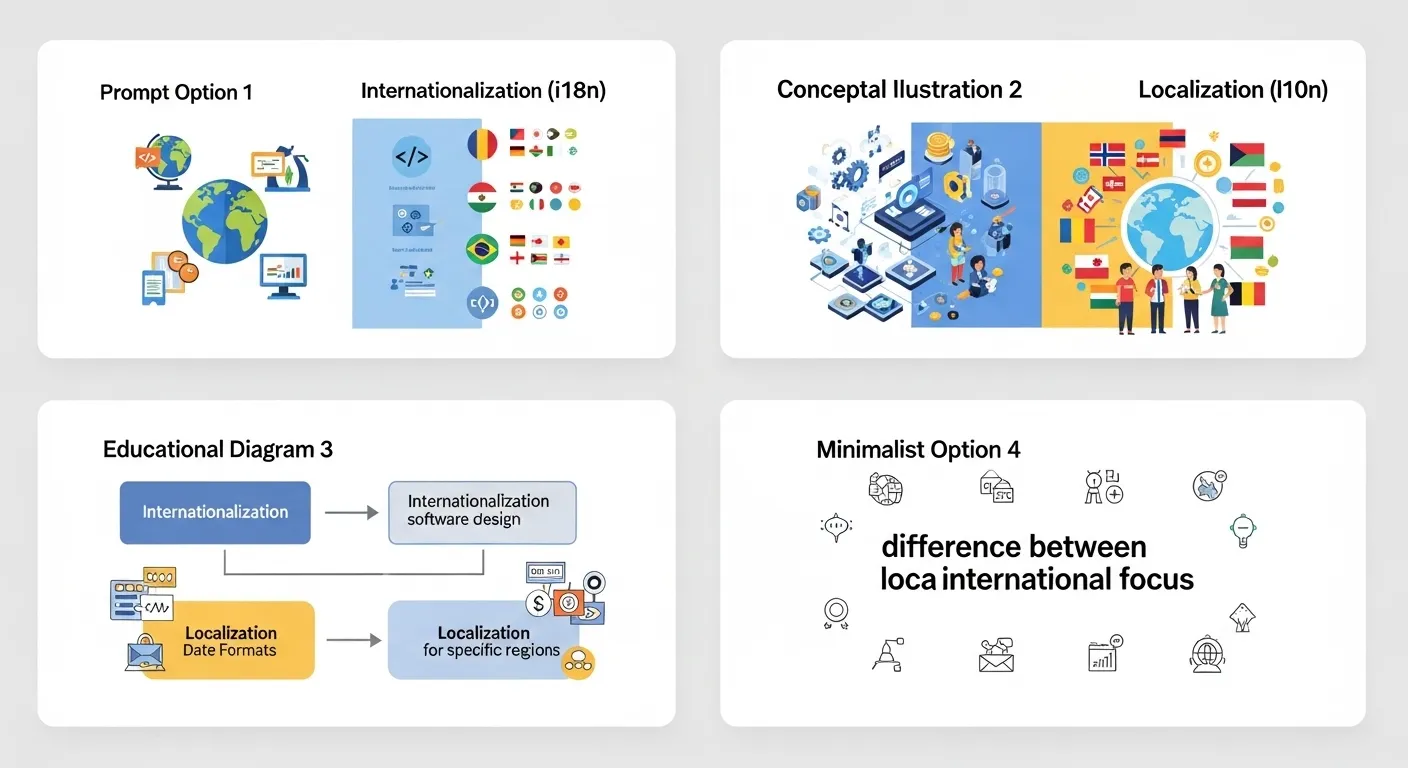
A small software company once launched its app globally, expecting instant success. However, users in different countries struggled with language, currency formats, and cultural references. That’s when the team realized the importance of understanding the difference between localization and internationalization. Localization means adapting content for a specific region, while internationalization focuses on designing systems that work globally from the start. This real-world story highlights why the difference between localization and internationalization matters in today’s connected world. Whether you are a developer, marketer, or student, knowing the difference between localization and internationalization helps you create products that truly connect with users. In fact, mastering the difference between localization and internationalization can determine whether a product succeeds globally or fails locally.
Key Difference Between the Both
- Localization adapts content to a specific culture or region.
- Internationalization prepares a product to support multiple regions without major redesign.
Why Is Their Difference Necessary to Know?
Understanding the difference between localization and internationalization is essential for learners and experts. In society, businesses are expanding globally, and communication across cultures is critical. Without this knowledge, products may fail to meet user expectations. For learners, it builds awareness of global communication. For professionals, it ensures better product design, user satisfaction, and market success.
Pronunciation (US & UK)
- Localization: /ˌloʊ.kə.ləˈzeɪ.ʃən/ (US), /ˌləʊ.kə.laɪˈzeɪ.ʃən/ (UK)
- Internationalization: /ˌɪn.t̬ɚˌnæʃ.ən.əl.əˈzeɪ.ʃən/ (US), /ˌɪn.təˌnæʃ.ən.əl.aɪˈzeɪ.ʃən/ (UK)
Now, let’s dive deeper into the difference between localization and internationalization.
Difference Between Localization and Internationalization
1. Definition
Localization focuses on adapting content; internationalization focuses on designing for adaptability.
- Example 1: Translating an app into Spanish (localization).
- Example 2: Designing an app to support multiple languages (internationalization).
2. Stage of Development
Localization happens after product creation; internationalization happens during development.
- Example 1: Adding regional currency later (localization).
- Example 2: Building currency support from the start (internationalization).
3. Scope
Localization is region-specific; internationalization is global.
- Example 1: Adapting content for France only (localization).
- Example 2: Supporting all countries (internationalization).
4. Focus Area
Localization focuses on users; internationalization focuses on system design.
- Example 1: Changing date format for users (localization).
- Example 2: Designing flexible date formats (internationalization).
5. Language Handling
Localization translates language; internationalization enables translation.
- Example 1: Converting English to Urdu (localization).
- Example 2: Supporting multiple language files (internationalization).
6. Cultural Adaptation
Localization includes cultural elements; internationalization does not.
- Example 1: Changing images for cultural relevance (localization).
- Example 2: Keeping design neutral (internationalization).
7. Cost
Localization can be repeated for each region; internationalization is a one-time investment.
- Example 1: Translating for each country separately (localization).
- Example 2: Building reusable frameworks (internationalization).
8. Flexibility
Localization depends on existing systems; internationalization ensures flexibility.
- Example 1: Adjusting layouts manually (localization).
- Example 2: Designing flexible layouts (internationalization).
9. Technical Complexity
Localization is less technical; internationalization is more technical.
- Example 1: Editing text (localization).
- Example 2: Writing adaptable code (internationalization).
10. Goal
Localization aims for local relevance; internationalization aims for global readiness.
- Example 1: Making content relatable (localization).
- Example 2: Making systems adaptable (internationalization).
Nature and Behaviour of Both
Localization:
Localization is adaptive and user-focused. It behaves like a customization process, ensuring content feels natural and familiar to a specific audience.
Internationalization:
Internationalization is proactive and system-oriented. It behaves like a foundation that supports multiple languages and cultures without major changes.
Why People Are Confused About Their Use?
People often confuse these terms because both relate to global expansion. They are closely connected and often used together. Many assume they mean the same thing, but in reality, one prepares the system while the other adapts the content.
Table: Difference and Similarity Between Localization and Internationalization
| Feature | Localization | Internationalization | Similarity |
| Purpose | Adapt to specific region | Prepare for global use | Both support global reach |
| Timing | After development | During development | Work together |
| Focus | User experience | System design | Improve usability |
| Scope | Local | Global | Enhance accessibility |
| Complexity | Less technical | More technical | Important in software development |
Which Is Better in What Situation?
Localization:
Localization is better when a product is already developed and needs to connect with a specific audience. It ensures that users feel comfortable and understood. For example, marketing campaigns, translated apps, and region-specific content rely heavily on localization. It is ideal for businesses entering a new market and wanting to build trust with local users.
Internationalization:
Internationalization is better at the early stages of product development. It helps create a flexible system that can easily adapt to different languages and regions. This approach saves time and cost in the long run. It is ideal for global platforms that aim to serve users from multiple countries efficiently.
Metaphors and Similes
- “Localization is like tailoring a suit to fit perfectly.”
- “Internationalization is like designing a universal outfit that fits everyone.”
Connotative Meaning
Localization: Positive
- Example: “Localized content feels personal and engaging.”
Internationalization: Neutral to positive
- Example: “Internationalization shows forward-thinking design.”
Idioms or Proverbs
- “Think globally, act locally”
- Example: “Companies use internationalization to think globally and localization to act locally.”
Works in Literature
- Global Content Strategy (Non-fiction, Pam Didner, 2014)
- The Cultural Dimension of Global Business (Academic, Gary Ferraro, 2002)
Movies Related to Keywords
- Lost in Translation (2003, USA/Japan)
- The Social Network (2010, USA – shows global tech expansion themes)
Frequently Asked Questions
1. What is the main difference between localization and internationalization?
Localization adapts content, while internationalization prepares systems.
2. Which comes first?
Internationalization comes before localization.
3. Are both necessary?
Yes, both are essential for global success.
4. Is localization expensive?
It can be, especially for multiple regions.
5. Can a product skip internationalization?
Yes, but it makes localization harder later.
How Both Are Useful for Surroundings
Localization and internationalization help create inclusive environments. They allow people from different cultures to access products easily. This improves communication, business growth, and global understanding.
Final Words for the Both
Localization brings personalization, while internationalization provides scalability. Together, they create a powerful strategy for global success. Here is a deeper look into how these two critical disciplines complement each other to achieve global market dominance:
1. Architectural Blueprint vs. Cultural Polish
- Internationalization (The Engineering Foundation): Internationalization happens completely behind the scenes in the source code. It is the process of designing your software, product, or content framework so that it can handle multiple languages, currencies, and regions without needing structural code changes. It strips out hardcoded text and creates empty placeholders for regional data.
- Localization (The Front-End Adaptation): Localization is the process of taking that empty, flexible framework and filling it with culturally specific content. It goes far beyond literal word-for-word translation to adapt imagery, idioms, color choices, payment methods, and legal compliance to make the product feel native to the target country.
2. Global Code Scalability vs. Regional Consumer Trust
- Internationalization (Ensuring Fluid Growth): Without i18n, expanding to a new country means copy-pasting your code and rebuilding the platform from scratch—a maintenance nightmare. Internationalization ensures scalability because it allows a single codebase to serve the entire planet simultaneously. It handles technical complexities like right-to-left text flow (for Arabic or Hebrew) and varying date/time formats.
- Localization (Driving Conversion): A product can be technically perfect, but if it doesn’t speak the local language or respect cultural nuances, users will abandon it. Localization brings personalization by making an international user feel seen and understood. It translates the abstract software into a relatable, trustworthy, and frictionless consumer experience that drives sales and brand loyalty.
3. Systemic Agility vs. Local Relevance
| Dimension | Internationalization (i18n) | Localization (l10n) |
| Primary Goal | Global Readiness (Preparing the product for any market). | Local Resonance (Adapting the product for a specific market). |
| Ownership | Software Architects, Developers, and Systems Engineers. | Translators, Cultural Experts, Local Marketers, and UX Designers. |
| Core Focus | Generalization, abstraction, and code scalability. | Specialization, context, and user personalization. |
| Execution Phase | Done before localization (during initial development). | Done after internationalization (during market entry). |
The Bottom Line: Internationalization ensures your product won’t break when it crosses borders; localization ensures it will sell. Attempting to localize without internationalization leads to unscalable, broken systems. Internationalizing without localizing leaves you with a cold, generic product that fails to connect with real people. Together, they form an unbreakable loop that transforms local innovations into global phenomena.
Conclusion
Understanding the difference between localization and internationalization is crucial in today’s globalized world. While internationalization builds the foundation for global compatibility, localization ensures that products resonate with local audiences. Both processes are interconnected and essential for success in international markets. By mastering these concepts, individuals and businesses can create user-friendly, culturally relevant, and scalable solutions. Ultimately, the balance between localization and internationalization determines how effectively a product reaches and satisfies a global audience.
Final Thoughts: The Engineering Blueprint vs. The Cultural Polish
To maximize efficiency when scaling a product across borders, development and marketing teams must look at how these two processes handle problems from entirely different angles:
- The Global Blueprint (Internationalization / i18n): This step belongs to the developers and systems architects. It involves designing a flexible backend that natively supports right-to-left (RTL) scripts, unicode (UTF-8) text, dynamic UI layouts that accommodate text expansion, and independent locale files. Its goal is to ensure the product can adapt to any region without rewriting the core code.
- The Local Nuance (Localization / l10n): This step belongs to translators, local marketers, and UX designers. It infuses regional context into the product by utilizing local idioms, adjusting imagery to avoid cultural taboos, mirroring layouts for specific languages, and aligning features with regional consumer behavior. Its goal is to make the product feel as if it was originally built for that specific target market.
Balancing backend flexibility with front-end cultural precision is what transforms a functional application into an intuitive, globally adopted platform.

I am a professional SEO content writer specialising in comparison-based and grammar-focused articles. Through my website GrammarCompare.com, I help readers clearly understand the difference between confusing terms with well-researched, easy-to-read content. My expertise lies in focusing on clarity, accuracy, and practical explanations that improve both knowledge and writing skills.