A parent once stood at a crossroads while choosing a school for her child. One school focused on independence and hands-on learning, while the other emphasized imagination, creativity, and storytelling. These approaches represented Montessori and Waldorf education. Understanding the difference between Montessori and Waldorf became essential for her decision.
The difference between Montessori and Waldorf lies in their teaching philosophy, classroom structure, and learning goals. While Montessori encourages self-directed learning, Waldorf nurtures creativity through guided imagination. In today’s world, knowing the difference between Montessori and Waldorf helps parents and educators make informed choices. Whether for early childhood or advanced learning, the difference between Montessori and Waldorf shapes how children grow academically and emotionally.
Key Difference Between the Both
Montessori focuses on independence and practical skills, while Waldorf emphasizes imagination, creativity, and holistic development.
Why Is Their Difference Necessary to Know?
Understanding the difference between Montessori and Waldorf is important for learners and experts because it influences educational outcomes. Montessori prepares children for real-world problem-solving, while Waldorf builds emotional intelligence and creativity. In society, both systems play a vital role—one fosters innovation and independence, while the other nurtures artistic and social growth.
Pronunciation
- Montessori
- US: /ˌmɒntɪˈsɔːri/
- UK: /ˌmɒntɪˈsɒri/
- Waldorf
- US: /ˈwɔːldɔːrf/
- UK: /ˈwɔːldɒf/
Now that we understand the basics, let’s explore the difference between Montessori and Waldorf in detail.
Difference Between Montessori and Waldorf
1. Teaching Philosophy
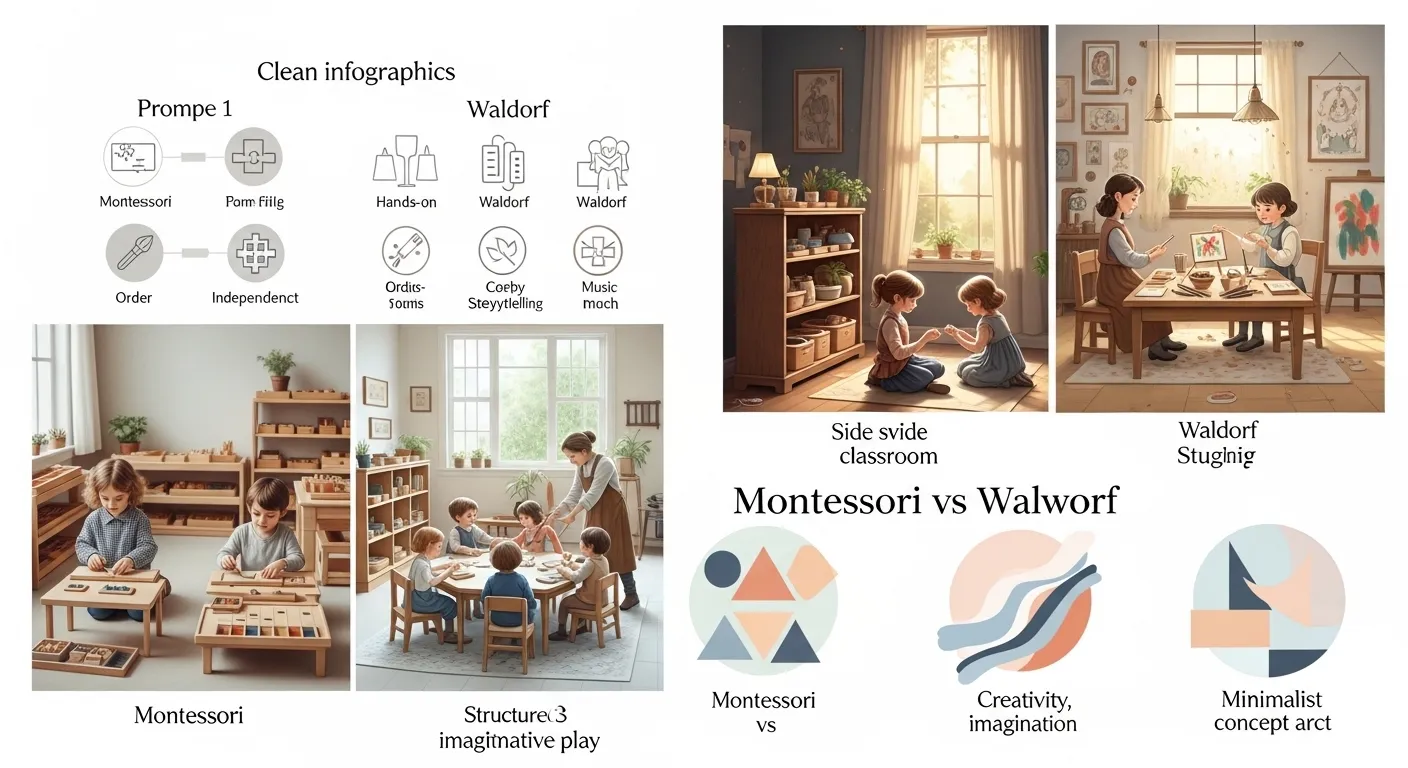
Montessori is child-centered and focuses on independence. Waldorf is teacher-guided and focuses on imagination.
- Example 1: Montessori child chooses activities freely.
- Example 2: Waldorf teacher tells stories to guide learning.
2. Learning Style
Montessori uses hands-on learning. Waldorf uses storytelling and arts.
- Example 1: Montessori uses puzzles and tools.
- Example 2: Waldorf uses painting and drama.
3. Classroom Environment
Montessori classrooms are structured and organized. Waldorf classrooms are warm and artistic.
- Example 1: Montessori shelves are neatly arranged.
- Example 2: Waldorf rooms have soft colors and handmade items.
4. Role of Teacher
Montessori teachers guide quietly. Waldorf teachers actively lead.
- Example 1: Montessori teacher observes more.
- Example 2: Waldorf teacher interacts constantly.
5. Curriculum Focus
Montessori focuses on practical life and academics. Waldorf focuses on creativity and imagination.
- Example 1: Montessori teaches math early.
- Example 2: Waldorf delays formal academics.
6. Use of Technology
Montessori may allow limited technology. Waldorf avoids it in early years.
- Example 1: Montessori uses digital tools occasionally.
- Example 2: Waldorf prefers no screens.
7. Assessment Method
Montessori uses observation-based assessment. Waldorf avoids formal testing.
- Example 1: Montessori tracks progress individually.
- Example 2: Waldorf focuses on personal growth.
8. Age Grouping
Montessori mixes age groups. Waldorf groups by age.
- Example 1: Montessori class has 3–6-year-olds together.
- Example 2: Waldorf classes are same-age.
9. Materials Used
Montessori uses scientific learning materials. Waldorf uses natural and artistic materials.
- Example 1: Montessori uses counting beads.
- Example 2: Waldorf uses wooden toys.
10. Goal of Education
Montessori aims for independence. Waldorf aims for holistic development.
- Example 1: Montessori builds self-reliance.
- Example 2: Waldorf builds creativity and empathy.
Nature and Behaviour
Montessori is practical, structured, and independent. It encourages logical thinking and discipline.
Waldorf is creative, emotional, and expressive. It focuses on imagination and social harmony.
Why People Are Confused About Their Use?
People often confuse Montessori and Waldorf because both are alternative education systems. They avoid traditional methods, focus on child development, and promote holistic learning. However, their core philosophies are quite different.
Table: Difference and Similarity
| Aspect | Montessori | Waldorf | Similarity |
| Philosophy | Independence | Creativity | Child-centered |
| Teaching Style | Self-directed | Teacher-guided | Active learning |
| Materials | Scientific | Artistic | Hands-on |
| Environment | Structured | Artistic | Supportive |
| Assessment | Observational | Non-testing | Individual growth |
Which Is Better in What Situation?
Montessori:
Montessori is better for children who are independent and curious. It suits learners who enjoy exploring at their own pace. It is ideal for developing practical skills, discipline, and logical thinking.
Waldorf:
Waldorf is better for children who are imaginative and creative. It suits those who enjoy storytelling, art, and emotional expression. It is ideal for nurturing creativity and social skills.
Metaphors and Similes
- Montessori is like a “toolbox” where children build their own skills.
- Waldorf is like a “garden” where creativity grows naturally.
Connotative Meaning
- Montessori: Positive (independence, discipline)
- Example: “Her Montessori mindset made her self-reliant.”
- Waldorf: Positive (creativity, imagination)
- Example: “His Waldorf-style thinking inspired innovation.”
Idioms or Proverbs
- “Learn by doing” (fits Montessori)
- Example: Children in Montessori truly learn by doing.
- “Imagination knows no bounds” (fits Waldorf)
- Example: Waldorf students show that imagination knows no bounds.
Works in Literature
- The Montessori Method – Educational, Maria Montessori, 1912
- Education of the Child – Philosophy, Rudolf Steiner, 1907
Movies Related to Keywords
- Maria Montessori: Una Vita per i Bambini (2007, Italy)
- Being and Becoming (2014, France)
FAQs
1. What is the main difference between Montessori and Waldorf?
Montessori focuses on independence, while Waldorf focuses on creativity.
2. Which is better for early education?
Both are effective; choice depends on the child’s personality.
3. Do both systems avoid exams?
Yes, both prefer alternative assessment methods.
4. Is technology used in both?
Montessori allows limited use; Waldorf avoids it early on.
5. Which develops creativity more?
Waldorf emphasizes creativity more strongly.
How Both Are Useful for Surroundings
Montessori develops problem-solvers who contribute to society. Waldorf nurtures creative thinkers who bring innovation and empathy. Together, they create a balanced and progressive environment.
Final Words for Both
Montessori builds independence and discipline. Waldorf builds imagination and emotional intelligence. Both are valuable in shaping future generations.
Conclusion
The difference between Montessori and Waldorf lies in their unique philosophies and teaching approaches. Montessori emphasizes independence, structure, and practical skills, while Waldorf focuses on creativity, imagination, and emotional growth. Understanding the difference between Montessori and Waldorf helps parents and educators choose the best path for a child’s development. Both systems contribute significantly to education by nurturing different aspects of human potential. Ultimately, the choice depends on the child’s needs, personality, and learning style, making both approaches equally important in modern education.

I am a professional SEO content writer specialising in comparison-based and grammar-focused articles. Through my website GrammarCompare.com, I help readers clearly understand the difference between confusing terms with well-researched, easy-to-read content. My expertise lies in focusing on clarity, accuracy, and practical explanations that improve both knowledge and writing skills.