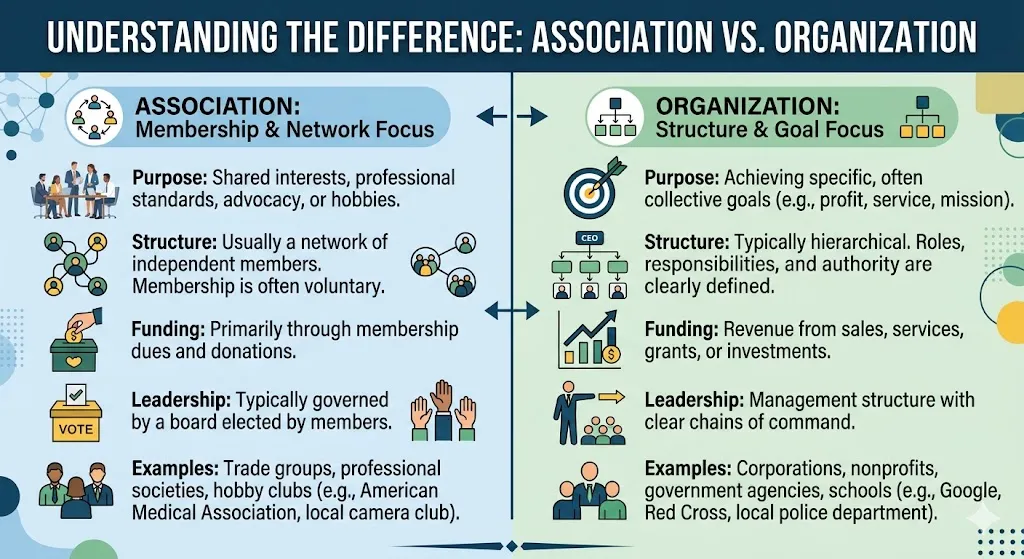
In a small town, a group of teachers came together to share ideas and improve education. They called themselves a “teachers’ association.” Meanwhile, a nearby school operated under a structured system with defined roles, policies, and leadership, it was an organization. This simple real-life situation helps us understand the difference between association and organization. An association is often a voluntary group formed for a common interest, while an organization is a more structured entity with defined goals and hierarchy.
Understanding the difference between association and organization is important because these terms are often used interchangeably. However, the difference between association and organization becomes clear when we examine their purpose, structure, and functioning. In fact, knowing the difference between association and organization helps both learners and professionals use these terms accurately in real-world contexts.
Key Difference Between the Both
An association is usually informal and based on shared interests, while an organization is formal, structured, and goal-oriented.
Why Their Difference is Necessary to Know
Understanding the difference between association and organization helps students, professionals, and leaders communicate effectively. It is essential in business, education, and governance. Associations promote collaboration and shared interests, while organizations ensure efficiency, accountability, and productivity. Knowing this distinction improves clarity in legal, academic, and social contexts.
Pronunciation
- Association
- US: /əˌsoʊ.siˈeɪ.ʃən/
- UK: /əˌsəʊ.siˈeɪ.ʃən/
- Organization
- US: /ˌɔːr.ɡən.əˈzeɪ.ʃən/
- UK: /ˌɔː.ɡən.aɪˈzeɪ.ʃən/
Now that we’ve introduced the basics, let’s explore the detailed comparison.
Difference Between Association and Organization
1. Definition
- Association: A group of people united for a common purpose.
- Example 1: A sports association formed by local players.
- Example 2: A writers’ association sharing ideas.
- Organization: A structured entity with defined roles and goals.
- Example 1: A company with employees and management.
- Example 2: A school with administration and staff.
2. Structure
- Association: Informal or loosely structured.
- Example 1: Friends forming a book club.
- Example 2: Volunteers joining a charity group.
- Organization: Formal and hierarchical.
- Example 1: A corporation with departments.
- Example 2: A government office with officials.
3. Purpose
- Association: Focuses on shared interests.
- Example 1: Hobby clubs.
- Example 2: Alumni groups.
- Organization: Focuses on achieving specific goals.
- Example 1: Business profits.
- Example 2: Educational outcomes.
4. Membership
- Association: Voluntary membership.
- Example 1: Joining a music club.
- Example 2: Becoming part of a community group.
- Organization: Membership or employment may be formal.
- Example 1: Being hired in a company.
- Example 2: Enrolling in an institution.
5. Rules and Regulations
- Association: Flexible rules.
- Example 1: Informal meeting schedules.
- Example 2: No strict policies.
- Organization: Strict rules and policies.
- Example 1: Company policies.
- Example 2: School regulations.
6. Leadership
- Association: Often democratic or informal leadership.
- Example 1: Elected club president.
- Example 2: Volunteer coordinators.
- Organization: Defined leadership hierarchy.
- Example 1: CEO and managers.
- Example 2: Principal and teachers.
7. Legal Status
- Association: May or may not be legally registered.
- Example 1: Informal groups.
- Example 2: Registered societies.
- Organization: Usually legally recognized.
- Example 1: Registered companies.
- Example 2: NGOs.
8. Scope
- Association: Limited scope.
- Example 1: Local clubs.
- Example 2: Interest-based groups.
- Organization: Broad scope.
- Example 1: Multinational companies.
- Example 2: National institutions.
9. Decision-Making
- Association: Collective decision-making.
- Example 1: Group voting.
- Example 2: Consensus decisions.
- Organization: Centralized decision-making.
- Example 1: Managerial decisions.
- Example 2: Board approvals.
10. Longevity
- Association: May be temporary.
- Example 1: Event-based groups.
- Example 2: Short-term projects.
- Organization: Long-term existence.
- Example 1: Established companies.
- Example 2: Universities.
Nature and Behavior
- Association: Flexible, cooperative, and interest-driven. It encourages participation and shared ideas.
- Organization: Structured, disciplined, and goal-oriented. It focuses on efficiency and productivity.
Why People Are Confused
People often confuse these terms because both involve groups of people working together. The overlap in purpose, collaboration, makes them seem similar. However, their structure and formality create the real distinction.
Table: Difference and Similarity
| Aspect | Association | Organization | Similarity |
| Nature | Informal | Formal | Both involve groups |
| Purpose | Shared interest | Specific goals | Both aim for outcomes |
| Structure | Loose | Structured | Both have members |
| Leadership | Flexible | Hierarchical | Both need leadership |
| Rules | Flexible | Strict | Both follow some rules |
Which is Better in What Situation?
An association is better when the goal is collaboration, sharing ideas, or building community. For example, hobby groups, volunteer teams, or social clubs benefit from flexibility and open participation. Associations allow creativity and personal involvement without strict rules, making them ideal for informal settings.
An organization is better when efficiency, accountability, and clear outcomes are required. Businesses, schools, and government bodies need structured systems to function effectively. Organizations ensure discipline, proper management, and long-term success through defined roles and responsibilities.
Metaphors and Similes
- Association is like a “circle of friends,” where everyone shares equally.
- Organization is like a “machine,” where each part has a specific role.
- Association flows like a river, flexible and adaptive.
- Organization stands like a building, strong and structured.
Connotative Meaning
- Association: Neutral to positive
- Example: “A friendly association of artists.”
- Organization: Positive
- Example: “A well-organized company.”
Idioms and Proverbs
- “Birds of a feather flock together” (association)
- Example: People with similar interests form associations.
- “Unity is strength” (organization/association)
- Example: A strong organization succeeds through unity.
Works in Literature
- The Organization Man – Non-fiction, William H. Whyte, 1956
- The Associational Life of Americans – Sociology, Theda Skocpol, 2003
Movies Related to the Concepts
- The Organization (1971, USA)
- The Social Network (2010, USA) – shows organizational structure
- Fight Club (1999, USA) – informal association turning structured
FAQs
1. Is an association always informal?
Not always. Some associations are formally registered but still less structured than organizations.
2. Can an association become an organization?
Yes, if it develops structure, rules, and hierarchy.
3. Are all organizations profit-based?
No, many are non-profit like NGOs and charities.
4. Which is easier to manage?
Associations are easier due to flexibility, but organizations are more efficient.
5. Why is the distinction important?
It helps in legal, academic, and professional clarity.
How Both Are Useful for Surroundings
Associations build community, encourage participation, and promote shared interests. Organizations provide structure, deliver services, and ensure development. Together, they contribute to social harmony and progress.
Final Words for Both
Association represents unity through shared interests, while organization represents unity through structure and purpose. Both are essential in shaping society.
Conclusion
Understanding the difference between association and organization helps us use these terms correctly and appreciate their roles in society. While associations bring people together informally for shared interests, organizations provide structure and direction to achieve specific goals. Both are equally important, serving different purposes in personal, professional, and social contexts. By clearly recognizing the difference between association and organization, individuals and professionals can communicate more effectively and make better decisions in group settings.

I am a professional SEO content writer specialising in comparison-based and grammar-focused articles. Through my website GrammarCompare.com, I help readers clearly understand the difference between confusing terms with well-researched, easy-to-read content. My expertise lies in focusing on clarity, accuracy, and practical explanations that improve both knowledge and writing skills.