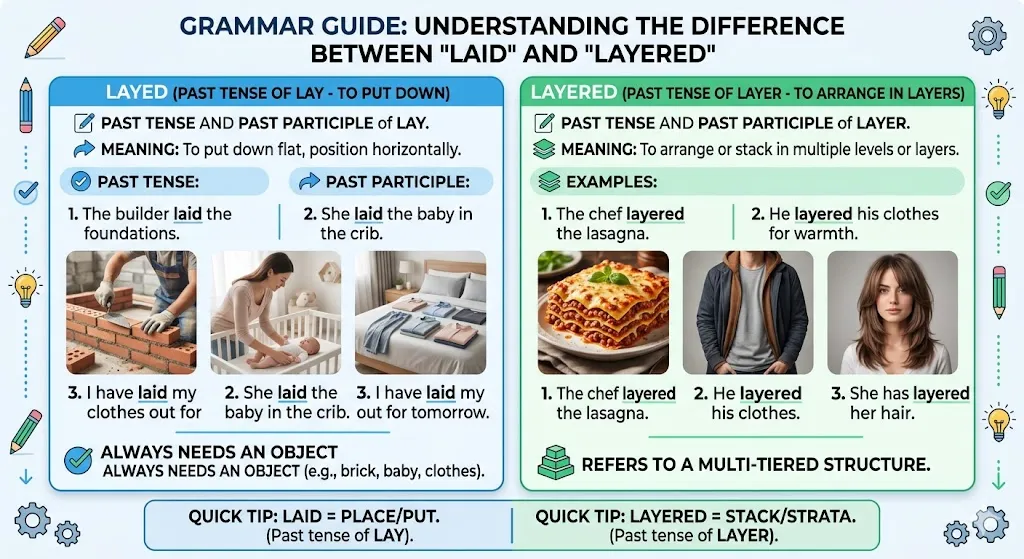
Imagine a student writing an email to a teacher: “I layed the books on the table yesterday.” The teacher quickly notices the mistake and corrects it to “I laid the books.” This small correction highlights the difference between layed and laid, a common confusion in English writing. While “laid” is the correct past tense of “lay,” “layed” is actually not a standard word in modern English usage. Understanding the difference between layed and laid helps avoid embarrassing mistakes in academic and professional writing. Many learners struggle with the difference between layed and laid, especially because both sound similar. By mastering the difference between layed and laid, you can improve clarity and accuracy in communication.
Key Difference Between the Both
“Laid” is the correct past tense of “lay,” while “layed” is incorrect and rarely used in standard English.
Why Their Difference is Necessary to Know
Knowing the difference between layed and laid is essential for students, writers, and professionals. It ensures proper grammar usage, improves credibility, and avoids misunderstandings. In formal writing, even a small mistake like using “layed” instead of “laid” can affect the quality of communication.
Pronunciation
- Layed
- US: /leɪd/
- UK: /leɪd/
- Laid
- US: /leɪd/
- UK: /leɪd/
(Note: Both are pronounced the same, which adds to the confusion.)
Now, let’s move into a detailed comparison to fully understand their usage.
Difference Between Layed and Laid
1. Correctness
- Layed: Incorrect spelling in standard English.
- Example 1: He layed the phone down. ❌
- Example 2: She layed the keys on the table. ❌
- Laid: Correct past tense of “lay.”
- Example 1: He laid the phone down. ✔
- Example 2: She laid the keys on the table. ✔
2. Verb Origin
- Layed: Not derived from a standard verb form.
- Example 1: Misused in informal writing.
- Example 2: Often seen in beginner mistakes.
- Laid: Comes from the verb “lay.”
- Example 1: Lay → Laid → Laid.
- Example 2: “Lay the book down” → “Laid the book down.”
3. Dictionary Recognition
- Layed: Rarely recognized in dictionaries.
- Example 1: Not listed as standard usage.
- Example 2: Marked incorrect in grammar tools.
- Laid: Fully recognized word.
- Example 1: Found in all dictionaries.
- Example 2: Used in formal writing.
4. Usage Context
- Layed: Incorrect in all contexts.
- Example 1: Not used in academic writing.
- Example 2: Avoided in professional communication.
- Laid: Used in past actions.
- Example 1: “She laid the table.”
- Example 2: “They laid bricks.”
5. Grammar Role
- Layed: Has no grammatical role.
- Example 1: Not accepted in exams.
- Example 2: Flagged as an error.
- Laid: Verb (past tense and past participle).
- Example 1: “He has laid the foundation.”
- Example 2: “She had laid the cloth.”
6. Common Mistakes
- Layed: Result of confusion with “played.”
- Example 1: “He played” → wrongly “he layed.”
- Example 2: Pattern-based error.
- Laid: Correct form.
- Example 1: Memorized as irregular verb.
- Example 2: Used correctly in sentences.
7. Acceptance in Exams
- Layed: Marked wrong.
- Example 1: Grammar tests.
- Example 2: Essays.
- Laid: Marked correct.
- Example 1: Academic writing.
- Example 2: Language tests.
8. Frequency of Use
- Layed: Rare and incorrect.
- Example 1: Seen in informal chats.
- Example 2: Common learner error.
- Laid: Frequently used.
- Example 1: Books and articles.
- Example 2: Daily conversation.
9. Historical Use
- Layed: Obsolete or incorrect spelling.
- Example 1: Rare old texts.
- Example 2: Non-standard usage.
- Laid: Historically correct form.
- Example 1: Used for centuries.
- Example 2: Standard English grammar.
10. Clarity in Communication
- Layed: Causes confusion.
- Example 1: Reader questions correctness.
- Example 2: Reduces credibility.
- Laid: Ensures clarity.
- Example 1: Clear meaning.
- Example 2: Professional tone.
Nature and Behaviour
- Layed: Non-standard, incorrect, and avoided in formal communication.
- Laid: Standard, correct, and widely accepted in all forms of English.
Why People Are Confused
People confuse these words because they sound identical and follow patterns similar to regular verbs like “play → played.” This leads learners to incorrectly form “lay → layed,” instead of the correct irregular form “laid.”
Table: Difference and Similarity
| Aspect | Layed | Laid | Similarity |
| Correctness | Incorrect | Correct | Same pronunciation |
| Usage | Not used | Common | Both relate to “lay” |
| Grammar | Invalid | Valid verb | Both sound identical |
| Recognition | Not accepted | Accepted | Often confused |
Which is Better in What Situation?
“Layed” is never better in any situation because it is not a correct form in modern English. Using it in writing or speech can lead to misunderstanding and may reduce the credibility of the speaker or writer. Therefore, it should always be avoided in academic, professional, and even casual communication.
“Laid” is always the better choice when referring to the past tense of “lay.” It fits correctly in all grammatical contexts and ensures clarity. Whether you are writing an essay, sending an email, or speaking in conversation, “laid” maintains accuracy and professionalism.
Metaphors and Similes
- “He laid the foundation like a builder setting bricks.”
- “Her words were laid gently like a blanket.”
(“Layed” is not used in figurative language due to incorrectness.)
Connotative Meaning
- Layed: Negative (incorrect usage)
- Example: “The sentence looked wrong because of ‘layed.’”
- Laid: Neutral to positive
- Example: “She laid the groundwork for success.”
Idioms and Proverbs
- “Lay the foundation” (correct form: laid)
- Example: He laid the foundation for his career.
- “Lay it on the line”
- Example: She laid it on the line during the meeting.
Works in Literature
- As You Like It – Play, William Shakespeare, 1599 (uses “laid”)
- Pride and Prejudice – Novel, Jane Austen, 1813 (uses “laid”)
Movies Related to the Concept
- The Lay of the Land (2010, USA)
- Laid in America (2016, USA)
FAQs
1. Is “layed” ever correct?
No, it is not correct in modern standard English.
2. What is the past tense of “lay”?
The correct past tense is “laid.”
3. Why do people write “layed”?
Because they confuse it with regular verbs like “played.”
4. Is “laid” used in formal writing?
Yes, it is correct and widely used.
5. How can I remember the difference?
Remember: “Lay → Laid,” just like “Say → Said.”
How Both Are Useful for Surroundings
Understanding correct grammar like “laid” improves communication in education, business, and daily life. Even recognizing incorrect forms like “layed” helps learners avoid mistakes and improve language skills.
Final Words for the Both
“Layed” represents a common mistake, while “laid” represents correct grammar. Mastering this difference strengthens your English skills.
Conclusion
The difference between layed and laid is simple yet crucial for accurate communication. While “layed” is incorrect and should be avoided, “laid” is the proper past tense of “lay” and is widely accepted in all forms of English. Understanding the difference between layed and laid helps learners write with confidence and clarity. By remembering this rule and practicing correct usage, you can eliminate a common grammar mistake and enhance your overall language proficiency.

I am a professional SEO content writer specialising in comparison-based and grammar-focused articles. Through my website GrammarCompare.com, I help readers clearly understand the difference between confusing terms with well-researched, easy-to-read content. My expertise lies in focusing on clarity, accuracy, and practical explanations that improve both knowledge and writing skills.