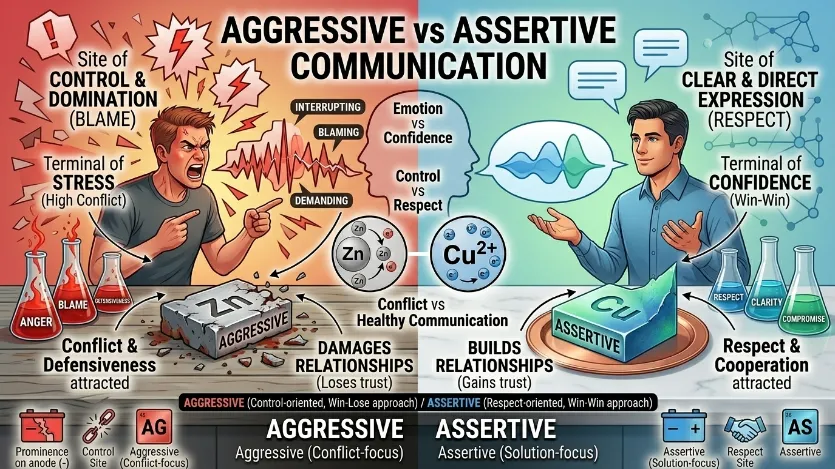
Imagine a workplace meeting where two colleagues present their ideas. One speaks loudly, interrupts others, and forces opinions this is aggressive. The other expresses thoughts clearly, respects others, and listens actively this is assertive. This simple scenario highlights the difference between aggressive and assertive communication styles in real life. Understanding the difference between aggressive and assertive is essential because it shapes how we interact, resolve conflicts, and build relationships. Many people confuse these behaviors, often thinking confidence equals dominance, but the difference between aggressive and assertive lies in respect and balance. Whether at work, school, or home, knowing the difference between aggressive and assertive can improve communication and emotional intelligence.
Key Difference Between the Both
The key difference is simple: aggressive behavior violates others’ rights, while assertive behavior respects both your own and others’ rights.
Why Is Their Difference Necessary to Know?
Understanding this difference is important for learners and professionals alike. In society, communication affects teamwork, leadership, and emotional well-being. Aggressive behavior can lead to conflict, stress, and broken relationships. Assertive behavior promotes confidence, mutual respect, and healthy dialogue. For experts in psychology, education, and management, distinguishing between these styles helps in guiding people toward better interpersonal skills and conflict resolution.
Key Behavioral Differences
- The Intent: Aggressive communication operates on a “win-lose” mentality, aiming to overpower the other person. Assertive communication operates on a “win-win” model, aiming to express one’s needs while actively respecting the boundaries of others.
- The Delivery: Aggression relies on volume, intense body language, and blame-heavy language (e.g., “You always do this”). Assertiveness utilizes a calm, grounded tone, active listening, and constructive “I” statements (e.g., “I feel overwhelmed when schedules shift at the last minute”).
- The Long-Term Impact: Aggression fosters resentment, high turnover in workplaces, and broken trust. Assertiveness fosters psychological safety, healthy boundaries, and sustainable professional collaborations.
Pronunciation
- Aggressive
- US: /əˈɡrɛsɪv/
- UK: /əˈɡresɪv/
- Assertive
- US: /əˈsɜːrtɪv/
- UK: /əˈsɜːtɪv/
Now that the foundation is clear, let’s explore the detailed difference between aggressive and assertive communication styles.
Difference Between Aggressive and Assertive
1. Communication Style
- Aggressive: Harsh and dominating
- Example 1: “You are wrong, just listen to me!”
- Example 2: Interrupting others constantly
- Assertive: Calm and respectful
- Example 1: “I understand your view, but I think differently.”
- Example 2: Waiting for your turn to speak
2. Tone of Voice
- Aggressive: Loud and forceful
- Example 1: Shouting in meetings
- Example 2: Using sarcastic tone
- Assertive: Firm but polite
- Example 1: Speaking clearly without shouting
- Example 2: Using steady tone
3. Body Language
- Aggressive: Pointing fingers, invading space
- Example 1: Standing too close
- Example 2: Angry facial expressions
- Assertive: Open and relaxed
- Example 1: Maintaining eye contact
- Example 2: Neutral posture
4. Respect for Others
- Aggressive: Disrespects others
- Example 1: Ignoring opinions
- Example 2: Mocking others
- Assertive: Values others
- Example 1: Listening actively
- Example 2: Acknowledging ideas
5. Emotional Control
- Aggressive: Driven by anger
- Example 1: Reacting instantly
- Example 2: Losing temper quickly
- Assertive: Controlled emotions
- Example 1: Pausing before responding
- Example 2: Staying calm under pressure
6. Goal
- Aggressive: Winning at all costs
- Example 1: Forcing decisions
- Example 2: Dominating discussions
- Assertive: Mutual understanding
- Example 1: Finding compromise
- Example 2: Encouraging teamwork
7. Impact on Relationships
- Aggressive: Damages relationships
- Example 1: Creating fear
- Example 2: Causing resentment
- Assertive: Builds trust
- Example 1: Strengthening bonds
- Example 2: Promoting cooperation
8. Self-Expression
- Aggressive: Over-expresses without care
- Example 1: Blaming others
- Example 2: Using insults
- Assertive: Balanced expression
- Example 1: Using “I” statements
- Example 2: Expressing needs clearly
9. Conflict Handling
- Aggressive: Escalates conflict
- Example 1: Arguing loudly
- Example 2: Threatening behavior
- Assertive: Resolves conflict
- Example 1: Seeking solutions
- Example 2: Staying respectful
10. Self-Perception
- Aggressive: Insecure or defensive
- Example 1: Feeling threatened easily
- Example 2: Overcompensating
- Assertive: Confident and aware
- Example 1: Knowing self-worth
- Example 2: Accepting feedback
Nature and Behaviour
- Aggressive Nature: Dominating, impulsive, and often emotionally reactive. It seeks control and ignores boundaries.
- Assertive Nature: Balanced, confident, and respectful. It focuses on fairness and clear communication.
Why People Are Confused About Their Use?
People often mistake assertiveness for aggression because both involve speaking up. Cultural norms also play a role some societies view direct communication as rude. Lack of emotional awareness further blurs the line, making people think being loud equals being confident.
1. The “Speaking Up” Paradox
The baseline mechanics of assertiveness and aggression look identical from afar: both individuals refuse to be passive, both voice an opinion, and both push back against a status quo. The misunderstanding happens because many people are conditioned to believe that any boundary-setting is inherently confrontational. When someone transition from passive to assertive, onlookers who prefer compliance often mislabel that newfound boundary as “aggressive.”
2. Cultural Filters and Directness
Communication is never received in a vacuum; it is filtered through cultural upbringing:
- High-Context / Indirect Cultures: In many East Asian, Mediterranean, or Latin American societies, harmony and reading between the lines are prioritized. Speaking too directly, even if entirely respectful, can be interpreted as abrasive or self-centered.
- Low-Context / Direct Cultures: In places like Germany, the Netherlands, or the United States, clarity and efficiency are valued. What looks like healthy, assertive transparency in Berlin might look like a harsh verbal assault in Tokyo.
3. Loudness vs. True Confidence
A major systemic issue is that society often rewards the loudest voice in the room, mistaking volume for authority and dominance for leadership. True confidence is quiet, steady, and doesn’t require the devaluation of others to validate itself. When people lack emotional intelligence, they rely on vocal dominance because they don’t possess the emotional vocabulary or self-regulation required to hold a firm line calmly.
Table: Difference and Similarity
| Aspect | Aggressive | Assertive | Similarity |
| Communication | Forceful | Respectful | Both express opinions |
| Tone | Loud | Calm | Both involve speaking |
| Goal | Control | Balance | Both aim to influence |
| Emotion | Uncontrolled | Controlled | Both involve feelings |
| Impact | Negative | Positive | Both affect relationships |
Which Is Better in What Situation?
Aggressive:
Aggressive behavior may seem useful in emergencies where quick decisions are needed, such as stopping danger. However, in most situations, it causes more harm than good. It may bring short-term results but damages trust and long-term relationships.
Assertive:
Assertive behavior is better in almost all situations, especially in workplaces, relationships, and education. It helps express needs clearly while respecting others. Assertiveness leads to better teamwork, healthier communication, and long-term success.
Metaphors and Similes
- Aggressive: “He was like a storm, loud and destructive.”
- Assertive: “She stood like a calm river, steady and clear.”
Connotative Meanings
- Aggressive: Mostly negative
- Example: “His aggressive attitude pushed people away.”
- Assertive: Positive
- Example: “Her assertive nature earned respect.”
Idioms and Proverbs
- “Barking up the wrong tree” (aggressive misjudgment)
- Example: He was barking up the wrong tree by blaming others loudly.
- “Speak your mind” (assertive expression)
- Example: She spoke her mind respectfully in the meeting.
Works in Literature
- Emotional Intelligence – Psychology, Daniel Goleman, 1995
- Crucial Conversations – Self-help, Patterson et al., 2002
- The Assertiveness Workbook – Self-help, Randy J. Paterson, 2000
Movies Related to Themes
- The Devil Wears Prada (2006, USA) – shows aggressive leadership
- Erin Brockovich (2000, USA) – example of assertive communication
- 12 Angry Men (1957, USA) – assertive reasoning vs aggressive debate
FAQs
1. Is assertive behavior rude?
No, it is respectful and balanced.
2. Can aggressive people become assertive?
Yes, with practice and self-awareness.
3. Is assertiveness a skill?
Yes, it can be learned and improved.
4. Why is aggression harmful?
It damages relationships and creates conflict.
5. Is silence better than aggression?
Silence avoids conflict but assertiveness solves it better.
How Both Are Useful for Surroundings
Aggressive behavior can sometimes highlight urgency or seriousness. Assertive behavior creates harmony, promotes understanding, and improves social environments like workplaces and families.
Final Words
Aggression may create fear, but assertiveness builds respect. Choosing the right approach defines the quality of communication and relationships.
Conclusion
In conclusion, the difference between aggressive and assertive lies in respect, control, and intention. While aggressive behavior focuses on dominance and often harms relationships, assertive behavior promotes balance, clarity, and mutual understanding. Learning this difference is essential for personal growth, professional success, and social harmony. By practicing assertiveness, individuals can express themselves confidently without hurting others. Ultimately, the ability to communicate effectively is not about being the loudest voice in the room, but about being the most respectful and clear.
The Three Pillars in Action
🧠 Intention (The “Why”)
- The Aggressive Intention: Driven by a desire to control the situation or the person. It stems from a zero-sum mindset: “For me to win, you have to lose.”
- The Assertive Intention: Driven by transparency. The goal isn’t to alter the other person’s behavior by force, but to lay your cards on the table so everyone knows where things stand. It says, “Here is my boundary. How do we work within this?”
🎛️ Control (The “How”)
- Aggressive Control: This is an external push. It uses loud volume, intimidating body language, or emotional manipulation to overpower the room. Paradoxically, aggressive people often feel completely out of control internally, so they overcompensate externally.
- Assertive Control: This is internal mastery. An assertive person controls themselves their tone, their breathing, and their responses. Because they aren’t trying to force the other person into a corner, they can remain calm even under pressure.
🤝 Respect (The “Who”)
- Aggressive Respect: One-way traffic. The aggressive person demands absolute respect for their own time, opinions, and feelings, but treats the other party’s inputs as obstacles to be crushed.
- Assertive Respect: A two-way street. It requires a high level of emotional intelligence. You can fiercely disagree with a colleague’s strategy (assertive) without calling their competence into question (aggressive).
The Dangerous Middle Ground: Passive-Aggression
While exploring this spectrum, it’s worth noting the sneaky cousin of aggression: passive-aggressiveness.
When people want to be aggressive but lack the courage to face the conflict directly, they retreat here. It manifests as sarcastic jokes, the silent treatment, or intentional back-pedaling (“I was just kidding, don’t be so sensitive”). Like pure aggression, its goal is still to punish or control, but it hides behind a mask of innocence.
Why This Matters for Personal Growth
Shifting from aggressive (or passive) to assertive changes your life’s trajectory. When you communicate assertively, you stop leaking energy into unnecessary drama. You don’t have to clean up the relational wreckage that aggression leaves behind, and you don’t have to swallow your own resentment like passive communication requires.

I am a professional SEO content writer specialising in comparison-based and grammar-focused articles. Through my website GrammarCompare.com, I help readers clearly understand the difference between confusing terms with well-researched, easy-to-read content. My expertise lies in focusing on clarity, accuracy, and practical explanations that improve both knowledge and writing skills.