Imagine a small business owner trying to fix a computer issue late at night. They open a black window and type commands—this is where the difference between CMD and PowerShell begins to matter. Both tools look similar at first glance, yet their capabilities are very different. Understanding the difference between CMD and PowerShell can save time, improve productivity, and even simplify complex system tasks. In today’s digital world, knowing the difference between CMD and PowerShell is not just for IT professionals—it’s becoming essential for learners, developers, and system administrators alike. Whether you’re managing files or automating tasks, the difference between CMD and PowerShell plays a crucial role in how efficiently you work.
Key Difference Between the Both
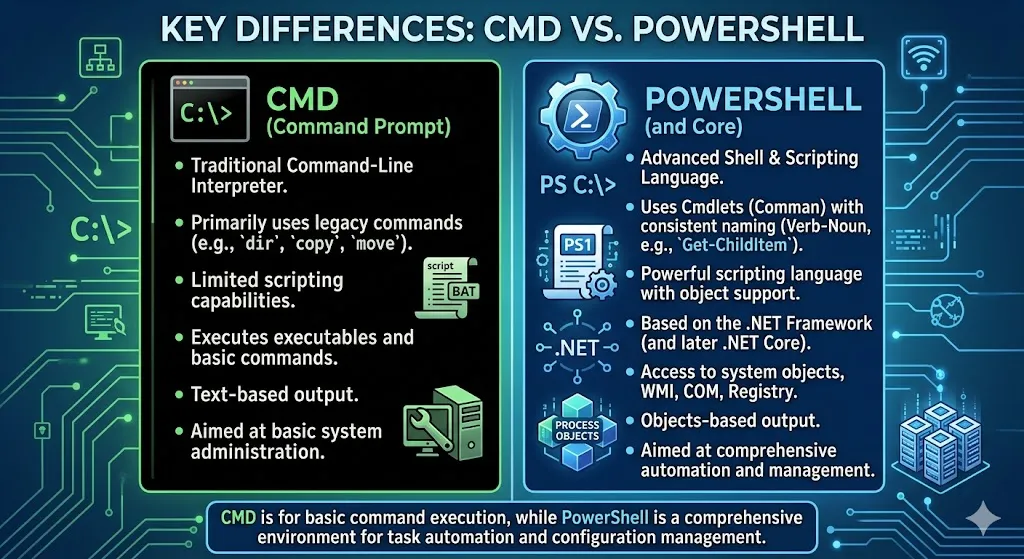
The main difference lies in functionality: CMD (Command Prompt) is a basic command-line interpreter, while PowerShell is an advanced scripting environment with automation and object-oriented capabilities.
Why Is Their Difference Necessary to Know?
Understanding their differences is important because both tools serve different purposes in society. CMD is simple and useful for quick tasks, while PowerShell is powerful for automation and system management. For learners, it builds foundational knowledge. For experts, it enhances efficiency and control. In industries like IT, cybersecurity, and software development, knowing when to use each tool can significantly impact performance and productivity.
Pronunciation
- CMD
- US: /ˌsiː.emˈdiː/
- UK: /ˌsiː.emˈdiː/
- PowerShell
- US: /ˈpaʊ.ər.ʃel/
- UK: /ˈpaʊ.ə.ʃel/
Now that we’ve introduced the basics, let’s dive deeper into the difference between these two powerful tools.
Difference Between CMD and PowerShell
1. Interface Type
- CMD uses a simple text-based interface.
- Example 1: Typing dir shows files.
- Example 2: Typing cd changes directories.
- PowerShell uses an advanced command-line interface.
- Example 1: Displays structured output.
- Example 2: Supports scripting panels.
2. Command Structure
- CMD uses basic commands.
- Example 1: copy file.txt D:\
- Example 2: del file.txt
- PowerShell uses cmdlets.
- Example 1: Copy-Item
- Example 2: Remove-Item
3. Output Type
- CMD outputs plain text.
- Example 1: Lists file names only.
- Example 2: No structured data.
- PowerShell outputs objects.
- Example 1: Data with properties.
- Example 2: Easily filtered results.
4. Scripting Ability
- CMD supports batch scripts.
- Example 1: .bat files
- Example 2: Limited automation
- PowerShell supports advanced scripts.
- Example 1: .ps1 scripts
- Example 2: Complex automation tasks
5. Learning Curve
- CMD is easy to learn.
- Example 1: Simple commands
- Example 2: Beginner-friendly
- PowerShell is complex.
- Example 1: Requires syntax knowledge
- Example 2: Needs practice
6. Automation
- CMD has limited automation.
- Example 1: Scheduled tasks
- Example 2: Basic loops
- PowerShell excels in automation.
- Example 1: Task scheduling
- Example 2: System-wide automation
7. Integration
- CMD has minimal integration.
- Example 1: Works with DOS tools
- Example 2: Limited APIs
- PowerShell integrates widely.
- Example 1: Works with .NET
- Example 2: Connects to cloud services
8. Error Handling
- CMD has basic error handling.
- Example 1: Simple error codes
- Example 2: Limited debugging
- PowerShell has advanced handling.
- Example 1: Try-catch blocks
- Example 2: Detailed logs
9. Use Case
- CMD is for quick tasks.
- Example 1: File navigation
- Example 2: Basic troubleshooting
- PowerShell is for complex tasks.
- Example 1: System administration
- Example 2: Automation scripts
10. Flexibility
- CMD is less flexible.
- Example 1: Fixed commands
- Example 2: Limited customization
- PowerShell is highly flexible.
- Example 1: Custom scripts
- Example 2: Expandable modules
Nature and Behaviour
- CMD: Simple, direct, and task-oriented. It behaves like a basic tool for quick execution.
- PowerShell: Intelligent, adaptable, and powerful. It behaves like a full programming environment.
Why People Are Confused About Their Use?
People often confuse them because both look similar and open in a black terminal window. Beginners assume they work the same way. However, their internal capabilities and purposes are very different, leading to misunderstanding.
Difference and Similarity Table
| Feature | CMD | PowerShell | Similarity |
| Interface | Basic | Advanced | Both are command-line tools |
| Output | Text | Objects | Display results |
| Scripting | Batch files | Advanced scripts | Automate tasks |
| Learning | Easy | Complex | Require practice |
| Use | Simple tasks | Complex operations | Used by IT professionals |
Which Is Better in What Situation?
CMD is better when you need to perform quick and simple tasks. For example, navigating directories, checking IP configurations, or running basic commands. It is lightweight and fast, making it ideal for beginners or quick fixes.
PowerShell is better for advanced tasks such as automation, system administration, and managing large environments. It is especially useful for developers and IT professionals who need to handle complex workflows, scripts, and integrations efficiently.
Metaphors and Similes
- CMD is like a manual screwdriver—simple but effective.
- PowerShell is like a power drill—advanced and efficient.
- CMD works like a bicycle, easy and straightforward.
- PowerShell works like a car, powerful and versatile.
Connotative Meaning
- CMD
- Neutral/Positive: Simplicity, reliability
- Negative: Limited capability
- Example: “He used CMD for quick fixes.”
- PowerShell
- Positive: Power, control, efficiency
- Negative: Complexity
- Example: “PowerShell handled the automation easily.”
Idioms or Proverbs
- “Old is gold” → CMD still works reliably.
- “Knowledge is power” → PowerShell gives advanced control.
Examples:
- CMD proves that old is gold in simple tasks.
- Learning PowerShell shows that knowledge is power.
Works in Literature (Related to Command Systems / Computing)
- The Soul of a New Machine – Non-fiction, Tracy Kidder, 1981
- Hackers – Non-fiction, Steven Levy, 1984
- Code – Non-fiction, Charles Petzold, 1999
Movies Related to Computing/Command Systems
- The Matrix – 1999, USA
- Hackers – 1995, USA
- The Social Network – 2010, USA
FAQs
1. What is the main difference between CMD and PowerShell?
CMD is basic, while PowerShell is advanced and supports automation.
2. Which is easier to learn?
CMD is easier for beginners.
3. Is PowerShell replacing CMD?
PowerShell is more advanced, but CMD is still used.
4. Can both run the same commands?
Some commands work in both, but PowerShell has more features.
5. Which is better for automation?
PowerShell is much better for automation tasks.
How Both Are Useful for Surroundings
CMD helps users quickly fix issues and manage files in everyday computing. PowerShell helps organizations automate tasks, manage systems, and improve efficiency in workplaces like offices, IT departments, and industries.
Final Words
CMD and PowerShell are both valuable tools. One offers simplicity, while the other offers power. Choosing the right tool depends on your needs and skills.
Conclusion
The difference between CMD and PowerShell is more than just appearance—it reflects the evolution of command-line tools. CMD remains a reliable option for simple tasks, while PowerShell opens the door to advanced automation and system management. Understanding both allows users to work smarter, not harder. Whether you are a beginner or an expert, mastering these tools can significantly improve your technical skills and productivity. In a world driven by technology, knowing when and how to use each tool is a powerful advantage.

I am a professional SEO content writer specialising in comparison-based and grammar-focused articles. Through my website GrammarCompare.com, I help readers clearly understand the difference between confusing terms with well-researched, easy-to-read content. My expertise lies in focusing on clarity, accuracy, and practical explanations that improve both knowledge and writing skills.