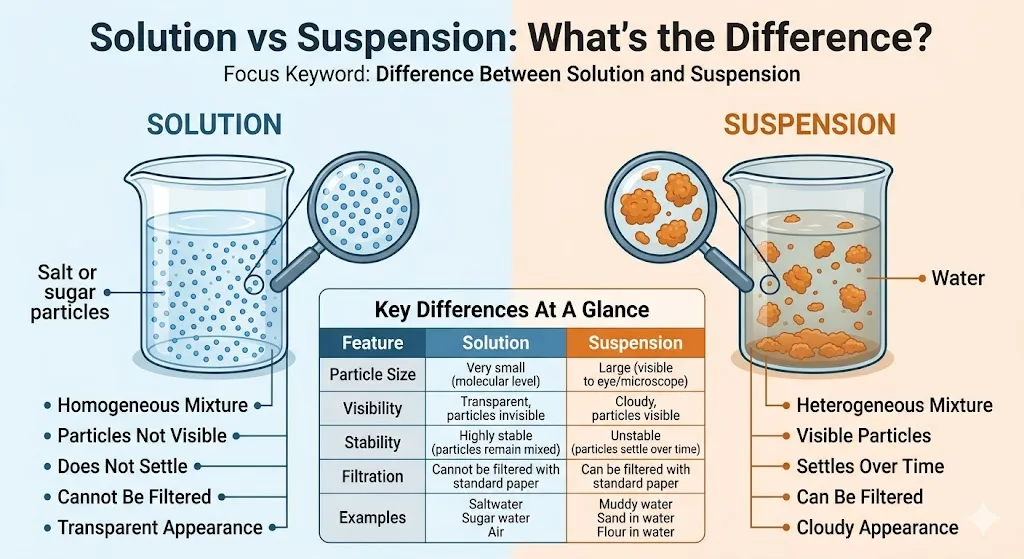
In a school science lab, a student once mixed sugar in water and saw it completely disappear. Later, he added sand to water and noticed it settled at the bottom. At first, both mixtures looked similar, but they behaved very differently. This simple experiment shows the meaning of “solution” and “suspension.” A solution is a mixture where one substance dissolves completely, while a suspension contains particles that do not dissolve and can settle over time.
Understanding the difference between solution and suspension is important for students and professionals alike. The difference between solution and suspension helps explain how substances mix and behave. Many learners struggle with the difference between solution and suspension because both are mixtures. However, knowing the difference between solution and suspension improves scientific understanding and practical applications in daily life.
Key Difference Between the Both
The key difference is that a solution is a homogeneous mixture where particles dissolve completely, while a suspension is a heterogeneous mixture where particles remain undissolved and can settle.
Why Is Their Difference Important for Learners and Experts?
Understanding the difference between solution and suspension is crucial in science, medicine, and industry. Learners gain a clear foundation in chemistry, while experts use this knowledge in pharmaceuticals, environmental science, and food production. It helps in identifying substances, choosing correct mixtures, and ensuring safety in experiments and products.
Pronunciation (US & UK)
- Solution
- US: /səˈluːʃən/
- UK: /səˈluːʃən/
- Suspension
- US: /səˈspɛnʃən/
- UK: /səˈspɛnʃən/
Let’s now explore their differences in detail to fully understand these important scientific concepts.
Difference Between Solution and Suspension
1. Definition
A solution is a homogeneous mixture; a suspension is a heterogeneous mixture.
- Example 1: Salt dissolved in water is a solution.
- Example 2: Mud in water is a suspension.
2. Particle Size
Solution particles are very small; suspension particles are large.
- Example 1: Sugar molecules in water are tiny.
- Example 2: Dust particles in air are visible.
3. Visibility
Particles in a solution cannot be seen; in a suspension, they can.
- Example 1: Clear sugar water shows no particles.
- Example 2: Cloudy water shows particles.
4. Settling
Solution particles do not settle; suspension particles settle over time.
- Example 1: Salt water remains uniform.
- Example 2: Sand settles at the bottom.
5. Filtration
Solutions cannot be separated by filtration; suspensions can.
- Example 1: You cannot filter dissolved sugar easily.
- Example 2: You can filter sand from water.
6. Stability
Solutions are stable; suspensions are unstable.
- Example 1: A solution remains mixed for long periods.
- Example 2: A suspension separates on standing.
7. Appearance
Solutions are clear; suspensions are cloudy.
- Example 1: Clean drinking water is clear.
- Example 2: Dirty water looks cloudy.
8. Light Passage
Solutions allow light to pass; suspensions scatter light.
- Example 1: Light passes through salt water.
- Example 2: Light scatters in muddy water.
9. Uniformity
Solutions are uniform throughout; suspensions are not.
- Example 1: Every part of a solution is the same.
- Example 2: Suspension composition varies.
10. Examples in Daily Life
Solutions are common in drinks; suspensions appear in mixtures.
- Example 1: Tea with sugar is a solution.
- Example 2: Orange juice with pulp is a suspension.
Nature and Behaviour
A solution behaves uniformly and remains stable over time. Its particles are evenly distributed and do not separate.
A suspension behaves irregularly and separates when left undisturbed. Its particles are larger and settle due to gravity.
Why Are People Confused About Their Use?
People are confused because both are mixtures and may look similar at first glance. Without careful observation, it is difficult to distinguish between a clear solution and a cloudy suspension.
Difference and Similarity Table
| Feature | Solution | Suspension | Similarity |
| Type | Homogeneous | Heterogeneous | Both are mixtures |
| Particle Size | Very small | Large | Contain particles |
| Visibility | Not visible | Visible | Mixed substances |
| Stability | Stable | Unstable | Used in daily life |
| Separation | Not by filtration | By filtration | Physical mixtures |
Which Is Better in What Situation?
A solution is better when a uniform mixture is needed, such as in medicine, beverages, or chemical reactions. Its stability and clarity make it ideal for consistent results and easy consumption. For example, medicines in liquid form often rely on solutions to ensure accurate dosage.
A suspension is better when undissolved particles are required, such as in certain medicines or food products. Suspensions are useful when ingredients need to remain separate but mixed temporarily. For instance, some antibiotics are given as suspensions to maintain effectiveness.
Metaphors and Similes
- A solution is like a “perfect blend,” where everything becomes one.
- A suspension is like a “crowded room,” where individuals remain separate.
Connotative Meanings
- Solution: Positive (clarity, resolution)
- Example: She found a solution to the problem.
- Suspension: Neutral/Negative (uncertainty, delay)
- Example: The project is under suspension.
Idioms and Proverbs
- “Every problem has a solution”
- Example: Keep trying until you find a solution.
- “Hang in suspension” (figurative use)
- Example: The decision remained in suspension.
Works in Literature
- “A Brief History of Time” – Stephen Hawking (Science, 1988)
- “The Selfish Gene” – Richard Dawkins (Science, 1976)
Movies
- “The Martian” (2015, USA)
- “Interstellar” (2014, USA)
FAQs
1. What is the main difference?
A solution is uniform; a suspension is not.
2. Can suspensions settle?
Yes, particles settle over time.
3. Are solutions always clear?
Yes, they are usually transparent.
4. Can you filter a solution?
No, not by simple filtration.
5. Where are suspensions used?
In medicines and food products.
How Both Are Useful for Surroundings
Solutions are essential in drinking water, medicines, and chemical processes. Suspensions are useful in paints, medicines, and food items where particles must remain dispersed temporarily.
Final Words
Both solution and suspension are important types of mixtures. Understanding their differences helps in science, daily life, and industry applications.
Conclusion
The difference between solution and suspension lies in their structure, behavior, and appearance. Solutions are uniform, stable, and clear, while suspensions are non-uniform, unstable, and cloudy. Recognizing these differences helps students grasp basic chemistry concepts and enables professionals to apply them effectively in real-world situations. Whether in laboratories, kitchens, or industries, understanding these mixtures improves decision-making and practical outcomes. Ultimately, both play vital roles in science and everyday life.

I am a professional SEO content writer specialising in comparison-based and grammar-focused articles. Through my website GrammarCompare.com, I help readers clearly understand the difference between confusing terms with well-researched, easy-to-read content. My expertise lies in focusing on clarity, accuracy, and practical explanations that improve both knowledge and writing skills.