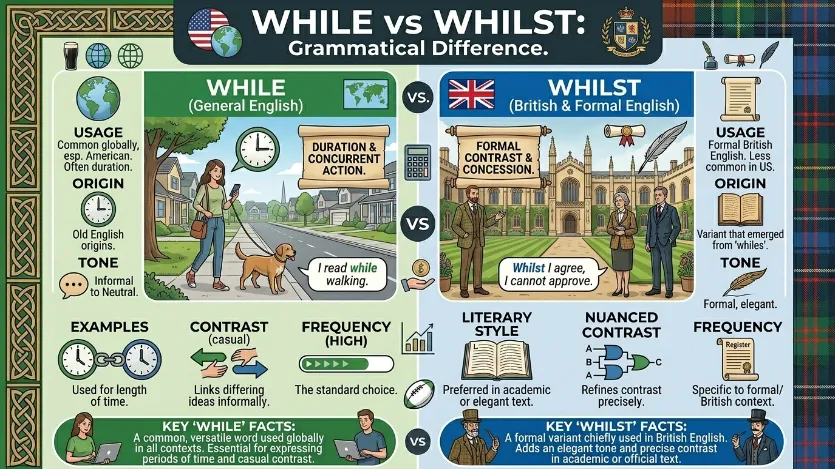
A student once wrote an essay and used “whilst” throughout, thinking it sounded more formal and correct. However, his teacher suggested replacing most of them with “while” to make the writing clearer and more natural. This small correction highlights an important language detail. Both “whilst” and “while” mean “during the time that” or “at the same time,” but their usage depends on style and region.
Understanding the difference between whilst and while is essential for clear communication. The difference between whilst and while often confuses learners because both words are grammatically correct. However, the difference between whilst and while lies in tone, usage, and regional preference. Knowing the difference between whilst and while helps writers choose the right word in formal and informal contexts.
Key Difference Between the Both
The main difference is that “while” is more common in modern English, especially in American English, whereas “whilst” is more formal and mainly used in British English.
Why Is Their Difference Important for Learners and Experts?
Understanding the difference between whilst and while helps learners improve writing clarity and tone. For experts, it ensures proper language use in academic, professional, and international communication. It also helps avoid sounding overly formal or outdated in casual contexts, making communication more effective and audience-appropriate.
Pronunciation (US & UK)
- While
- US: /waɪl/
- UK: /waɪl/
- Whilst
- US: /waɪlst/
- UK: /waɪlst/
Now, let’s explore their differences in detail to understand when and how to use each correctly.
Difference Between Whilst and While
1. Usage Frequency
“While” is more commonly used than “whilst.”
- Example 1: I listened to music while studying.
- Example 2: She smiled while talking.
2. Formality
“Whilst” sounds more formal than “while.”
- Example 1: Whilst writing the report, he remained focused.
- Example 2: The event continued whilst guests arrived.
3. Regional Preference
“Whilst” is common in British English; “while” in American English.
- Example 1: UK writers often use “whilst.”
- Example 2: US writers prefer “while.”
4. Tone
“While” sounds neutral; “whilst” sounds traditional.
- Example 1: While working, he stayed calm.
- Example 2: Whilst working, he stayed calm (more formal tone).
5. Modern Usage
“While” is preferred in modern writing.
- Example 1: Blogs use “while.”
- Example 2: Emails commonly use “while.”
6. Academic Writing
“Whilst” may appear in formal academic texts.
- Example 1: Whilst analyzing data, results improved.
- Example 2: Whilst conducting research, errors were found.
7. Simplicity
“While” is simpler and easier to understand.
- Example 1: While eating, he watched TV.
- Example 2: While walking, she called her friend.
8. Sentence Flow
“While” improves readability in most cases.
- Example 1: While driving, stay alert.
- Example 2: While reading, take notes.
9. Global Understanding
“While” is more globally recognized.
- Example 1: International readers understand “while.”
- Example 2: “Whilst” may confuse some learners.
10. Context Flexibility
“While” is more flexible in all contexts.
- Example 1: While he likes tea, she prefers coffee.
- Example 2: While it was raining, we stayed inside.
Nature and Behaviour
“While” is flexible, modern, and widely accepted. It fits both formal and informal contexts.
“Whilst” is more traditional and formal. It is often used to create a sophisticated tone but may feel outdated in casual writing.
Why Are People Confused About Their Use?
People are confused because both words have the same meaning and can often replace each other. Regional differences and exposure to British or American English also create uncertainty.
Difference and Similarity Table
| Feature | While | Whilst | Similarity |
| Usage | Common | Less common | Same meaning |
| Tone | Neutral | Formal | Used in sentences |
| Region | US & global | UK | English grammar words |
| Simplicity | Simple | Slightly complex | Time-related meaning |
| Popularity | High | Moderate | Interchangeable in many cases |
Which Is Better in What Situation?
“While” is better in most situations, especially in modern writing, emails, blogs, and international communication. It is clear, simple, and widely understood. Writers prefer it for readability and accessibility. Using “while” ensures that your message reaches a broader audience without confusion.
“Whilst” is better in formal or traditional contexts, especially in British English writing, academic papers, or literary works. It adds a formal tone and stylistic elegance. However, overusing it may make writing seem outdated or overly complex.
Metaphors and Similes
- “While” is like a “smooth road,” easy and direct.
- “Whilst” is like an “old bridge,” classic but less used.
Connotative Meanings
- While: Neutral (clear, modern)
- Example: While working, stay focused.
- Whilst: Slightly positive (formal, elegant), sometimes negative (old-fashioned)
- Example: Whilst speaking, he maintained dignity.
Idioms and Proverbs
- “Make hay while the sun shines”
- Example: Finish your work while you have time.
- “Strike while the iron is hot”
- Example: Act quickly while the opportunity exists.
Works in Literature
- “Hamlet” – William Shakespeare (Tragedy, 1603)
- “Pride and Prejudice” – Jane Austen (Romance, 1813)
Movies
- “While You Were Sleeping” (1995, USA)
- “A Walk in the Clouds” (1995, USA)
FAQs
1. Are “whilst” and “while” interchangeable?
Yes, in most cases, but tone and region matter.
2. Which is more common?
“While” is more commonly used worldwide.
3. Is “whilst” outdated?
Not outdated, but less common in modern usage.
4. Can I use “whilst” in essays?
Yes, especially in formal or British English contexts.
5. Which should beginners use?
Beginners should use “while” for simplicity.
How Both Are Useful for Surroundings
Both words help express time relationships in sentences. They improve clarity in communication and writing, allowing people to describe simultaneous actions effectively.
Final Words
“While” and “whilst” share meaning but differ in tone and usage. Choosing the right one depends on context, audience, and style.
Conclusion
The difference between whilst and while is subtle yet important. While both words express the same idea, their usage varies based on formality and region. “While” is modern, simple, and widely accepted, making it ideal for everyday communication. “Whilst,” on the other hand, adds a formal and traditional touch, suitable for specific contexts. Understanding this distinction allows writers and speakers to communicate more effectively and appropriately. Ultimately, mastering such small differences can greatly improve language skills and confidence.

I am a professional SEO content writer specialising in comparison-based and grammar-focused articles. Through my website GrammarCompare.com, I help readers clearly understand the difference between confusing terms with well-researched, easy-to-read content. My expertise lies in focusing on clarity, accuracy, and practical explanations that improve both knowledge and writing skills.