A child once sat watching an animated movie, laughing at talking toys and later singing along with a magical princess. When asked, “Which one do you like more Disney or Pixar?” the child paused in confusion. Both seemed similar, yet they felt different. This is where understanding the difference between The Walt Disney Company and Pixar Animation Studios becomes important.
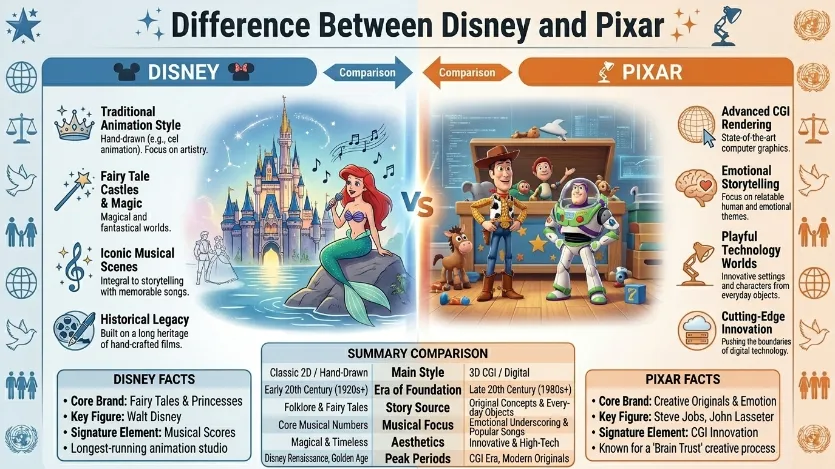
The difference between Disney and Pixar lies in their storytelling style, animation techniques, and history. While both create animated masterpieces, the difference between Disney and Pixar shapes how audiences experience emotions and imagination. Many viewers overlook the difference between Disney and Pixar, assuming they are the same, but learning the difference between Disney and Pixar reveals two unique creative identities that have transformed global entertainment.
Key Difference Between the Both
Disney is a large entertainment company known for traditional and modern animation, while Pixar specializes in computer-generated animation with deep storytelling.
Why Is Their Difference Necessary to Know?
Understanding this difference helps learners and experts appreciate animation as an art form. It highlights how creativity, technology, and storytelling influence society, culture, and emotional development in audiences worldwide.
Pronunciation
- Disney
- US: /ˈdɪz.ni/
- UK: /ˈdɪz.ni/
- Pixar
- US: /ˈpɪk.sɑːr/
- UK: /ˈpɪk.sɑː/
Now, let’s explore the differences in detail.
Difference Between Disney and Pixar
1. Foundation and History
- Disney: Founded in 1923 with a long legacy.
- Example: Early cartoons like Mickey Mouse.
- Example: Classic films like Snow White.
- Pixar: Founded in 1986 as a tech-driven studio.
- Example: Started with short films.
- Example: Became famous with CGI films.
2. Animation Style
- Disney: Traditional hand-drawn and later CGI.
- Example: Hand-drawn princess films.
- Example: Hybrid animation styles.
- Pixar: Fully computer-generated imagery (CGI).
- Example: Realistic textures.
- Example: Advanced 3D visuals.
3. Storytelling Approach
- Disney: Fairy tales and fantasy themes.
- Example: Princess stories.
- Example: Magical kingdoms.
- Pixar: Emotional and realistic themes.
- Example: Friendship stories.
- Example: Family relationships.
4. Target Audience
- Disney: Primarily children and families.
- Example: Musical animations.
- Example: Colorful characters.
- Pixar: Appeals to all age groups.
- Example: Deep emotional plots.
- Example: Adult humor.
5. Technology Use
- Disney: Adopted CGI later.
- Example: Transition from 2D to 3D.
- Example: Mixed animation tools.
- Pixar: Pioneer in CGI technology.
- Example: First fully CGI film.
- Example: Advanced rendering systems.
6. Character Development
- Disney: Archetypal characters.
- Example: Hero vs villain.
- Example: Princess roles.
- Pixar: Complex and relatable characters.
- Example: Flawed heroes.
- Example: Emotional growth.
7. Music and Songs
- Disney: Strong focus on musical storytelling.
- Example: Iconic songs.
- Example: Broadway-style music.
- Pixar: Limited use of songs.
- Example: Background scores.
- Example: Emotional soundtracks.
8. Film Themes
- Disney: Magic, love, and adventure.
- Example: Fairy tales.
- Example: Good vs evil.
- Pixar: Life lessons and emotions.
- Example: Identity and purpose.
- Example: Loss and growth.
9. Production Approach
- Disney: Large-scale production teams.
- Example: Multiple departments.
- Example: Traditional workflows.
- Pixar: Collaborative creative process.
- Example: Braintrust meetings.
- Example: Iterative storytelling.
10. Ownership
- Disney: Parent company.
- Example: Owns multiple studios.
- Example: Global brand.
- Pixar: Owned by Disney since 2006.
- Example: Works under Disney.
- Example: Maintains creative identity.
Nature and Behaviour
- Disney: Grand, magical, and tradition-oriented. It focuses on fantasy and musical storytelling.
- Pixar: Innovative, emotional, and realistic. It focuses on deep storytelling and human experiences.
Why People Are Confused
People are confused because Pixar is owned by Disney, and both logos appear together in films. Their collaboration makes it seem like they are the same entity.
Table: Difference and Similarity
| Feature | Disney | Pixar | Similarity |
| Type | Entertainment giant | Animation studio | Film production |
| Style | Traditional + CGI | CGI | Animated films |
| Themes | Fantasy | Real-life emotions | Family-friendly |
| Music | Musical focus | Minimal songs | Strong soundtracks |
| Ownership | Parent company | Subsidiary | Work together |
Which Is Better in What Situation?
Disney is better when you want magical storytelling, musical experiences, and classic fairy tales. It is ideal for younger audiences and those who enjoy fantasy worlds filled with imagination and songs.
Pixar is better when you want emotional depth, realistic storytelling, and meaningful life lessons. It connects strongly with both children and adults, making it perfect for viewers seeking deeper narratives.
Metaphors and Similes
- Disney: “Like a magical kingdom full of dreams.”
- Pixar: “Like a mirror reflecting real human emotions.”
Connotative Meanings
- Disney: Positive (magic, dreams, happiness)
- Example: “A Disney-like experience.”
- Pixar: Positive (innovation, emotion, depth)
- Example: “A Pixar-level story.”
Idioms or Proverbs
- “A Disney ending” (happy ending)
- Example: Their story had a Disney ending.
- “Pixar moment” (deep emotional scene)
- Example: That scene was a real Pixar moment.
Works in Literature
- Disney War (Non-fiction, James B. Stewart, 2005)
- Creativity, Inc. (Business, Ed Catmull, 2014)
Movies by Disney and Pixar
- The Lion King (1994, USA)
- Frozen (2013, USA)
- Toy Story (1995, USA)
- Inside Out (2015, USA)
FAQs
1. What is the main difference between Disney and Pixar?
Disney focuses on traditional and fantasy animation, while Pixar specializes in CGI and emotional storytelling.
2. Does Disney own Pixar?
Yes, Disney acquired Pixar in 2006.
3. Which is older?
Disney is much older than Pixar.
4. Which makes more emotional films?
Pixar is known for emotional storytelling.
5. Are their movies similar?
They share similarities but differ in style and themes.
How Both Are Useful for Surroundings
Both contribute to entertainment, education, and emotional development. They inspire creativity, teach values, and bring people together across cultures.
Final Words
Disney and Pixar are not rivals but partners with unique strengths. Their differences make animation richer and more diverse.
Conclusion
The difference between Disney and Pixar lies in their history, storytelling style, and creative approach. While Disney brings magical worlds and musical charm, Pixar offers emotional depth and technological innovation. Understanding these differences enhances appreciation for animation and storytelling. Both have shaped modern cinema and continue to influence audiences worldwide. By recognizing their unique identities, viewers can enjoy the best of both worlds and understand the art behind their favorite films. To truly grasp what separates these two giants, we have to look behind the screen at their internal creative structures, production management systems, and the specific narrative mechanics they use to build conflict.
1. The Conflict Engine: Villains vs. Internal Flaws
The core driving force of a plot is its conflict. The two studios approach this from completely opposite directions.
The Disney “External” Model (Forces of Nature)
Disney traditionally builds its narrative around an external, highly personified antagonist. The villain acts as a roadblock to the protagonist’s destiny.
- The Mechanism: Think of Ursula (The Little Mermaid), Scar (The Lion King), or Jafar (Aladdin). They are actively malicious, highly theatrical, and intentionally drive the plot forward. If you remove the villain, the conflict disappears. The hero’s journey is about gaining the strength or courage to defeat this outside force.
The Pixar “Internal” Model (The Existential Flaw)
Pixar movies frequently lack a traditional villain altogether. When antagonists do exist, they are usually minor complications compared to the protagonist’s own psychological journey.
- The Mechanism: In Toy Story, the primary danger isn’t the kid next door (Sid) it is Woody’s own consuming jealousy and identity crisis over being replaced. In Finding Nemo, the antagonist is the vast, uncaring ocean, but the real battle is Marlin’s paralyzing anxiety and inability to let go of his son. The hero is almost always their own worst enemy, and the plot resolves through self-reckoning rather than defeating a bad guy.
2. Workplace Culture and Review Systems
The corporate environment and creative feedback loops of each studio yield entirely different types of movies. While Disney historical operations leaned closer to a hierarchical, executive-driven approach, Pixar pioneered a peer-to-peer ecosystem.
                  [ CREATIVE CRITIQUE SYSTEMS ]
                                |
         ------------------------------------------------
        |                                                |
 [ Pixar's Braintrust ]                       [ Disney's Story Trust ]
   - Made up strictly of directors/storytellers. - Blends filmmakers with executive heads.
   - Zero authority to enforce changes.          - Historically tighter link to studio notes.
   - Focuses heavily on identifying flaws.        - Focuses heavily on preserving brand identity.
Pixar’s Braintrust
The cornerstone of Pixar’s creative consistency is the Braintrust a group of the studio’s top directors, writers, and story leads who meet periodically to screen works-in-progress.
- Radical Candor: The meetings rely on brutal honesty, treating the film (never the filmmaker) as the patient under the microscope.
- Zero Authority: Crucially, the Braintrust has no power to fix problems or order changes. The director of the film walks out of the room with a list of structural flaws, but they retain 100% control over how or if they fix them.
Disney’s Story Trust
After Disney bought Pixar in 2006, they adopted a similar model called the Story Trust. However, because of Disney’s legacy, its review pipeline naturally keeps a closer eye on brand cohesion, legacy preservation, and theatrical pacing (ensuring the movie hits classic structural beats that align with the broader Disney heritage).
3. The Structural Formulas: “Once Upon a Time” vs. “What If?”
Legendary Disney animator Glen Keane once perfectly encapsulated the core premise difference between the two houses using a simple linguistic framework:
Inside Out: What if your basic emotions were operators sitting at a literal control console inside your mind?
Disney is “Once Upon a Time…”: This sets up a mythological, classical baseline. It establishes a heightened reality where magic is real, talking animals are normal, and a moral universe balances good and evil. The setting serves as a timeless stage for a legendary fable (Frozen, Moana, Beauty and the Beast).
Pixar is “Wouldn’t it be cool if / What If…”: This acts as a contemporary, high-concept thought experiment. It takes an incredibly mundane, real-world reality and adds an invisible layer to it. Pixar then explores that layer through a highly structured, almost corporate workplace lens:
Monsters, Inc.: What if the monsters under your bed were just blue-collar utility workers harvesting scream-energy for an electricity corporation?

I am a professional SEO content writer specialising in comparison-based and grammar-focused articles. Through my website GrammarCompare.com, I help readers clearly understand the difference between confusing terms with well-researched, easy-to-read content. My expertise lies in focusing on clarity, accuracy, and practical explanations that improve both knowledge and writing skills.