A young family once fled their war-torn country and waited in a neighboring nation for safety. Meanwhile, another individual escaped persecution and requested protection only after reaching a new country’s border. Both were seeking safety, yet their legal identities were different one was a refugee, the other an asylee. The difference between refugee and asylee is subtle but very important in legal and humanitarian contexts.
Understanding the difference between refugee and asylee helps people recognize how international protection systems work. While both terms describe individuals escaping danger, the difference between refugee and asylee depends mainly on where and how protection is requested. Many people misunderstand the difference between refugee and asylee, which can lead to confusion in discussions about immigration and human rights. Learning the difference between refugee and asylee allows individuals, students, and professionals to better understand global migration issues.
Key Difference Between the Both
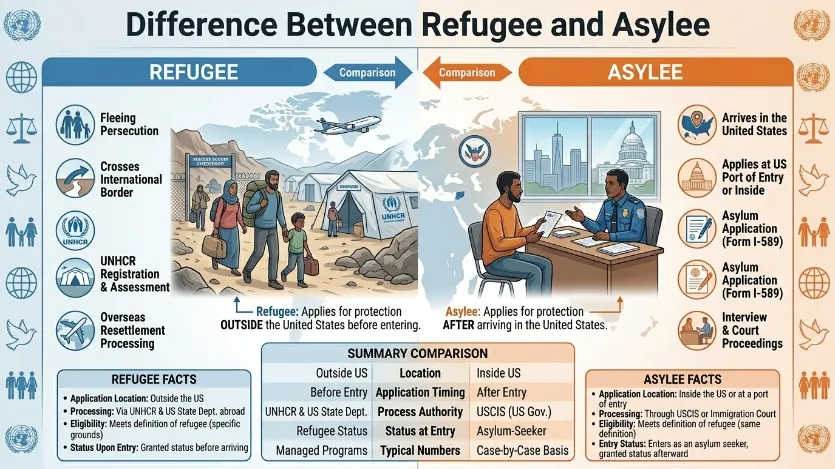
The main difference is that a refugee seeks protection from outside the country they are fleeing, while an asylee requests protection after arriving in the host country.
Why Is Their Difference Necessary to Know?
Knowing this difference is important for students, policymakers, and society. It helps in understanding immigration laws, human rights policies, and global humanitarian efforts. This knowledge also promotes empathy and informed discussions about displaced populations.
Pronunciation
- Refugee
- US: /ˌref.juˈdʒiː/
- UK: /ˌref.juˈdʒiː/
- Asylee
- US: /əˌsaɪ.liː/
- UK: /əˌsaɪ.liː/
To truly understand their roles and significance, let’s explore their differences in depth.
Difference Between Refugee and Asylee
1. Place of Application
- Refugee: Applies from outside the host country.
- Example: A Syrian family applying from a refugee camp.
- Example: A person waiting in another country for approval.
- Asylee: Applies after entering the host country.
- Example: A person requesting asylum at the airport.
- Example: Someone applying after crossing a border.
2. Legal Status Process
- Refugee: Status is granted before entry.
- Example: Approved by international agencies.
- Example: Resettled through programs.
- Asylee: Status is granted after arrival.
- Example: Court decision.
- Example: Immigration interview.
3. Entry Method
- Refugee: Enters legally through resettlement.
- Example: UN-supported relocation.
- Example: Government-approved travel.
- Asylee: May enter legally or irregularly.
- Example: Tourist visa overstay.
- Example: Border crossing.
4. Processing Authority
- Refugee: Processed by international bodies and governments.
- Example: UN agencies.
- Example: Embassy programs.
- Asylee: Processed by the host country’s authorities.
- Example: Immigration courts.
- Example: Asylum offices.
5. Waiting Location
- Refugee: Waits outside the destination country.
- Example: Refugee camps.
- Example: Temporary shelters abroad.
- Asylee: Waits within the country.
- Example: Detention centers.
- Example: Community housing.
6. Documentation
- Refugee: Receives documents before arrival.
- Example: Travel papers.
- Example: Entry permits.
- Asylee: Applies for documents after arrival.
- Example: Work permits.
- Example: ID cards.
7. Risk Level During Process
- Refugee: Faces risk while waiting abroad.
- Example: Unsafe camps.
- Example: Limited resources.
- Asylee: Faces legal uncertainty in host country.
- Example: Deportation risk.
- Example: Long legal process.
8. Support Services
- Refugee: Often receives structured resettlement support.
- Example: Housing assistance.
- Example: Language training.
- Asylee: Support varies by country.
- Example: NGO help.
- Example: Limited aid.
9. Recognition Timing
- Refugee: Recognized before arrival.
- Example: Approved before travel.
- Example: Pre-screened cases.
- Asylee: Recognized after arrival.
- Example: Case hearings.
- Example: Delayed decisions.
10. Mobility
- Refugee: Travel arranged by authorities.
- Example: Organized relocation.
- Example: Group resettlement.
- Asylee: Travels independently.
- Example: Self-arranged journey.
- Example: Personal escape.
Nature and Behaviour
- Refugee: Represents a structured and internationally coordinated process. It often involves planning and organized relocation.
- Asylee: Reflects urgency and personal initiative, often involving immediate escape and legal action after arrival.
Why People Are Confused
People confuse these terms because both describe individuals fleeing danger, persecution, or conflict. Their situations are emotionally similar, but the legal definitions differ based on timing and location.
Table: Difference and Similarity
| Feature | Refugee | Asylee | Similarity |
| Application | Outside country | Inside country | Seek protection |
| Legal Status | Before entry | After entry | Human rights protection |
| Authority | International + national | National | Legal process |
| Support | Structured | Variable | Aid available |
| Risk | External | Internal | Face danger |
Which Is Better in What Situation?
Refugee status is generally better for individuals who can safely wait outside a country and go through formal resettlement programs. It provides structured support, legal entry, and often better preparation for integration into a new society.
Asylee status is better for those who cannot wait and must escape immediately. It allows individuals to seek protection quickly after arrival, even if the process is uncertain. This option is crucial in urgent and life-threatening situations.
Metaphors and Similes
- Refugee: “Like a traveler waiting at a closed gate for permission to enter safety.”
- Asylee: “Like a runner who crosses the finish line and then asks for shelter.”
Connotative Meanings
- Refugee: Neutral to positive (survival and resilience)
- Example: Refugees rebuilding their lives.
- Asylee: Neutral (legal protection seeker)
- Example: Asylees seeking justice and safety.
Idioms or Proverbs
- “Seek refuge”
- Example: They sought refuge from violence.
- “Safe haven”
- Example: The country became a safe haven for asylees.
Works in Literature
- Refugee (Novel, Alan Gratz, 2017)
- The Ungrateful Refugee (Memoir, Dina Nayeri, 2019)
Movies Related to the Theme
- The Good Lie (2014, USA)
- In This World (2002, UK)
FAQs
1. What is the main difference between refugee and asylee?
A refugee applies from outside a country, while an asylee applies after entering it.
2. Do both have the same rights?
Generally similar rights after approval, but processes differ.
3. Can a refugee become an asylee?
No, they are distinct legal categories based on application location.
4. Which process is faster?
It depends on the country, but refugee processing can take longer.
5. Are both protected under international law?
Yes, both are protected under human rights laws.
How Both Are Useful for Surroundings
Both refugees and asylees contribute to cultural diversity, economic growth, and social resilience. They bring new skills, perspectives, and strengthen communities.
Final Words
Refugees and asylees represent hope, survival, and the human quest for safety. Understanding their differences builds awareness and compassion.
Conclusion
In conclusion, the difference between refugee and asylee lies primarily in where and how protection is sought. While refugees apply from outside a country, asylees request protection after arrival. Both share the same goal safety and a better life. Recognizing these distinctions is essential for understanding global migration, legal systems, and humanitarian efforts. By learning about these terms, individuals can engage in more informed and empathetic discussions about one of the most pressing issues in the modern world. To understand the full scope of these pathways, we have to look past basic definitions and analyze the specific legal vetting structures, the agency networks involved, and how host nations manage these individuals administratively.
1. The Refugee Pathway: External Bureaucracy
The refugee resettlement system is an incredibly controlled, multi-tiered international operation. Because refugees are vetted before they arrive, the process is heavily dependent on international partnerships.
As shown in the UNHCR workflow, a person’s path as a refugee follows a highly formalized structure:
- Phase 1 & 2: Registration & Mandate Status: The individual flees their home country into a neighboring transit country. They must register with the United Nations High Commissioner for Refugees (UNHCR). The UNHCR conducts interviews to determine if they meet the legal definition under the 1951 Convention. If they pass, they are granted Prima Facie or Mandate Refugee status.
- Phase 3 & 4: Referral & State Vetting: The UNHCR identifies candidates for whom returning home or staying in the transit country is impossible. They refer these files to host nations (like the US, Canada, or Australia). The destination country then runs its own intensive screening—including biometric collection, intelligence-agency background checks, and medical screenings.
- Resettlement: Once cleared, the International Organization for Migration (IOM) handles the travel logistics. The individual boards a flight to the host nation, landing with immediate legal permanent residence and authorization to work.
2. The Asylee Pathway: Domestic Legal Frameworks
Asylum seeker pathways bypass the international vetting framework entirely because the individual is already standing on the host country’s soil. Instead of dealing with the UN, applicants must deal directly with the domestic immigration court systems of that country.
Because they arrive without prior clearance, domestic legal systems categorize their applications into two distinct tracks:
Affirmative Asylum
- The Scenario: The individual enters the host country (often on a valid temporary visa like a tourist or student visa) and proactively files an asylum application within the legally mandated time frame (usually within one year of arrival).
- The Process: They attend a non-adversarial interview with an asylum officer at a domestic immigration agency. If the officer believes their story and documentation prove a well-founded fear of persecution, their status is granted. If denied, they are referred to immigration court for removal proceedings, where they can try again via the defensive track.
Defensive Asylum
The Process: To defend themselves against immediate deportation, they request asylum. This is a highly formal, adversarial court proceeding. A government attorney argues against the applicant, trying to prove they do not meet the criteria or that it is safe for them to return home. An immigration judge hears both sides and issues a binding legal ruling.
The Scenario: The individual is apprehended by border patrol at a port of entry without a valid visa, or they are caught living in the country without legal status.

I am a professional SEO content writer specialising in comparison-based and grammar-focused articles. Through my website GrammarCompare.com, I help readers clearly understand the difference between confusing terms with well-researched, easy-to-read content. My expertise lies in focusing on clarity, accuracy, and practical explanations that improve both knowledge and writing skills.