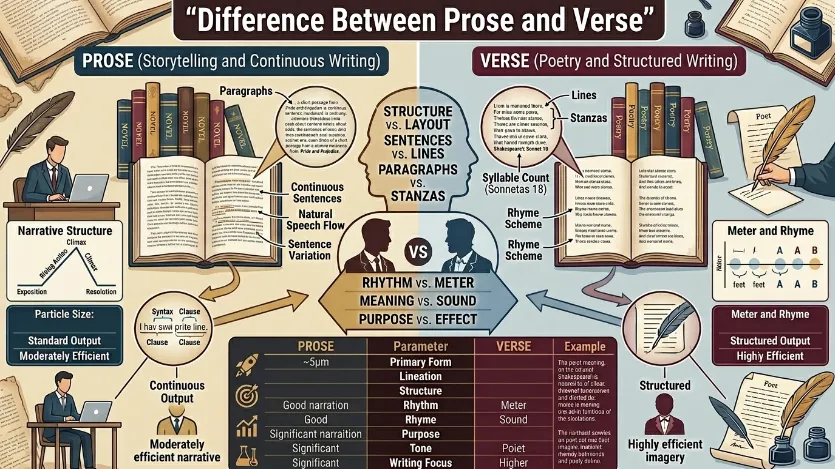
One evening, a teacher asked her students to describe a rainy day. One student wrote, “The rain fell softly, soaking the earth and calming the air.” Another wrote, “Soft rain sings, earth drinks deep, calm whispers fill the air.” Both described the same moment, yet one was written in prose and the other in verse. This simple classroom scene highlights the difference between prose and verse in a real-world way.
The difference between prose and verse lies not only in structure but also in rhythm and expression. While prose flows naturally like everyday speech, verse follows patterns and musical qualities. Understanding the difference between prose and verse helps readers and writers appreciate literature deeply. Whether you are a beginner or an expert, knowing the difference between prose and verse enhances creativity and communication.
Key Difference Between the Both
The main difference is that prose is written in ordinary sentences without a fixed rhythm, while verse is written in lines with rhythm, meter, or rhyme.
Why Is Their Difference Necessary to Know?
Understanding this difference is important for learners, writers, and literary experts. It helps students analyze texts correctly and improves writing skills. For professionals like authors, poets, and educators, it allows them to choose the right form for expression. In society, prose is widely used in communication, education, and media, while verse enriches culture through poetry, songs, and artistic expression. Knowing their difference builds better appreciation of literature and strengthens language skills.
Pronunciation (US & UK)
- Prose
- US: /proʊz/
- UK: /prəʊz/
- Verse
- US: /vɜːrs/
- UK: /vɜːs/
Linking Hook
Now, let’s dive deeper into the detailed difference between prose and verse with simple explanations and examples.
Difference Between Prose and Verse
1. Structure
- Prose is written in paragraphs.
- Example 1: A novel chapter.
- Example 2: A newspaper article.
- Verse is written in lines and stanzas.
- Example 1: A poem with four lines.
- Example 2: Song lyrics arranged in verses.
2. Rhythm
- Prose has no fixed rhythm.
- Example 1: “She walked to the store.”
- Example 2: “He opened the door slowly.”
- Verse has rhythm or meter.
- Example 1: “She walks in light, so calm, so bright.”
- Example 2: Rhyming poetry lines.
3. Language Style
- Prose uses natural, everyday language.
- Example 1: Conversations in stories.
- Example 2: Essays and reports.
- Verse uses artistic and expressive language.
- Example 1: Figurative expressions.
- Example 2: Symbolic words.
4. Purpose
- Prose aims to inform or tell a story.
- Example 1: Novels.
- Example 2: Biographies.
- Verse aims to evoke emotions.
- Example 1: Love poems.
- Example 2: Songs.
5. Use of Figures of Speech
- Prose uses fewer figures of speech.
- Example 1: Simple storytelling.
- Example 2: News writing.
- Verse uses many figures of speech.
- Example 1: Metaphors.
- Example 2: Similes.
6. Length of Sentences
- Prose uses complete sentences.
- Example 1: “He went home after work.”
- Example 2: “They enjoyed the meal together.”
- Verse may use fragments.
- Example 1: “Gone with the wind.”
- Example 2: “Silent night, holy night.”
7. Organization
- Prose is organized in paragraphs.
- Example 1: Essay sections.
- Example 2: Story chapters.
- Verse is organized in stanzas.
- Example 1: Four-line stanza.
- Example 2: Haiku structure.
8. Flexibility
- Prose is more flexible in structure.
- Example 1: Can vary sentence length.
- Example 2: No strict rules.
- Verse often follows rules.
- Example 1: Rhyming schemes.
- Example 2: Meter patterns.
9. Reading Experience
- Prose is straightforward to read.
- Example 1: Novels.
- Example 2: Articles.
- Verse requires interpretation.
- Example 1: Poetry analysis.
- Example 2: Symbolic reading.
10. Common Forms
- Prose includes novels, essays, and stories.
- Example 1: Fiction books.
- Example 2: Academic writing.
- Verse includes poems and songs.
- Example 1: Sonnets.
- Example 2: Ballads.
Nature and Behaviour
- Prose: Direct, logical, and clear. It behaves like everyday conversation.
- Verse: Emotional, rhythmic, and artistic. It behaves like music in words.
Why People Are Confused About Their Use?
People get confused because both prose and verse use language to express ideas. Some modern writing blends both forms, such as prose poetry. Beginners may not easily recognize rhythm or structure, making the difference less obvious.
Difference and Similarity Table
| Feature | Prose | Verse | Similarity |
| Structure | Paragraphs | Lines & stanzas | Both use language |
| Rhythm | No fixed rhythm | Rhythmic | Express ideas |
| Style | Simple | Artistic | Can tell stories |
| Purpose | Inform or narrate | Evoke emotion | Used in literature |
| Rules | Flexible | Often structured | Require creativity |
Which Is Better in What Situation?
Prose is better for communication, storytelling, and academic writing. It allows writers to explain ideas clearly and logically. In schools, businesses, and journalism, prose is the preferred form because it is easy to understand. When the goal is to inform, describe, or narrate in a direct way, prose is the best choice.
Verse is better for artistic expression and emotional impact. It is widely used in poetry, songs, and cultural traditions. Verse can convey deep feelings in a short space and create a musical effect. When the goal is to inspire, entertain, or express emotions creatively, verse is more effective.
Metaphors and Similes
- Prose is like a straight road clear and direct.
- Verse is like a dancing river flowing with rhythm.
- Prose works like a conversation.
- Verse works like a song.
Connotative Meaning
- Prose: Neutral
- Example: “A prose explanation of the topic.”
- Verse: Positive
- Example: “A beautiful verse touched the heart.”
Idioms or Proverbs
- “Actions speak louder than words”
- Example: Even in prose or verse, meaning matters more than style.
- “Art speaks where words are unable to explain”
- Example: Verse often expresses what prose cannot.
Works in Literature
- Pride and Prejudice – Genre: Novel (Prose), Writer: Jane Austen, Year: 1813
- Hamlet – Genre: Tragedy (Verse & Prose mix), Writer: William Shakespeare, Year: 1603
- The Raven – Genre: Poem (Verse), Writer: Edgar Allan Poe, Year: 1845
Movies Related to Literary Expression
- Dead Poets Society (1989, USA)
- Bright Star (2009, UK/Australia)
FAQs
1. What is the main difference between prose and verse?
Prose is written in sentences and paragraphs, while verse is written in lines with rhythm.
2. Can prose have poetic elements?
Yes, prose can include imagery and figurative language.
3. Is verse always rhymed?
No, free verse does not follow rhyme schemes.
4. Which is easier to write?
Prose is generally easier for beginners.
5. Can a text include both prose and verse?
Yes, many literary works combine both forms.
How Both Are Useful for Surroundings
Prose helps in everyday communication, education, and information sharing. Verse enriches culture, inspires creativity, and expresses emotions. Together, they shape language, literature, and human expression in society.
Final Words
Prose and verse are two powerful forms of expression. One offers clarity, while the other offers beauty. Both are essential in language and literature.
Conclusion
The difference between prose and verse is fundamental to understanding literature. Prose provides clarity and structure, making it ideal for communication and storytelling. Verse, on the other hand, adds rhythm and emotion, enriching artistic expression. By understanding the difference between prose and verse, readers and writers can better appreciate and use language. Both forms complement each other and play vital roles in education, culture, and creativity. Let’s look closer at the mechanics of both forms. The real magic happens when you see how prose and verse use different structural components to manipulate pacing, sound, and reader attention.
1. The Anatomy of Prose
Prose relies entirely on standard grammatical logic. The text expands horizontally until it hits the margin, then wraps naturally to the next line.
- Syntax as Pacing: Instead of using visual line breaks, prose controls speed through sentence lengths. Short sentences speed up action; long, complex sentences slow down a narrative for deep thought.
- The Paragraph Unit: Paragraphs group related thoughts together. A shift to a new paragraph tells the reader that time has passed, the location has shifted, or a new speaker has started talking.
Sub-genres of Prose
- Fictional Prose: Novels, novellas, short stories.
- Non-Fictional Prose: Biographies, essays, journalistic articles, academic papers.
2. The Anatomy of Verse
Verse treats words as musical notes. Every single line break is an explicit choice by the author to alter the rhythm, build suspense, or highlight a specific word.
- The Line Break: In verse, a line can end mid-sentence (enjambment), forcing the reader’s eye to hurry to the next line to finish the thought, which builds momentum. If a line ends on a clean grammatical pause (end-stopped), it creates a moment of stillness.
- Meter (The Beat): Traditional verse uses a rhythmic framework built out of poetic “feet” (patterns of stressed and unstressed syllables).
As shown above, classical verse like iambic pentameter relies on a specific sequence of “short” (unstressed) and “long” (stressed) syllables. This internal beat gives verse its melodic quality, which makes it distinct from the casual pacing of prose.
Types of Verse
Free Verse: Rejects strict meters and rhyme patterns entirely, relying on the natural cadence of speech and creative line breaks for impact.
Rhymed Verse: Follows a strict meter and standard rhyming patterns (like sonnets or villanelles).
Blank Verse: Keeps a strict meter (usually iambic pentameter) but removes the rhymes entirely.

I am a professional SEO content writer specialising in comparison-based and grammar-focused articles. Through my website GrammarCompare.com, I help readers clearly understand the difference between confusing terms with well-researched, easy-to-read content. My expertise lies in focusing on clarity, accuracy, and practical explanations that improve both knowledge and writing skills.