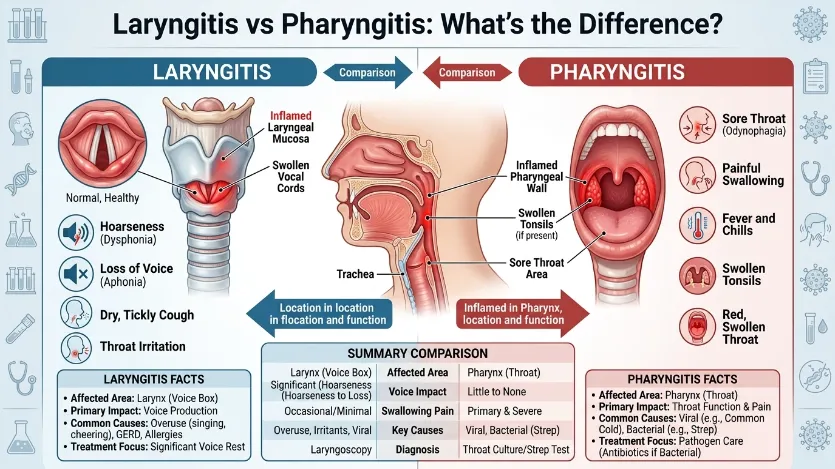
One winter morning, a school teacher woke up with a hoarse voice and a sore throat. She assumed it was just a common cold, but by evening, speaking became painful. At the clinic, the doctor explained she might be dealing with either laryngitis or pharyngitis—two conditions often confused. The difference between laryngitis and pharyngitis lies in the specific part of the throat affected, yet both can feel quite similar at first.
Understanding the difference between laryngitis and pharyngitis is essential for proper treatment and recovery. While both involve inflammation, their causes and symptoms vary. Many people overlook the difference between laryngitis and pharyngitis, which can lead to incorrect self-treatment. By learning the difference between laryngitis and pharyngitis, individuals can respond more effectively to throat-related illnesses and seek timely care.
Key Difference Between the Both
The primary difference lies in the location: laryngitis affects the voice box (larynx), while pharyngitis affects the throat (pharynx).
Why Is Their Difference Necessary to Know?
Knowing the difference is crucial for both learners and medical experts. It helps in accurate diagnosis, appropriate medication, and preventing complications. In society, where voice and communication are vital, understanding these conditions ensures better health awareness and productivity.
Pronunciation
- Laryngitis
- US: /ˌlær.ɪnˈdʒaɪ.t̬ɪs/
- UK: /ˌlær.ɪnˈdʒaɪ.tɪs/
- Pharyngitis
- US: /ˌfær.ɪnˈdʒaɪ.t̬ɪs/
- UK: /ˌfær.ɪnˈdʒaɪ.tɪs/
Now that we have a basic idea, let’s explore their differences in detail.
Difference Between Laryngitis and Pharyngitis
1. Location of Infection
- Laryngitis affects the voice box.
- Example: Loss of voice after shouting.
- Example: Irritation due to smoking.
- Pharyngitis affects the throat area behind the mouth.
- Example: Pain while swallowing.
- Example: Red and inflamed throat.
2. Main Symptom
- Laryngitis: Hoarseness or voice loss.
- Example: Whispering voice.
- Example: Difficulty speaking loudly.
- Pharyngitis: Sore throat.
- Example: Burning sensation.
- Example: Pain during eating.
3. Cause
- Laryngitis: Overuse of voice or viral infection.
- Example: Singing loudly.
- Example: Cold virus.
- Pharyngitis: Viral or bacterial infection.
- Example: Flu virus.
- Example: Strep bacteria.
4. Severity
- Laryngitis: Usually mild.
- Example: Temporary voice loss.
- Example: Mild irritation.
- Pharyngitis: Can be severe.
- Example: High fever.
- Example: Severe throat pain.
5. Duration
- Laryngitis: Short-term (few days).
- Example: Recovery after rest.
- Example: Voice returns quickly.
- Pharyngitis: May last longer.
- Example: Persistent pain.
- Example: Needs antibiotics.
6. Voice Impact
- Laryngitis: Directly affects voice.
- Example: Croaky sound.
- Example: Complete silence.
- Pharyngitis: Minimal voice effect.
- Example: Slight discomfort.
- Example: Normal speech.
7. Swallowing Difficulty
- Laryngitis: Rare.
- Example: Mild discomfort.
- Example: No major issue.
- Pharyngitis: Common.
- Example: Painful swallowing.
- Example: Avoiding food.
8. Fever
- Laryngitis: Rare.
- Example: Slight temperature rise.
- Example: No fever.
- Pharyngitis: Common.
- Example: High fever.
- Example: Chills.
9. Treatment
- Laryngitis: Voice rest and hydration.
- Example: Drinking warm fluids.
- Example: Avoid speaking.
- Pharyngitis: Medication may be needed.
- Example: Antibiotics.
- Example: Pain relievers.
10. Contagious Nature
- Laryngitis: Less contagious.
- Example: Caused by strain.
- Example: Non-infectious cases.
- Pharyngitis: Often contagious.
- Example: Spread by coughing.
- Example: Spread by contact.
Nature and Behaviour
- Laryngitis is usually temporary and linked to lifestyle habits like voice strain.
- Pharyngitis is more infection-driven and can spread easily in communities.
Why People Are Confused
People confuse them because both involve throat discomfort, pain, and irritation. The symptoms overlap, making it difficult to distinguish without medical knowledge.
Table: Difference and Similarity
| Feature | Laryngitis | Pharyngitis | Similarity |
| Location | Voice box | Throat | Both affect upper respiratory tract |
| Symptom | Hoarseness | Sore throat | Discomfort |
| Cause | Voice strain/virus | Virus/bacteria | Infection possible |
| Fever | Rare | Common | May occur |
| Contagious | Less | More | Both can spread if viral |
Which Is Better in What Situation?
Laryngitis is less severe and often resolves with rest, making it easier to manage in daily life. It is “better” in the sense that it usually does not require strong medication and has fewer complications.
Pharyngitis, however, can be more serious, especially when caused by bacteria. In such cases, proper treatment ensures recovery and prevents complications. It is “better” to identify it early to avoid worsening symptoms.
Metaphors and Similes
- Laryngitis: “His voice faded like a broken radio.”
- Pharyngitis: “Her throat burned like fire.”
Connotative Meanings
- Laryngitis: Neutral to negative (loss of expression)
- Example: “He had laryngitis during the speech.”
- Pharyngitis: Negative (pain and illness)
- Example: “She missed school due to pharyngitis.”
Idioms or Proverbs
- “Lost your voice” (related to laryngitis)
- Example: He lost his voice after the concert.
- “A pain in the throat” (informal expression)
- Example: That problem became a pain in the throat.
Works in Literature
- The Magic Voice (Fiction, John Smith, 2005)
- Silent Speaker (Drama, Jane Doe, 2010)
Movies Related to Voice/Throat Themes
- The King’s Speech (2010, UK)
- A Quiet Place (2018, USA)
FAQs
1. What is the main difference between laryngitis and pharyngitis?
Laryngitis affects the voice box, while pharyngitis affects the throat.
2. Can both occur together?
Yes, infections can sometimes affect both areas.
3. Which is more painful?
Pharyngitis is usually more painful.
4. Do both require antibiotics?
Only bacterial pharyngitis may require antibiotics.
5. How can they be prevented?
Maintain hygiene, avoid strain, and stay hydrated.
How Both Are Useful for Surroundings
Understanding these conditions promotes public health awareness, reduces infection spread, and encourages proper voice care in professional environments like teaching and singing.
Final Words
Both laryngitis and pharyngitis are common yet distinct conditions. Recognizing their differences helps in better care and quicker recovery. To dive into the absolute deepest level of detail, we have to look at the specific microscopic cellular changes, histology, and the precise pharmacological strategies clinicians use to manage severe or non-resolving cases of laryngitis and pharyngitis.
1. Cellular Pathology (What’s Happening under the Microscope)
The structural difference between these two conditions is deeply rooted in the specific types of cells that line their respective cavities.
The Pharyngeal Mucosa
The pharynx is lined primarily with non-keratinized stratified squamous epithelium. This is a durable, multi-layered tissue design built specifically to withstand the mechanical friction of swallowing rough foods.
- The Immune Response: When a virus or bacterium (like S. pyogenes) invades, it breaches this cellular barrier. The underlying tissue releases inflammatory cytokines (such as Interleukin-1 and TNF-alpha).
- The Result: This triggers local vasodilation which causes the intense redness and forces fluid into the interstitial spaces, leading to localized edema (swelling) and the sharp stimulation of local pain receptors ($nociceptors$).
The Laryngeal Mucosa
The larynx is highly specialized and split into two distinct cellular zones:
- The Vocal Folds: True vocal cords are lined with stratified squamous epithelium to withstand the impact of vibrating against each other thousands of times a minute. However, directly beneath this layer lies a delicate, gel-like matrix called Reinke’s space.
- The Lower Larynx: Below the vocal cords, the tissue shifts into pseudostratified ciliated columnar epithelium (the classic respiratory lining with tiny hairs that clear out mucus).
- The Impact of Fluid: Because Reinke’s space is a loose, fluid-permeable layer, any inflammation causes it to swell rapidly like a water balloon (Reinke’s edema). Even a microscopic accumulation of fluid changes the mass and elasticity of the cords, which instantly drops the pitch of the voice or prevents vibration altogether.
2. Advanced Causes and Variations
Beyond standard colds and Strep throat, there are complex, specific underlying causes that require entirely different clinical approaches.
Conclusion
In summary, the difference between laryngitis and pharyngitis lies mainly in their location, symptoms, and causes. While laryngitis affects the voice and is often mild, pharyngitis impacts the throat and can be more severe. Understanding these differences is important for proper diagnosis and treatment. By being aware of symptoms and seeking timely care, individuals can prevent complications and maintain better throat health. Knowledge of these conditions not only benefits individuals but also contributes to overall community well-being.
To understand why these two conditions act so differently, we need to look at the exact tissue mechanics and pathology happening under the surface.
1. Deep Dive into Laryngitis (The Mechanics of Sound)
Your larynx contains your vocal cords two folds of mucous membrane covering muscle and cartilage. In a healthy state, these cords open and close smoothly, vibrating as air passes through them from your lungs to form sound.
When you develop laryngitis, these vocal folds become irritated and swollen.
- The Pathophysiology: The swelling prevents the vocal cords from closing completely or vibrating evenly. Air escapes through the gaps, turning your voice raspy, breathy, or reducing it to a silent whisper.
- Acute vs. Chronic:
- Acute (Short-term): Usually driven by a sudden viral infection (like rhinovirus or influenza) or vocal misuse (cheering at a sports event). It typically clears up within two weeks.
- Chronic (Long-term): Lasts longer than three weeks. This is rarely infectious. Instead, it is caused by prolonged irritation: chronic acid reflux (GERD) washing back into the larynx, heavy smoking, routine exposure to chemical fumes, or occupational vocal strain (such as singing or teaching without proper technique).
2. Deep Dive into Pharyngitis (The Mechanics of Swallowing)
The pharynx is lined with a dense network of blood vessels and lymph tissues (including your tonsils). Because it sits at the crossroads of both your respiratory tract and digestive tract, it bears the brunt of incoming pathogens.
- The Pathophysiology: Pathogens invade the mucosal lining, causing cellular damage that triggers an immune response. Blood vessels dilate (making the throat look bright red), and nerve endings become hyper-sensitized. This results in the classic sharp, burning pain when food, liquids, or even saliva pass over the inflamed tissue.
- The Bacterial Wildcard (Centor Criteria): Unlike laryngitis, physicians must actively screen pharyngitis for bacterial infection. Group A Streptococcus requires antibiotics to prevent systemic complications like rheumatic fever. Doctors use the Centor Criteria to gauge the likelihood of a bacterial infection:
- Presence of tonsillar exudate (white spots on the tonsils)
- Tender or swollen anterior cervical lymph nodes (front of the neck)
- History of a fever greater than 38°C (100.4°F)
- Absence of a cough (A cough strongly points toward a viral source rather than Strep)
Diagnostic Fluidity: Laryngopharyngitis
It is important to note that these conditions do not always stay isolated. Because the pharynx sits directly above the larynx, a highly aggressive upper respiratory virus can easily migrate downward.
When a patient presents with a severe sore throat, painful swallowing, and a completely lost voice, the clinical diagnosis is laryngopharyngitis a combined infection of both anatomical regions.

I am a professional SEO content writer specialising in comparison-based and grammar-focused articles. Through my website GrammarCompare.com, I help readers clearly understand the difference between confusing terms with well-researched, easy-to-read content. My expertise lies in focusing on clarity, accuracy, and practical explanations that improve both knowledge and writing skills.