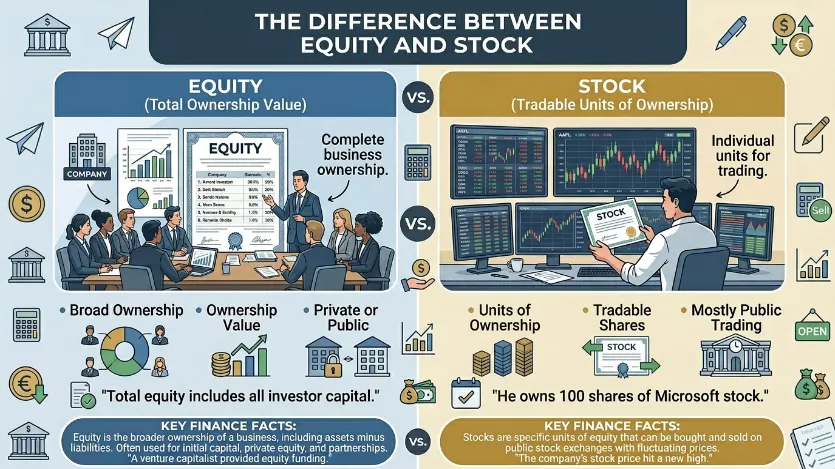
A young entrepreneur once told his friend, “I own stock in a technology company.” His friend replied, “That means you have equity in the company.” Both sounded correct, yet they were not exactly the same. This real-world conversation reflects the common confusion people face when understanding the difference between equity and stock. In finance and business, these two words are closely connected, but they carry different meanings and uses.
The difference between equity and stock is important for investors, business owners, students, and financial experts. Equity refers to ownership value in a company, while stock is a type of security representing shares in that ownership. Many people use them interchangeably, but understanding the difference between equity and stock helps in making smarter investment and business decisions. Knowing the difference between equity and stock also improves financial literacy and confidence in the modern economic world.
Key Difference Between Equity and Stock
The main difference is that equity represents overall ownership value in a business, while stock refers to individual shares issued by a company. Equity is broader, whereas stock is one form of equity ownership.
Why Is Their Difference Necessary to Know?
Understanding the distinction is valuable for both learners and experts because finance affects daily life, businesses, and society. Investors use these terms when buying shares, calculating company value, or discussing profits and losses. Students studying business or economics need clarity to avoid confusion in professional communication.
In society, companies raise money through stock markets, and people build wealth through equity investments. Entrepreneurs also use equity to attract investors. Therefore, knowing the difference improves decision-making, financial awareness, and communication in business environments.
Pronunciation of Both Words
Equity
- US Pronunciation: /ˈekwəti/
- UK Pronunciation: /ˈekwɪti/
Stock
- US Pronunciation: /stɑːk/
- UK Pronunciation: /stɒk/
Understanding these terms deeply will help you navigate the world of business, investing, and economics with confidence. Let us now explore the detailed difference between equity and stock.
Difference Between Equity and Stock
1. Meaning
Equity
Equity means ownership interest in a company or asset.
Examples:
- Sarah owns 40% equity in her startup company.
- Homeowners build equity by paying their mortgage.
Stock
Stock represents shares issued by a corporation.
Examples:
- John bought Apple stock yesterday.
- Investors sold their stocks during the market crash.
2. Scope
Equity
Equity is a broader term that includes ownership in businesses, properties, and assets.
Examples:
- Business equity reflects company ownership.
- Real estate equity increases over time.
Stock
Stock only relates to company shares traded in markets.
Examples:
- Tesla stock rose sharply today.
- He invests mainly in technology stocks.
3. Nature
Equity
Equity can exist in private or public companies.
Examples:
- Private investors gained equity in the startup.
- Family businesses often distribute equity among relatives.
Stock
Stocks are usually associated with publicly traded companies.
Examples:
- Public stocks are listed on exchanges.
- Investors monitor stock prices daily.
4. Representation
Equity
Equity represents total ownership value.
Examples:
- Equity includes retained earnings.
- Equity reflects net company value.
Stock
Stock represents specific units of ownership.
Examples:
- Each stock share has voting rights.
- She owns 500 stock shares.
5. Risk Level
Equity
Equity may involve broader financial risks.
Examples:
- Startup equity can be uncertain.
- Equity investors face long-term risks.
Stock
Stock prices fluctuate daily in the market.
Examples:
- Stock volatility worries investors.
- Stocks can lose value quickly.
6. Trading Ability
Equity
Equity is not always publicly traded.
Examples:
- Private equity is difficult to sell.
- Startup equity requires agreements.
Stock
Stocks are commonly traded on exchanges.
Examples:
- NYSE stocks trade every day.
- Investors buy stocks online instantly.
7. Ownership Structure
Equity
Equity may include ownership percentages.
Examples:
- Equity partners share profits.
- Investors negotiate equity stakes.
Stock
Stocks are divided into shares.
Examples:
- He purchased 100 shares of stock.
- Common stock gives voting power.
8. Use in Accounting
Equity
Equity appears on balance sheets as net assets.
Examples:
- Shareholder equity increased this year.
- Equity equals assets minus liabilities.
Stock
Stock appears as issued shares.
Examples:
- Preferred stock offers fixed dividends.
- Stock issuance raised company funds.
9. Income Generation
Equity
Equity holders benefit from company growth.
Examples:
- Equity investors earned profits.
- Equity value rose after expansion.
Stock
Stockholders receive dividends or capital gains.
Examples:
- Dividend stocks attract retirees.
- Stock gains increased his wealth.
10. Legal Perspective
Equity
Equity can involve legal ownership rights.
Examples:
- Equity agreements define ownership.
- Courts protect equity interests.
Stock
Stock ownership is defined through share certificates.
Examples:
- Stockholders attend annual meetings.
- Stocks provide shareholder rights.
Nature and Behaviour of Both
Equity
Equity behaves like a long-term ownership interest. Its value depends on company performance, profits, and assets. Equity can grow steadily over time, especially in successful businesses.
Stock
Stock behaves more dynamically because market prices change daily. Stocks react to news, economic conditions, investor emotions, and company performance.
Why Are People Confused About Their Use?
People are confused because both terms relate to ownership in a company. Financial media often use “equity” and “stock” interchangeably. In many situations, stock is considered a form of equity, which increases misunderstanding. Additionally, beginners in finance may not realize that equity has a wider meaning beyond publicly traded shares.
Difference and Similarity Table
| Aspect | Equity | Stock | Similarity |
|---|---|---|---|
| Meaning | Ownership value | Shares of ownership | Both show ownership |
| Scope | Broad | Narrow | Related to companies |
| Trading | Not always tradable | Easily tradable | Used in investing |
| Usage | Accounting and finance | Stock markets | Important financially |
| Ownership | Overall interest | Share units | Investors benefit |
| Risk | Long-term risk | Market volatility | Both involve risk |
Which Is Better in What Situation?
Equity
Equity is better for long-term business ownership and startup investment. Entrepreneurs often prefer equity because it allows control and growth participation. Equity also suits investors who want deeper involvement in a company’s success rather than short-term trading profits.
Stock
Stock is better for people seeking liquidity and market flexibility. Public stocks can be bought or sold quickly, making them suitable for traders and retail investors. Stocks are ideal for portfolio diversification and earning dividends or capital gains.
How the Keywords Are Used in Metaphors and Similes
Equity
- “Equity is the backbone of a business.”
- “Her equity in the company grew like a tree.”
Stock
- “His emotions rose and fell like stock prices.”
- “The market moved like a roller coaster stock chart.”
Connotative Meaning of Both Keywords
Equity
- Positive: fairness, ownership, growth
- Example: “The startup offered employee equity as motivation.”
- Neutral: financial ownership
- Example: “Equity increased this quarter.”
- Negative: risky ownership exposure
- Example: “Too much equity can lead to financial pressure.”
Stock
- Positive: investment opportunity
- Example: “Technology stocks created wealth.”
- Neutral: company shares
- Example: “She studies stock performance.”
- Negative: market instability
- Example: “Stock crashes frightened investors.”
Idioms or Proverbs Related to the Words
Stock
“Take stock”
Meaning: To evaluate a situation.
Example:
Before investing, Maria took stock of her finances.
“Stock in trade”
Meaning: Main skill or asset.
Example:
Creativity is the writer’s stock in trade.
Equity
Direct idioms with “equity” are rare, but it appears in legal and financial expressions.
“Sweat equity”
Meaning: Value gained through hard work.
Example:
The founders earned sweat equity by building the company themselves.
Works in Literature Featuring the Keywords
Equity
- “Private Equity” – Carrie Sun (Memoir, 2024)
- “Equity Asset Valuation” – Jerald Pinto (Finance/Education, 2020)
Stock
- “Reminiscences of a Stock Operator” – Edwin Lefèvre (Biography/Finance, 1923)
- “The Stock Market” – Larry Doyle (Finance, 2016)
Movie Names Related to the Keywords
Equity
- “Equity” – 2016, USA
Stock
- “The Wolf of Wall Street” – 2013, USA
- “Wall Street” – 1987, USA
Frequently Asked Questions
1. Is stock the same as equity?
No. Stock is a type of equity, but equity has a broader meaning.
2. Can equity exist without stock?
Yes. Private companies may have equity without publicly traded stock.
3. Why do investors buy stocks?
Investors buy stocks for profits, dividends, and ownership.
4. What does equity mean in accounting?
It means the owner’s remaining interest after liabilities are subtracted from assets.
5. Which is riskier: equity or stock?
Stocks are generally more volatile because market prices change daily.
How Both Are Useful for Surroundings
Equity and stock contribute to economic growth by helping businesses raise capital. They create jobs, encourage innovation, and improve financial systems. Communities benefit when companies grow through investments, leading to better opportunities and economic stability.
Final Words for Both
Equity symbolizes ownership and long-term value, while stock represents tradable units of company ownership. Together, they form the foundation of modern investing and business development.
Conclusion
The difference between equity and stock may appear small, but it is highly important in finance and business. Equity refers to total ownership value, while stock represents shares issued by companies. Understanding this distinction helps investors, students, entrepreneurs, and professionals communicate clearly and make better financial decisions. Equity often focuses on long-term ownership and value creation, whereas stocks emphasize trading and market participation. Both play essential roles in economic development and wealth creation. By learning the difference between equity and stock, individuals gain stronger financial knowledge and confidence in navigating the modern investment world.

I am a professional SEO content writer specialising in comparison-based and grammar-focused articles. Through my website GrammarCompare.com, I help readers clearly understand the difference between confusing terms with well-researched, easy-to-read content. My expertise lies in focusing on clarity, accuracy, and practical explanations that improve both knowledge and writing skills.