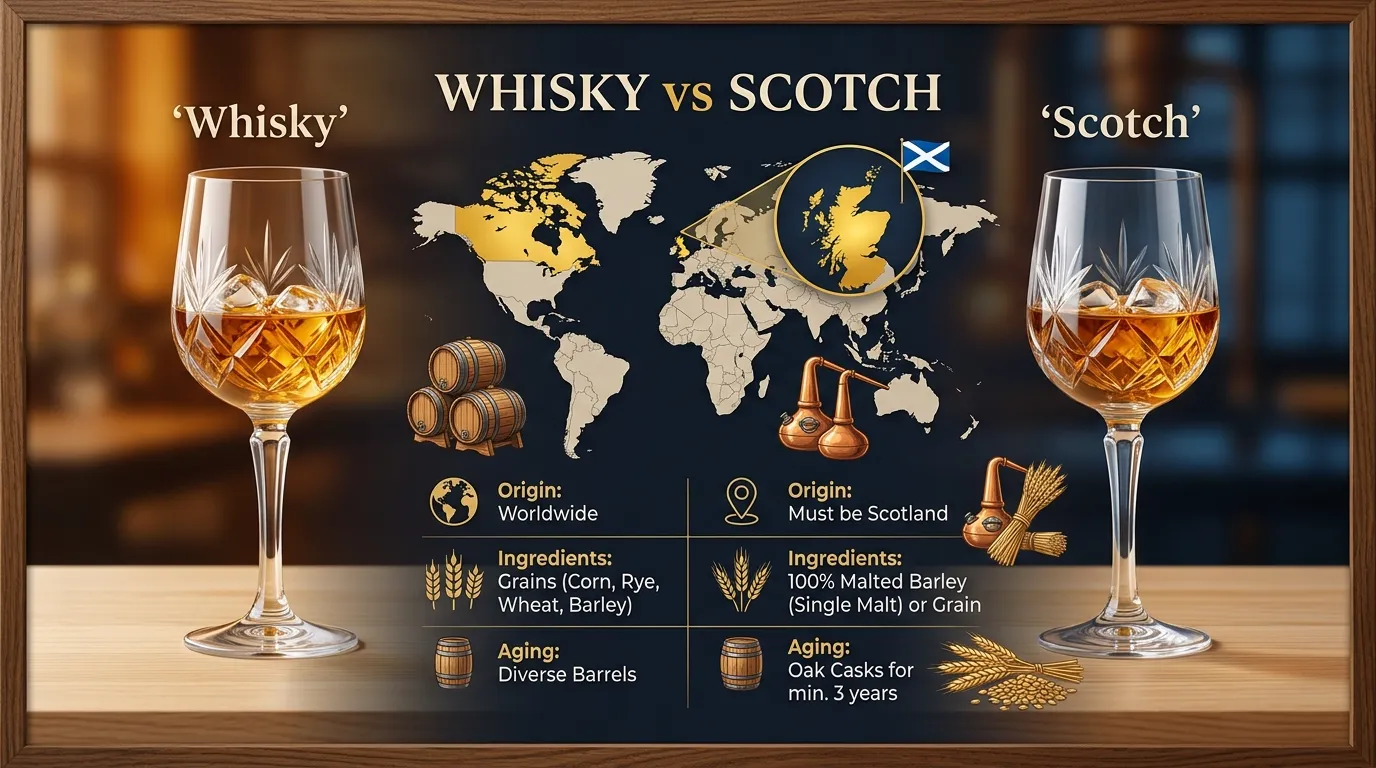
One evening at a dinner party, a guest confidently asked for a glass of whisky. The host smiled and offered a bottle labeled “Scotch.” The guest hesitated aren’t they the same? This small moment highlights a common confusion. Understanding the difference between whisky and scotch is not just about drinks; it reflects culture, geography, and tradition. Whisky is a broad category of distilled spirits made from fermented grain mash, while Scotch is a specific type of whisky made in Scotland under strict rules.
The difference between whisky and scotch often puzzles both beginners and experts because the terms are closely related yet distinct. Knowing the difference between whisky and scotch helps you make better choices, whether you are ordering at a bar or studying beverage traditions. In fact, the difference between whisky and scotch reveals how regional identity shapes global products.
Key Difference Between the Both
The main difference is simple: all Scotch is whisky, but not all whisky is Scotch. Scotch must be produced in Scotland following specific legal standards.
Why Is Their Difference Necessary to Know?
Understanding this difference is important for learners and experts because it builds clarity in communication, enhances appreciation of cultural heritage, and helps in making informed purchasing decisions. In society, it reflects how origin and craftsmanship influence value and identity.
Pronunciation (US & UK)
- Whisky (US/UK): /ˈwɪski/
- Scotch (US): /skɑːtʃ/
- Scotch (UK): /skɒtʃ/
Now that we’ve set the foundation, let’s explore the details that truly separate these two.
Difference Between Whisky and Scotch
1. Definition
Whisky is a general term for distilled grain spirits. Scotch is a specific type of whisky made in Scotland.
- Example 1: Bourbon is whisky but not Scotch.
- Example 2: Scotch is always whisky but from Scotland only.
2. Origin
Whisky is produced worldwide. Scotch is only produced in Scotland.
- Example 1: Japanese whisky comes from Japan.
- Example 2: Scotch comes strictly from Scottish distilleries.
3. Ingredients
Whisky may use different grains like corn, rye, or barley. Scotch mainly uses malted barley.
- Example 1: American bourbon uses corn.
- Example 2: Scotch single malt uses barley.
4. Production Laws
Whisky laws vary by country. Scotch has strict legal regulations.
- Example 1: Irish whisky follows Irish laws.
- Example 2: Scotch must age at least 3 years in Scotland.
5. Aging Process
Whisky aging rules differ globally. Scotch must be aged in oak barrels for at least 3 years.
- Example 1: Some whiskies age longer depending on brand.
- Example 2: Scotch aging is legally defined.
6. Flavor Profile
Whisky flavors vary widely. Scotch often has smoky or peaty notes.
- Example 1: Bourbon tastes sweet and vanilla-like.
- Example 2: Scotch may taste smoky and earthy.
7. Spelling
Whisky spelling differs by region. Scotch follows “whisky” spelling.
- Example 1: American whiskey includes an “e.”
- Example 2: Scotch uses “whisky” without “e.”
8. Types
Whisky includes many types like bourbon, rye, and Irish. Scotch includes single malt and blended Scotch.
- Example 1: Rye whisky is common in Canada.
- Example 2: Single malt Scotch is highly valued.
9. Cultural Identity
Whisky represents global traditions. Scotch represents Scottish heritage.
- Example 1: Japanese whisky reflects Japanese craftsmanship.
- Example 2: Scotch reflects Scottish tradition.
10. Price Range
Whisky prices vary widely. Scotch often has premium pricing due to strict standards.
- Example 1: Budget whiskies are widely available.
- Example 2: Aged Scotch can be expensive.
Nature and Behaviour
Whisky is diverse and adaptable, reflecting different cultures and tastes. Scotch is more traditional and regulated, emphasizing consistency and heritage.
Why People Are Confused
People are confused because Scotch is a type of whisky. The overlapping terminology and similar appearance make it difficult to distinguish between them.
Table: Difference and Similarities
| Aspect | Whisky | Scotch | Similarity |
| Definition | General category | Specific type | Both are distilled spirits |
| Origin | Worldwide | Scotland only | Both have regional identity |
| Ingredients | Various grains | Mostly barley | Grain-based drinks |
| Aging | Varies | Minimum 3 years | Aged in barrels |
| Flavor | Wide range | Often smoky | Rich taste profiles |
Which Is Better in What Situation?
Whisky:
Whisky is better when you want variety and flexibility. It suits casual gatherings, cocktails, and beginners exploring different flavors. Its wide range allows people to experiment with taste preferences easily.
Scotch:
Scotch is better for formal settings or when you want a refined, traditional experience. It is ideal for sipping slowly and appreciating craftsmanship. Experts often prefer Scotch for its depth and authenticity.
Metaphors and Similes
- Whisky is like a “global language” with many dialects.
- Scotch is like a “classic novel,” rich and rooted in tradition.
Connotative Meaning
- Whisky: Neutral to positive (variety, accessibility)
- Example: “He enjoys whisky for its diversity.”
- Scotch: Positive (premium, tradition)
- Example: “She gifted a fine Scotch as a sign of respect.”
Idioms or Proverbs
- “Smooth as whisky” something easy or pleasant
- Example: His speech was smooth as whisky.
- “A taste of Scotch” experiencing something refined
- Example: The event gave us a taste of Scotch elegance.
Works in Literature
- Whisky Galore (Novel, Compton Mackenzie, 1947)
- The Angel’s Share (Drama themes, various writers, modern)
Movies Related to Keywords
- Whisky Galore! (1949, UK)
- The Angel’s Share (2012, UK)
FAQs
1. Is Scotch stronger than whisky?
No, both have similar alcohol content; strength depends on the brand.
2. Can Scotch be called whisky?
Yes, Scotch is a type of whisky.
3. Why is Scotch more expensive?
Due to strict production rules and aging requirements.
4. Is all whisky smoky?
No, only some types like Scotch have smoky flavors.
5. Which is better for beginners?
Whisky is better due to its variety and mild options.
How Both Are Useful for Surroundings
Whisky and Scotch contribute to social bonding, cultural exchange, and economic growth through the beverage industry.
Final Words
Whisky offers diversity and innovation, while Scotch stands for tradition and quality. Both hold unique value in the world of beverages.
Conclusion
The difference between whisky and scotch lies in scope and specificity. Whisky is a broad category enjoyed worldwide, while Scotch is a carefully regulated product of Scotland. Understanding this difference enhances not only your knowledge but also your appreciation of culture and craftsmanship. Whether you prefer the variety of whisky or the heritage of Scotch, both offer unique experiences. By learning their distinctions, you can make informed choices and enjoy these beverages with greater confidence and awareness.
1. The Broad Definition: What is Whisky?
At its core, whisky (spelled whiskey in Ireland and the United States) is a spirit distilled from fermented grain mash and aged in wooden casks.
- The Grains: The mash bill can include a wide variety of grains, such as corn, rye, wheat, or barley.
- The Geography: It can be manufactured anywhere on Earth. Bourbon is a specialized type of American whiskey; Rye is popular across North America; and countries like Japan, Ireland, Australia, and India all produce globally celebrated variants of whisky.
2. The Strict Mandate: What Makes it Scotch?
To legally carry the name “Scotch Whisky” on a bottle label anywhere in the world, the spirit must strictly adhere to the Scotch Whisky Regulations. If a distiller violates even one of these structural rules, the product cannot be sold as Scotch:
[ Must be Distilled in Scotland ] ──> Aged 3+ Years in Oak ──> Min 40% ABV ──> True Scotch Whisky
- The Geography Rule: The spirit must be completely fermented, distilled, and matured within the physical borders of Scotland.
- The Grain Standard: The mash bill must be made primarily from malted barley, though other whole grains can be added for blended variants.
- The Oak Mandate: It must be aged in Scotland inside oak casks for a minimum of three years. Many premium Scotches are aged far longer (12, 15, or 18 years), but three years is the legal baseline.
- No Artificial Additives: The only ingredients permitted in Scotch are malted barley (and other whole grains), water, yeast, and plain caramel coloring for visual consistency. No added flavorings or sweeteners are allowed.
- The Proof Threshold: It must be bottled at a minimum alcoholic strength of 40% ABV (Alcohol By Volume).
3. The Peat Factor: Scotch’s Sensory Signature
While not all Scotch is smoky, the use of peat is a traditional production technique that sets many Scotches apart from global whiskies.
During the malting process, Scottish distillers historically burned blocks of decayed vegetation known as peat to dry the wet barley. The dense, oily smoke from the peat fire infuses the grain with phenols, imparting a distinct aroma of campfire smoke, iodine, brine, and tar into the final spirit. While other global whiskies occasionally experiment with peat, it remains the historic flavor hallmark of Scotland’s coastal and island distilleries.

I am a professional SEO content writer specialising in comparison-based and grammar-focused articles. Through my website GrammarCompare.com, I help readers clearly understand the difference between confusing terms with well-researched, easy-to-read content. My expertise lies in focusing on clarity, accuracy, and practical explanations that improve both knowledge and writing skills.