Imagine you are texting a friend about an important assignment. You type, “I send you the file yesterday,” and suddenly your friend gets confused. What went wrong? This small mistake highlights the difference between send and sent, a common challenge for English learners and even experienced users.
The words “send” and “sent” both come from the same verb but are used in different time frames. Understanding the difference between send and sent can improve your writing, speaking, and overall communication. Whether you are writing emails, chatting online, or preparing formal documents, knowing the difference between send and sent ensures clarity. In fact, mastering the difference between send and sent can make your English sound more natural and accurate in everyday situations.
Key Difference Between the Both
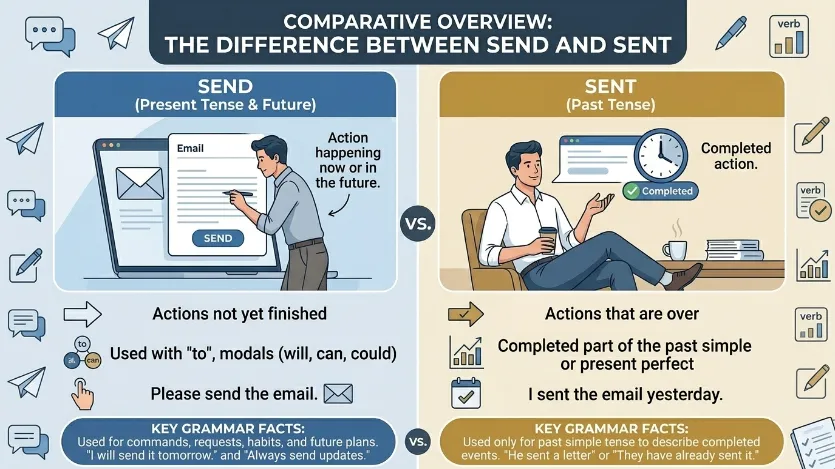
The main difference is that “send” is the present tense, while “sent” is the past tense and past participle of the verb.
Why Is Their Difference Necessary to Know?
Understanding the difference between send and sent is important for students, professionals, and anyone using English daily. It helps avoid misunderstandings, improves grammar accuracy, and builds confidence in communication. In society, clear communication is essential—whether in business emails, academic writing, or casual conversations. Even a small tense error can change meaning or create confusion.
Pronunciation
- Send
- US: /sɛnd/
- UK: /send/
- Sent
- US: /sɛnt/
- UK: /sent/
Now that you understand the basics, let’s explore the topic in depth.
Difference Between Send and Sent
1. Tense Usage
- Send: Present tense
- Example 1: I send emails every morning.
- Example 2: They send parcels weekly.
- Sent: Past tense
- Example 1: I sent the email yesterday.
- Example 2: She sent a gift last week.
2. Time Reference
- Send: Refers to current or future actions
- Example 1: I will send the report soon.
- Example 2: We send updates regularly.
- Sent: Refers to completed actions
- Example 1: He sent the message already.
- Example 2: They sent the invitation last night.
3. Verb Form
- Send: Base form
- Example 1: Please send the file.
- Example 2: I want to send a letter.
- Sent: Past form
- Example 1: I have sent the document.
- Example 2: She had sent the package before noon.
4. Use with Helping Verbs
- Send: Used with present/future auxiliaries
- Example 1: I will send it later.
- Example 2: Can you send me the details?
- Sent: Used with “have/has/had”
- Example 1: I have sent the email.
- Example 2: He had sent the reply earlier.
5. Context of Action
- Send: Action not yet completed
- Example 1: I send reports daily.
- Example 2: She sends reminders often.
- Sent: Action already completed
- Example 1: I sent the report yesterday.
- Example 2: She sent the reminder last hour.
6. Formal Writing
- Send: Used in instructions
- Example 1: Send your application now.
- Example 2: Please send your resume.
- Sent: Used in reporting
- Example 1: The company sent the notice.
- Example 2: He sent an official letter.
7. Question Formation
- Send: Present questions
- Example 1: Do you send emails daily?
- Example 2: Can you send the file?
- Sent: Past questions
- Example 1: Did you sent the file? (Incorrect)
- Correct: Did you send the file?
- Example 2: When did you send it?
8. Frequency vs Completion
- Send: Repeated actions
- Example 1: I send newsletters weekly.
- Example 2: They send alerts regularly.
- Sent: One-time completed action
- Example 1: I sent one newsletter yesterday.
- Example 2: They sent a single alert.
9. Grammar Accuracy
- Send: Used after “to”
- Example 1: I want to send a gift.
- Example 2: She plans to send a message.
- Sent: Not used after “to”
- Example 1: Incorrect: to sent
- Example 2: Correct: to send
10. Common Mistakes
- Send: Misused in past context
- Example 1: Incorrect: I send it yesterday.
- Example 2: Incorrect: She send the file last night.
- Sent: Correct for past
- Example 1: Correct: I sent it yesterday.
- Example 2: Correct: She sent the file last night.
Nature and Behaviour
- Send is active, present-focused, and forward-looking. It shows intention or routine.
- Sent is reflective and completed. It shows that the action has already happened.
Why People Are Confused
People often confuse these words because they come from the same root verb. Also, irregular verbs in English do not follow standard rules, making “send → sent” harder to remember.
Table: Difference and Similarity
| Feature | Send | Sent | Similarity |
| Tense | Present | Past | Same root verb |
| Usage | Current/Future | Completed action | Both indicate transfer |
| Form | Base verb | Past/participle | Same meaning core |
| Grammar | Used after “to” | Not used after “to” | Both verbs |
| Function | Ongoing action | Finished action | Communication tool |
Which Is Better in What Situation?
Send is better when you are talking about present or future actions. It is useful in instructions, daily routines, and planned communication. For example, in emails or workplace tasks, “send” clearly expresses what needs to be done next. It keeps communication active and forward-moving.
Sent is better when referring to actions that are already completed. It is ideal for reports, confirmations, and past discussions. For example, in professional settings, saying “I have sent the document” reassures others that the task is done. It provides clarity and closure.
Metaphors and Similes
- “He sends words like arrows.”
- “Her message was sent like a whisper in the wind.”
Connotative Meaning
- Send: Neutral/positive
- Example: I send love and greetings.
- Sent: Neutral
- Example: The message was sent on time.
Idioms and Proverbs
- “Send someone packing” (to dismiss)
- Example: The manager sent him packing.
- “Send word” (to inform)
- Example: Please send word when you arrive.
Works in Literature
- “The Sent Message” (Poetry, John Hay, 1895)
- “Sending Letters” (Essay, various authors, modern collections)
Movies Related to the Keywords
- “Send Me No Flowers” (1964, USA)
- “The Message” (1976, UK/Libya)
FAQs
1. What is the main difference between send and sent?
Send is present tense; sent is past tense.
2. Can I use “sent” in present sentences?
No, it is used only for past or completed actions.
3. Is “did you sent” correct?
No, correct form is “Did you send?”
4. Can “sent” be used with “have”?
Yes, e.g., “I have sent the email.”
5. Why is “send” used after “to”?
Because it is the base verb form.
How Both Are Useful for Surroundings
Both words help us communicate effectively in daily life. From sending messages to confirming tasks, they ensure clarity in relationships, workplaces, and digital communication.
Final Words for Both
“Send” moves communication forward, while “sent” confirms completion. Together, they form a complete expression of action in time.
Conclusion
Understanding the difference between send and sent is essential for clear and correct communication. While “send” focuses on present or future actions, “sent” reflects completed tasks. This small grammatical distinction plays a big role in avoiding confusion and improving fluency. Whether you are a student, professional, or casual speaker, mastering these two forms will strengthen your English skills. By practicing regularly and paying attention to context, you can confidently use both words in the right situations and enhance your overall communication.

I am a professional SEO content writer specialising in comparison-based and grammar-focused articles. Through my website GrammarCompare.com, I help readers clearly understand the difference between confusing terms with well-researched, easy-to-read content. My expertise lies in focusing on clarity, accuracy, and practical explanations that improve both knowledge and writing skills.