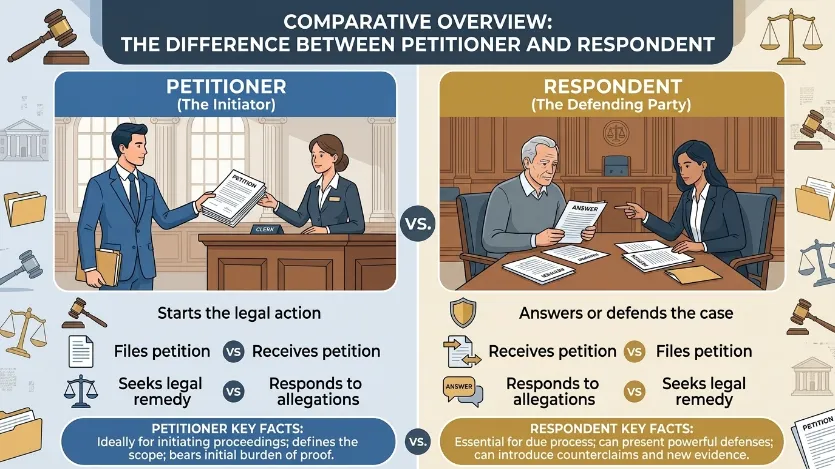
Imagine a real-life situation where two neighbors are in a dispute over property boundaries. One neighbor decides to take the matter to court, requesting justice and a legal solution. This person becomes the petitioner—the one who initiates the case. The other neighbor, who must answer the claims and defend themselves, is called the respondent. This simple story helps us understand the difference between petitioner and respondent in practical terms.
In legal systems, understanding the difference between petitioner and respondent is essential for both beginners and professionals. Whether in civil, criminal, or constitutional matters, the difference between petitioner and respondent defines the roles and responsibilities of each party. Without knowing the difference between petitioner and respondent, legal communication becomes confusing and ineffective.
Key Difference Between the Both
The main difference is that a petitioner initiates a legal action, while a respondent replies to or defends against that action.
Why Their Difference Is Important
Understanding the difference helps students, lawyers, and even common citizens navigate legal systems efficiently. It ensures clarity in court proceedings, protects rights, and maintains fairness in society. Without this distinction, justice systems would struggle to function properly.
Pronunciation
- Petitioner
- US: /pəˈtɪʃənər/
- UK: /pɪˈtɪʃənə/
- Respondent
- US: /rɪˈspɑːndənt/
- UK: /rɪˈspɒndənt/
Now that the foundation is clear, let’s explore the detailed differences between petitioner and respondent.
Difference Between Petitioner and Respondent
1. Role in Legal Case
- Petitioner: Starts the case.
- Example 1: A person files a divorce case.
- Example 2: A citizen files a constitutional petition.
- Respondent: Defends against the case.
- Example 1: The spouse replies in court.
- Example 2: The government answers the petition.
2. Position in Court
- Petitioner: Appears as the complainant.
- Example 1: Files complaint in civil court.
- Example 2: Seeks legal remedy.
- Respondent: Appears as the defending party.
- Example 1: Replies to allegations.
- Example 2: Challenges claims.
3. Purpose
- Petitioner: Seeks justice or relief.
- Example 1: Requests compensation.
- Example 2: Demands legal rights.
- Respondent: Protects against claims.
- Example 1: Denies allegations.
- Example 2: Provides counter-evidence.
4. Responsibility
- Petitioner: Must prove the claim.
- Example 1: Presents documents.
- Example 2: Calls witnesses.
- Respondent: Must defend or rebut.
- Example 1: Cross-examines witnesses.
- Example 2: Submits defense evidence.
5. Filing Documents
- Petitioner: Files petition first.
- Example 1: Submits application.
- Example 2: Initiates legal notice.
- Respondent: Files reply or written statement.
- Example 1: Responds to petition.
- Example 2: Files objections.
6. Legal Standing
- Petitioner: Claims rights are violated.
- Example 1: Human rights case.
- Example 2: Property dispute.
- Respondent: Accused of violation.
- Example 1: Government department.
- Example 2: Individual defendant.
7. Burden of Proof
- Petitioner: Carries initial burden.
- Example 1: Must prove harm.
- Example 2: Must show evidence.
- Respondent: May shift burden later.
- Example 1: Provides counter-proof.
- Example 2: Challenges facts.
8. Sequence in Case
- Petitioner: Speaks first.
- Example 1: Opens argument.
- Example 2: Presents case.
- Respondent: Replies afterward.
- Example 1: Defends position.
- Example 2: Refutes claims.
9. Legal Objective
- Petitioner: Wants change or relief.
- Example 1: Court order.
- Example 2: Compensation.
- Respondent: Wants dismissal.
- Example 1: Case rejection.
- Example 2: Relief denial.
10. Emotional Position
- Petitioner: Often feels wronged.
- Example 1: Victim of fraud.
- Example 2: Disputed property owner.
- Respondent: Often feels accused.
- Example 1: Defending reputation.
- Example 2: Denying wrongdoing.
Nature and Behaviour
Petitioner
Petitioners are proactive, assertive, and driven by the need for justice. They take initiative and bring issues to court.
Respondent
Respondents are reactive, defensive, and focused on protecting their rights and reputation.
Why People Are Confused
People often confuse these terms because both are parties in the same case. Additionally, terms like “plaintiff” and “defendant” are used in other legal systems, creating overlap and misunderstanding.
Table: Difference and Similarity
| Aspect | Petitioner | Respondent | Similarity |
| Role | Initiates case | Responds to case | Both are legal parties |
| Position | Complainant | Defender | Present in court |
| Purpose | Seeks relief | Defends claim | Aim for justice |
| Action | Files petition | Files reply | Use legal documents |
| Nature | Active | Reactive | Bound by law |
Which Is Better in What Situation?
A petitioner is better when someone seeks justice, protection, or enforcement of rights. For example, filing a case against injustice requires initiative, making the petitioner role powerful and necessary. This role suits individuals who want change and are ready to prove their claims.
A respondent is better when defending oneself against false or exaggerated claims. This role is important for maintaining balance in the legal system. A respondent ensures that accusations are tested and fairness is preserved.
Metaphors and Similes
- Petitioner: “Like a spark that starts a fire.”
- Respondent: “Like a shield that blocks an attack.”
Connotative Meanings
Petitioner
- Positive: Justice seeker
- Example: “She became a petitioner for human rights.”
- Neutral: Legal applicant
- Negative: Complainant (in casual tone)
Respondent
- Positive: Defender
- Example: “He stood as a respondent with dignity.”
- Neutral: Legal party
- Negative: Accused person
Idioms and Proverbs
(No direct idioms exist, but related expressions can apply)
- “Take the matter into your own hands”
- Example: The petitioner took the matter into court.
- “Face the music”
- Example: The respondent had to face the music in court.
Works in Literature
- Bleak House – Novel, Charles Dickens, 1853
- To Kill a Mockingbird – Novel, Harper Lee, 1960
- The Trial – Novel, Franz Kafka, 1925
Movies Related to Legal Roles
- A Few Good Men – 1992, USA
- The Lincoln Lawyer – 2011, USA
- Pink – 2016, India
- Philadelphia – 1993, USA
FAQs
1. Who is the petitioner?
The petitioner is the person who starts a legal case.
2. Who is the respondent?
The respondent is the person who replies to the case.
3. Is petitioner same as plaintiff?
Yes, in many cases, both terms mean the same.
4. Can a respondent become a petitioner?
Yes, in appeals or counter-cases.
5. Why is the difference important?
It clarifies roles and ensures smooth legal proceedings.
How Both Are Useful for Society
Petitioners bring issues to light and seek justice, while respondents ensure fairness by defending themselves. Together, they maintain balance, accountability, and trust in legal systems.
Final Words
The petitioner drives justice forward, while the respondent ensures that justice is fair and balanced.
Conclusion
Understanding the difference between petitioner and respondent is crucial for anyone dealing with legal systems. These roles define how a case begins and how it progresses. While the petitioner seeks justice and initiates action, the respondent ensures that claims are properly challenged. Together, they create a structured legal process that protects rights and promotes fairness. Whether you are a student, professional, or everyday citizen, knowing this distinction helps you better understand how justice works in real life.

I am a professional SEO content writer specialising in comparison-based and grammar-focused articles. Through my website GrammarCompare.com, I help readers clearly understand the difference between confusing terms with well-researched, easy-to-read content. My expertise lies in focusing on clarity, accuracy, and practical explanations that improve both knowledge and writing skills.